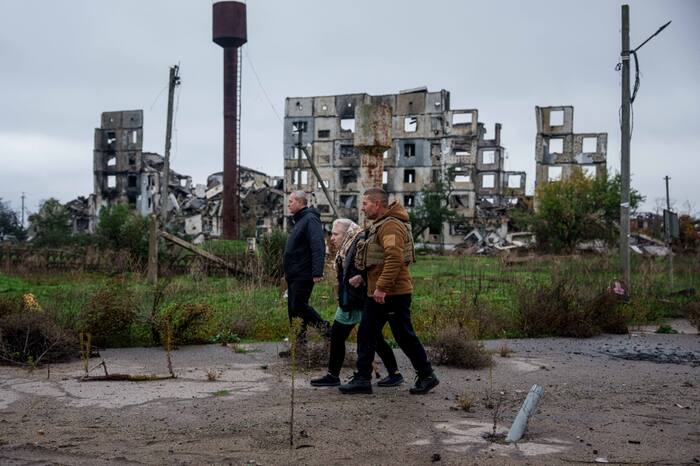
A localized ceasefire in an active warzone does not represent a return to normalcy; it functions as a compressed logistical window where civilian populations must rebalance their survival calculus before kinetic operations resume. In Kherson, a frontline city separated from opposing artillery and drone batteries only by the width of the Dnipro River, the expiration of a temporary truce triggers an immediate shift from open-air mobility back to subterranean survival. Understanding how residents prepare for the resumption of hostilities requires analyzing the intersection of urban geography, infrastructure fragility, and household risk management.
The Geography of Vulnerability in Frontline Urban Centers
Standard coverage of frontline cities often treats civilian preparation as a purely emotional or reactive process. In operational terms, preparation in Kherson is dictated by terrain and ballistics. Following the Ukrainian recapture of the right bank of the Dnipro River in November 2022, Kherson became an exposed urban target directly within the engagement envelope of short-range tube artillery, multiple launch rocket systems (MLRS), mortars, and first-person-view (FPV) drones operating from the left bank.
This proximity creates a distinct operational hazard known as zero-warning bombardment. Unlike cities deeper in the interior, where radar networks detect incoming cruise missiles or long-range drones and provide ten to thirty minutes of air-raid warning, artillery shells and FPV drones crossing a river span of one to three kilometers impact within seconds of launch.
A localized ceasefire temporarily suspends this immediate kinetic threat, altering the spatial behavior of the remaining population. During the pause, civilians emerge from basements to access central markets, repair damaged structures, and clear debris. When the ceasefire window closes, the city instantly reverts to a high-attrition environment where line-of-sight exposure near the riverfront carries a high probability of lethal strike.
The Four Pillars of Household Preparation
Civilian readiness during the final hours of a truce operates across four distinct logistical domains. Rather than waiting for municipal directives, remaining residents—many of whom are elderly, mobility-impaired, or financially unable to relocate—execute a decentralized protocol to ensure self-sufficiency during sustained shelling.
1. Thermal and Energy Redundancy
Frontline combat routinely degrades centralized power grids, water pumping stations, and district heating networks. A ceasefire allows utility crews to perform surface repairs, yet residents operate under the assumption that grid failure will recur immediately upon the resumption of fire.
- Potable Water Buffering: Households fill every available container—bathtubs, plastic jugs, and industrial drums—with tap water while municipal pumps remain energized. Because electric pumps fail during blackouts, losing pressure in high-rise apartment buildings within hours, stored water becomes the primary determinant of how long a family can remain sheltered without risking exposure at outdoor distribution points.
- Micro-Heating and Cooking: Residents stockpile solid fuels, such as firewood and briquettes, alongside liquefied petroleum gas (LPG) canisters. Relying on electric induction stoves or centralized gas lines introduces single-point-of-failure risks when shrapnel severs neighborhood distribution pipes.
- Decentralized Power: High-capacity power banks, vehicle batteries paired with inverters, and small portable generators are charged to full capacity during the truce. This stored energy is rationed strictly for medical devices, minimal LED lighting, and cellular communication rather than comfort.
2. Structural Hardening and Shelter Conditioning
Because basements and ground-floor corridors serve as primary shelters during artillery barrages, residents use temporary pauses in fighting to improve the habitability and blast resistance of underground spaces.
- Blast Mitigation: Window apertures in ground-floor apartments and stairwells are reinforced using oriented strand board (OSB), sandbags, or heavy furniture to arrest secondary fragmentation—shattered glass and spalling concrete—which accounts for a high percentage of urban blast injuries.
- Subterranean Stockpiling: Non-perishable calories, dry goods, canned proteins, and basic first-aid supplies are moved directly into basements. If heavy shelling pins down a residential block for forty-eight to seventy-two hours, moving between an upper-floor apartment and a basement stairwell becomes an unacceptable risk.
3. Medical and Trauma Readiness
Ambulance response times degrade severely during active bombardment, as emergency medical technicians cannot safely enter contested districts until fire subsides. Civilians bridge this pre-hospital care gap by maintaining personal trauma kits.
- Hemorrhage Control: Unlike standard household first-aid boxes, frontline kits prioritize tourniquets, hemostatic gauze, and pressure bandages to manage arterial bleeding from shrapnel wounds before professional extraction is possible.
- Chronic Medication Reserves: Pharmacies operate on restricted hours and face supply-chain bottlenecks. Residents use ceasefire windows to acquire multi-week supplies of insulin, blood pressure medications, and cardiovascular drugs, preventing acute medical emergencies during prolonged lockdowns.
4. Mobility and Evacuation Staging
Even residents who choose to remain in Kherson maintain a baseline readiness for rapid displacement if their immediate dwelling is destroyed or rendered uninhabitable.
- Go-Bag Standardization: Essential civil documents, property deeds, cash reserves, and a seventy-two-hour supply of clothing and rations are packed in a single bag kept near the shelter exit.
- Fuel and Vehicle Positioning: Those with private vehicles keep fuel tanks topped off and park cars behind solid concrete structures or under dense tree cover to shield them from overhead drone surveillance and fragmentation.
The Economic and Psychological Cost Function of Intermittent Truces
Localized ceasefires introduce a complex behavioral dynamic into civilian decision-making. From a game-theory perspective, an announced pause in hostilities creates an asymmetric risk environment. While a truce provides vital breathing room for humanitarian aid delivery and infrastructure maintenance, it also induces a temporary relaxation of defensive habits.
During a ceasefire, foot traffic increases in open plazas and commercial corridors. Markets reopen, and public transit routes expand closer to the riverfront. The danger lies in the transition phase: the exact hour a truce expires or collapses. Adversary forces frequently use the observation capabilities gained during a pause—tracking civilian movement patterns, repair crew locations, and supply hubs—to calibrate artillery targets for the opening salvo of renewed fighting.
Furthermore, the psychological toll of cyclical war creates decision fatigue. Constant vigilance requires high cognitive energy. When a ceasefire suspends the acute stress of incoming fire, the nervous system begins to down-regulate. Re-entering a state of hyper-vigilance as the deadline approaches generates severe anxiety, particularly among older demographics who form the majority of Kherson's remaining population. Some residents respond to this cognitive strain through fatalism, refusing to descend into cold, damp basements even when shelling resumes, thereby increasing casualty rates during the initial days of renewed combat.
Infrastructure Fragility and Municipal Constraints
Civilian preparation cannot be separated from the operational limits of municipal authorities. The Kherson City Military Administration and regional emergency services operate under severe resource constraints, balancing the immediate survival needs of residents against the high attrition rate of municipal equipment.
- The Repair Paradox: Utility workers face a recurring operational dilemma. Repairing a damaged electrical substation or water main during a ceasefire restores essential services to thousands of residents, yet those same repaired nodes remain fully visible to aerial reconnaissance. Once fighting resumes, the newly restored infrastructure becomes a primary target for precision strikes or artillery harassment, creating a cycle of costly repair and rapid destruction.
- Aid Distribution Bottlenecks: Humanitarian organizations rely on ceasefire windows to move bulk supplies—hygiene kits, food parcels, and construction materials—into districts nearest the Dnipro. Once the truce ends, large delivery trucks become prime targets for FPV drones, forcing aid agencies to halt direct distribution in red-zone neighborhoods and shift the burden of transport onto individual residents walking or cycling from safer zones.
- Evacuation Friction: Municipal authorities consistently urge civilians, particularly families with children, to evacuate from high-risk riverfront districts during quiet periods. However, evacuation compliance remains low due to structural economic barriers. Many remaining residents lack the financial capital to rent apartments in western or central Ukraine, fear losing their remaining physical assets to looting or weather damage, or care for bedridden relatives who cannot survive standard transit conditions.
Limitations of Civilian Defensive Measures
While rigorous preparation reduces vulnerability to indirect fire, household-level measures have strict physical limits against modern military hardware. Recognizing these boundaries is essential for an accurate assessment of civilian risk.
Residential basements in Soviet-era panel buildings (such as khrushchyovkas) offer effective protection against light shrapnel and blast overpressure from distant impacts, yet they are not hardened bunkers. A direct hit from a heavy artillery shell, a ballistic missile, or a guided aerial bomb (KAB) can collapse the superstructure above a basement, trapping occupants under tons of reinforced concrete. Without heavy cranes and specialized search-and-rescue teams—which cannot operate safely under active drone surveillance—structural collapse turns a shelter into a fatal trap.
Similarly, passive measures like sandbags and boarded windows provide zero protection against the evolving threat of fiber-optic and radio-controlled FPV drones. Unlike artillery, which saturates an area statistically, drone operators actively hunt individual targets, steering munitions directly into open doorways, moving civilian vehicles, or pedestrians carrying supplies. Against precision aerial surveillance, civilian survival depends entirely on minimizing time spent outdoors and avoiding predictable movement routines.
Strategic Outlook for Frontline Civilian Management
As localized ceasefires expire and active hostilities resume along the Dnipro River, the survival rate of Kherson's civilian population will depend on shifting from reactive sheltering to disciplined, low-visibility logistics. Municipal authorities and humanitarian operators must adapt their support models to the reality of persistent drone surveillance by decentralizing aid distribution into smaller, camouflaged micro-hubs rather than centralizing crowds at predictable delivery points. For the remaining residents, enduring the next phase of bombardment requires treating the end of a truce not as a sudden shock, but as a scheduled transition into strict subterranean lockdown, limiting surface movement exclusively to erratic, non-routine intervals during low-visibility weather conditions.


