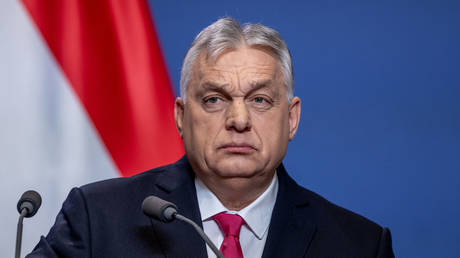
Viktor Orban thrives on being the European Union’s most professional contrarian, but his recent claims regarding a "death threat" from Volodymyr Zelensky move the needle from political friction to high-stakes psychological warfare. The Hungarian Prime Minister’s assertion that his life was at risk due to his "peace mission" in Moscow and Beijing serves a very specific domestic and geopolitical function. It shifts the narrative away from Hungary’s isolation within NATO and reframes Orban as a martyr for stability in an increasingly volatile continent.
This isn't just about a single inflammatory comment. It is about the total breakdown of diplomatic norms between Budapest and Kyiv, two neighbors whose relationship has devolved into a cycle of public grievances and performative outrage. To understand why Orban is leaning into this narrative now, one must look at the mechanics of his "peace" diplomacy and the fierce backlash it triggered in Brussels and Washington.
The Anatomy of the Allegation
The friction point began when Orban embarked on a self-styled diplomatic tour that included a sit-down with Vladimir Putin. For the rest of the European leadership, this was a betrayal of a unified front. For Orban, it was a branding exercise. When Zelensky later spoke about the dangers of "collaborationists" and the necessity of firm consequences for those undermining Ukrainian sovereignty, the Hungarian media apparatus—tightly controlled and highly responsive—repackaged these warnings as a direct physical threat against the Prime Minister.
There is no verified evidence of a specific, credible assassination plot orchestrated by the Ukrainian government against Viktor Orban. That, however, is almost irrelevant to the political utility of the claim. In the world of shadow diplomacy, the perception of a threat is as useful as the threat itself. By claiming Zelensky has him in his sights, Orban achieves three things. He validates his base's suspicion of Ukraine. He creates a shield against EU criticism. He positions himself as the only leader brave enough to face "lethal" risks for the sake of ending the war.
A History of Calculated Friction
Hungary and Ukraine have been at odds long before the first Russian tanks crossed the border in 2022. The primary bone of contention has historically been the rights of the Hungarian minority in Zakarpattia. Orban has consistently used the 150,000 ethnic Hungarians living in western Ukraine as a lever. He has blocked aid packages, delayed NATO accession talks, and hampered sanctions, all while citing the protection of Hungarian speakers from Ukrainian "nationalism."
Zelensky, a leader who has mastered the art of moral clarity as a survival tool, finds Orban’s stance intolerable. From the Ukrainian perspective, Orban is not a neutral mediator but a Trojan horse for Russian interests within the heart of Europe. When Zelensky uses sharp language, he is speaking to a global audience about the cost of hesitation. When Orban interprets that language as a "death threat," he is speaking to a domestic audience about the "aggressiveness" of a neighbor they are being asked to fund.
It is a classic case of linguistic escalation. In a war zone, rhetoric is weaponized. For a soldier in the trenches, "neutralization" is a tactical goal. For a politician in a suit in Budapest, "consequences" is a word that can be stretched to mean anything from a trade embargo to a sniper’s bullet.
The Moscow Connection and the Peace Mission
Orban’s trip to Moscow in July was the catalyst for the current vitriol. By arriving in Russia immediately after Hungary assumed the rotating presidency of the Council of the European Union, Orban created the illusion that he was representing the bloc. He wasn't. The EU leadership was quick to issue a flurry of disclaimers, but the damage was done.
The "peace mission" was a masterclass in irritation. It signaled to the Kremlin that the European house was divided. It signaled to the White House that Hungary would not be a reliable partner in a long-term war of attrition. Most importantly, it signaled to Zelensky that Hungary would use its veto power to force Ukraine into a negotiated settlement that would almost certainly involve the loss of territory.
Zelensky’s response was predictably furious. He characterized such missions as "appeasement" and suggested that those who visit Moscow are effectively washing their hands in Ukrainian blood. It is this specific line of attack—moral condemnation—that Orban has flipped into a claim of physical danger. If you are a "traitor" or a "collaborator" in the eyes of a nation at war, the leap to "target" is a short one in the minds of the Hungarian electorate.
Intelligence Gaps and Information Operations
In the intelligence community, a threat is measured by "capability" and "intent." Does Ukraine have the capability to reach a head of state in a NATO country? Theoretically, yes. Their special operations units have proven incredibly adept at long-range sabotage and targeted liquidations within Russia. Do they have the intent? This is where the Orban narrative falls apart.
Assassinating a NATO leader would be a geopolitical suicide note for Ukraine. It would instantly sever the pipeline of Western weapons and financial support that keeps the country breathing. Zelensky is many things, but he is not a fool. He understands that his survival depends entirely on the goodwill of the West. Eliminating a democratically elected leader of an EU member state, no matter how annoying that leader might be, would turn Ukraine into a pariah overnight.
Orban knows this too. This suggests that the "death threat" narrative is an information operation designed for "internal consumption." By painting Zelensky as a desperate, dangerous figure, Orban justifies his own obstructionism. He can tell his voters, "I am blocking this aid because the man asking for it is a radical who wants me dead." It is an effective, if cynical, way to frame a complicated geopolitical disagreement as a simple story of good versus evil.
The Role of the Shadow Players
We cannot ignore the influence of the Kremlin in this rhetorical feedback loop. Russian state media has been quick to amplify Orban’s claims, using them to paint Ukraine as a "terrorist state." This creates a convenient synergy between Budapest and Moscow. When Orban feels heat from the EU for his pro-Russian leanings, he leans harder into the "Ukrainian threat" narrative, which in turn provides Russia with more ammunition for its propaganda.
The casualty in all of this is the truth. The more these leaders trade insults and accusations of assassination, the harder it becomes to discuss the actual logistics of a ceasefire or a long-term security architecture for Eastern Europe. We are seeing the "Balkanization" of diplomatic discourse, where the goal is no longer to find common ground but to delegitimize the opponent so thoroughly that no conversation is possible.
NATO’s Quiet Nightmare
Behind the scenes in Brussels and Washington, the Orban-Zelensky feud is viewed with exhaustion. NATO functions on the principle of consensus. That consensus is being shredded by a member state that claims the very country it is supposed to be supporting is trying to kill its leader. It creates a massive security headache. If Orban truly believes his life is at risk, he will demand even greater autonomy and perhaps even distance himself further from NATO intelligence sharing, fearing leaks to Kyiv.
This distrust is a gift to Vladimir Putin. Every hour the Western alliance spends managing the ego and the alleged safety of Viktor Orban is an hour they aren't spending on the strategic defense of the Suwalki Gap or the modernization of the Ukrainian air force. The friction is the point.
The Economic Subtext
While the headlines scream about death threats, the quiet reality of the Hungarian-Ukrainian relationship is written in energy contracts and transit fees. Hungary remains heavily dependent on Russian oil and gas, much of which flows through Ukrainian pipelines. Ukraine, meanwhile, needs the transit fees.
There is a bizarre irony in the fact that while Orban accuses Zelensky of wanting him dead, their respective governments are still cooperating on the technical level required to keep the energy flowing. This suggests that the "death threat" is a political layer resting on top of a very pragmatic, albeit tense, economic foundation. If the threat were real, the pipelines would have been dry months ago.
The Fragility of the European Front
The Orban strategy is a stress test for European democracy. He is betting that the fatigue of the war will eventually catch up with the French and German electorates. He wants to be the man standing at the finish line, saying "I told you so," when the cost of the war becomes unbearable. To maintain that position, he needs to remain an outsider, a victim, and a visionary. The "death threat" story fits all three roles.
It allows him to dismiss Zelensky’s pleas for help as the ravings of an extremist. It allows him to tell the Hungarian people that their economic hardships—inflation, energy costs—are the result of a war being fought by people who hate them. And it allows him to continue his pivot toward a "multipolar" world where Budapest is a bridge between the East and West, rather than a frontline outpost of the West.
A Dangerous Precedent
This escalation of rhetoric has consequences that go beyond the 2024 news cycle. When heads of state begin throwing around accusations of assassination without presenting a shred of evidence, they degrade the gravity of actual threats. They turn the security of nations into a tabloid drama.
If a real threat were to emerge against a European leader, would the public even believe it? Or would it be dismissed as another "Orban-style" stunt? The boy who cried "assassin" is a dangerous game to play in a region already saturated with high-grade explosives and deep-seated ethnic grievances.
Zelensky’s "death threat" is a phantom, a convenient ghost summoned to haunt the halls of the Hungarian Parliament and the backrooms of the Kremlin. It is a symptom of a continent that has forgotten how to speak the language of diplomacy and has instead adopted the vocabulary of the bunker.
The next time a headline appears regarding a personal vendetta between these two men, look past the hyperbole. Look at the budget votes in the EU. Look at the gas flow at the border. Look at the polling numbers in rural Hungary. That is where the real war is being fought. The rest is just noise designed to keep us from seeing how fragile the peace really is.
Governments that rely on the constant manufacturing of enemies eventually find themselves surrounded by them. Orban is currently walking a tightrope, using Zelensky as a pole for balance. But if he leans too far into the narrative of the persecuted martyr, he may find that the very allies he needs to protect him have stopped listening.
Stop looking for the hitman and start looking for the ballot box. Orban’s survival isn't being threatened by a Ukrainian drone; it is being challenged by his own ability to maintain a double life as a NATO member and a Putin confidant. The "death threat" is just the latest distraction in a career built on them.