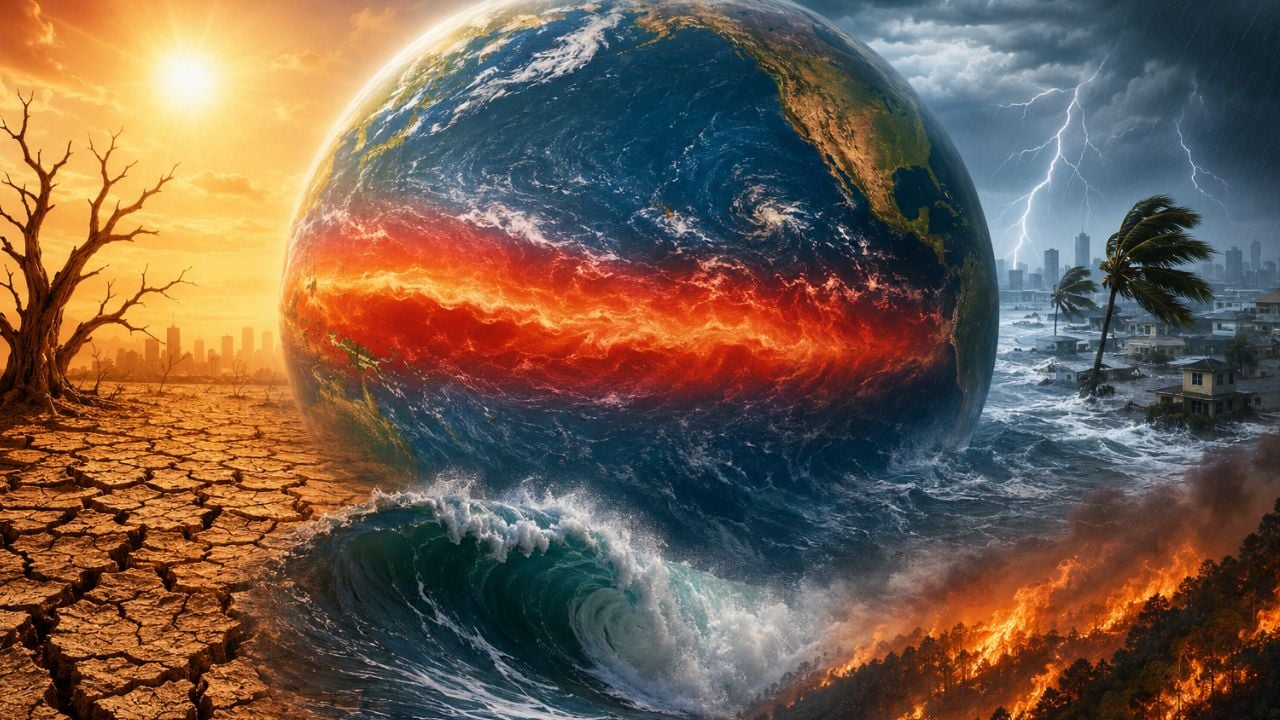
In a small coastal town in Peru, a fisherman named Mateo watches the horizon. He doesn’t look at the sky for clouds. He looks at the water. For generations, the cold, nutrient-rich currents have been the heartbeat of his village, bringing the anchovies that feed the birds that feed the world. But lately, the water feels wrong. It is too calm. It is too warm. It feels like a fever.
Thousands of miles away, in a windowless office in Maryland, a meteorologist stares at a different kind of horizon. Her screen is a chaotic mosaic of reds and oranges, colors that represent sea surface temperatures. Usually, these maps shift with the slow, predictable grace of the seasons. This year, the red is spreading with a frantic speed that defies the models.
The Pacific Ocean is waking up. And it is in a hurry.
The Engine Beneath the Waves
To understand what is happening, we have to stop thinking of the ocean as a static body of water and start seeing it as a massive, liquid battery. Normally, strong trade winds act like a giant fan, pushing warm surface water toward Asia and Australia. This allows cold water to rise from the depths along the South American coast—a process called upwelling.
This balance is the status quo. It is the reason why some places are deserts and others are rainforests.
But every few years, the fan slows down. The warm water that was pushed west begins to slosh back toward the east like water in a bathtub when you stand up too quickly. This is El Niño. It isn't a storm. It is a fundamental shift in the planet's heat distribution.
What makes this particular moment different isn't just that an El Niño is forming. It’s the velocity. Usually, we see this coming from a mile away, a slow-motion car crash that takes months to manifest. This time, the "Super" El Niño—a rare, high-intensity version of the phenomenon—is assembling itself with an urgency that has left climate scientists checking their sensors for errors.
The battery isn't just charging. It’s surging.
Why the Speed Matters
Imagine you are driving a car down a long, straight highway. If you accelerate slowly from 60 to 80 miles per hour, you barely feel the change. You have time to adjust your grip on the wheel, check your mirrors, and settle into the new speed.
Now imagine slamming your foot on the gas and hitting 100 in three seconds.
That is the difference between a standard El Niño and the one currently brewing. When the atmosphere and the ocean decouple this quickly, the ripple effects are violent and unpredictable. We are talking about a total reorganization of global weather patterns in a matter of weeks rather than months.
For the average person, this isn't just a fun fact for a cocktail party. It is the hidden hand behind the price of your morning coffee and the insurance premium on your home.
The Harvest and the Hunger
Consider the hypothetical case of a soybean farmer in Brazil. He relies on the predictability of the rains. In a normal year, he knows when to plant and when to pray. But a rapid-onset Super El Niño flips the script. While the southern United States might see a winter of relentless rain and flooding, parts of South America and Southeast Asia often plunge into brutal, desiccating droughts.
When the rain stops falling in the wrong places, the global supply chain winces.
- Corn and Soy: Yields in the Southern Hemisphere can plummet, sending ripples through the livestock industry.
- Coffee and Cocoa: These sensitive crops react poorly to sudden temperature spikes, meaning your daily rituals get more expensive.
- Energy: In regions reliant on hydropower, a lack of rain means the lights stay off or the bills go up as utilities switch to more expensive gas or coal.
The speed of this transition means there is no "adjustment period." There is only the shock.
The Invisible Stakes of a Warmer World
It is easy to get lost in the statistics of "degrees above average." A 2°C or 3°C increase in sea surface temperature sounds like a pleasant afternoon at the beach. But on a planetary scale, that heat represents an unfathomable amount of energy.
Think of the ocean as the world’s heat sink. It has been absorbing the vast majority of the excess heat trapped by greenhouse gases for decades. It has been a silent protector, buffering us from the full reality of a warming atmosphere.
But a Super El Niño is the moment the ocean breathes out.
All that stored energy is released back into the atmosphere. This is why El Niño years are often the hottest on record. We aren't just adding El Niño heat to a normal baseline; we are adding it to a planet that is already running a fever. It is a "double-whammy" effect.
Last year's records are likely to be shattered. The heatwaves we experienced will seem quaint compared to what happens when the Pacific decides to share its stored warmth with the rest of us.
The Great Coral Ghosting
Beneath the waves, the stakes are even more visceral. For those who dive or live near reefs, El Niño is a season of mourning.
Coral reefs are the cities of the sea, housing a quarter of all marine life. They are also incredibly sensitive. When the water gets too warm, too fast, the corals undergo a process called bleaching. They aren't dead yet, but they are starving. They expel the colorful algae that provide them with food, turning a ghostly, skeletal white.
If the heat persists—as it does during a "Super" event—the city dies. The fish leave. The sea walls that protect islands from storm surges crumble.
For a dive instructor in the Maldives or a fisherman in the Philippines, this isn't an abstract environmental concern. It is the death of their world. It is the silence of a place that used to be a riot of sound and color.
Preparing for the Unpredictable
We often treat weather like something that happens to us, a series of random events we have to endure. But with the data we have now, we are no longer blind. We can see the surge coming.
The challenge is that our systems are built for "normal."
Our drainage pipes are sized for "normal" storms.
Our power grids are braced for "normal" heatwaves.
Our insurance models are based on "normal" risks.
When a Super El Niño arrives ahead of schedule, it exposes every crack in that foundation. It turns a heavy rain into a catastrophic flood because the ground didn't have time to dry out from the last one. It turns a hot week into a deadly heat emergency because the cooling centers weren't prepared to open so early in the season.
The Human Echo
Back in Peru, Mateo pulls his nets into his boat. They are lighter than they should be. The water is clear and blue—beautiful to a tourist, but a desert to a fisherman. He knows the signs. He knows that soon, the rains will come to the desert, turning the dry arroyos into raging rivers that carry away homes and dreams.
He isn't reading the satellite maps from Maryland. He doesn't need to. He feels the shift in the wind. He feels the humidity clinging to his skin in a way it shouldn't in May.
This is the true face of the Super El Niño. It isn't a graph. It isn't a headline about "fast-growing anomalies." It is the look on a farmer's face when he realizes the seeds he just put in the ground will never sprout. It is the sound of a levee groaning under the weight of a river that has forgotten its banks.
We are living through a moment where the largest physical feature on our planet—the Pacific Ocean—is changing its rhythm. It is moving faster, hitting harder, and ignoring the schedules we tried to write for it.
The water is rising, the air is thickening, and the red on the map is glowing brighter every day. We are no longer waiting for the season to change. The change has already arrived, and it is moving at a pace we are only beginning to understand.
Somewhere in the middle of that vast, blue expanse, the heat is rising to the surface. It is a silent, massive upheaval, a relocation of energy that will eventually touch every person on Earth. We are all passengers on a very small boat, and the ocean has just decided to turn up the engine.
The fisherman ties his boat to the dock, double-knotting the ropes. He knows the calm is a lie. He knows that when the Pacific breathes, the rest of the world has to hold its breath.