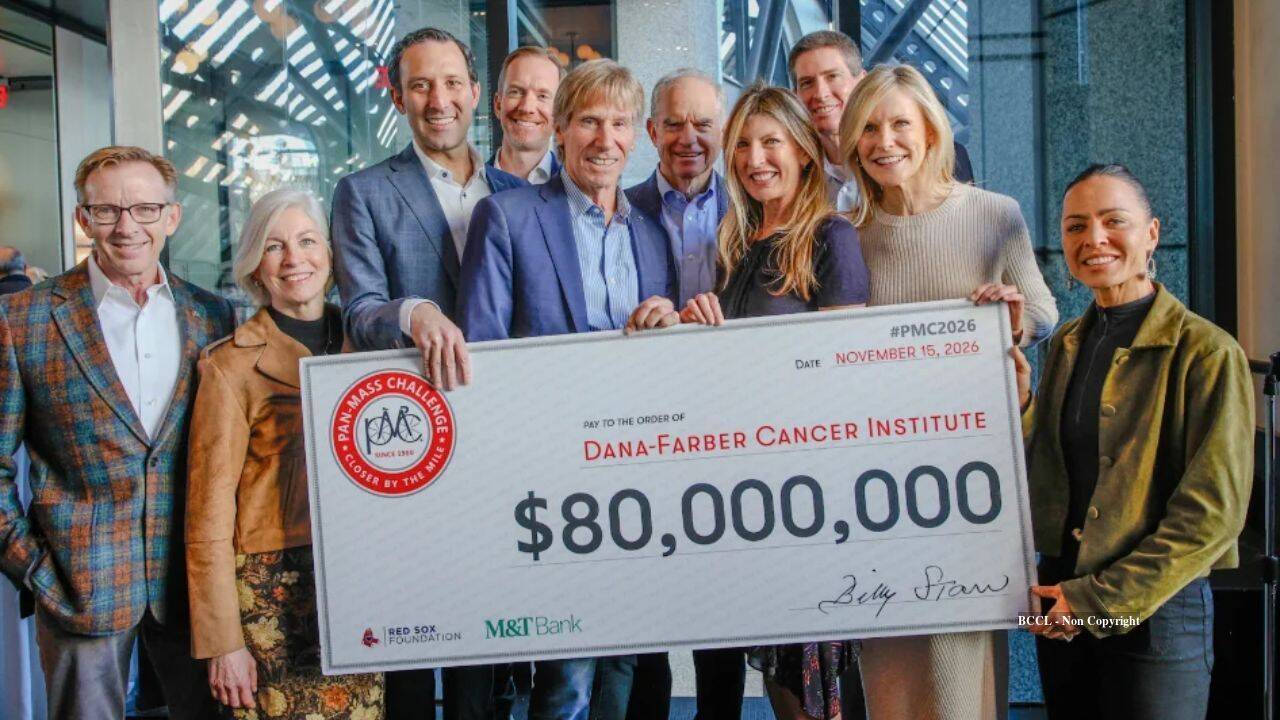
Every August, thousands of cyclists clip into their pedals across Massachusetts, ride nearly two hundred miles in the summer heat, and raise a staggering pile of cash for cancer research. This year, the Pan-Mass Challenge hit a record $80 million, pushing its lifetime total past $1.2 billion for the Dana-Farber Cancer Institute.
The local press eats it up. Corporate sponsors plaster their logos on jerseys. Riders collect their high-fives at the finish line in Provincetown. Everyone feels warm inside. You might also find this related story interesting: Why the Tribeca Founders Took a Haircut at the Dakota.
Here is the cold water nobody wants splashed on their spandex. Celebrating an $80 million bike ride as the pinnacle of medical philanthropy exposes a deep, structural rot in how we fund scientific breakthroughs.
I have spent years auditing nonprofit revenue models and watching high-net-worth donors pour money into endurance charity events. The lazy consensus says that any dollar raised for cancer is a pure triumph, and that a 100 percent pass-through rate makes an event untouchable. That consensus ignores basic economics, opportunity cost, and the harsh reality of how academic medical research actually works. As discussed in recent reports by Harvard Business Review, the results are significant.
The 100 Percent Pass-Through Illusion
Ask any Pan-Mass Challenge defender why the organization is immune to criticism, and they will recite one statistic like a religious mantra: 100 percent of every rider-raised dollar goes directly to Dana-Farber.
On paper, that looks immaculate. In practice, it is an accounting sleight of hand that tricks donors into ignoring the true cost of capital.
Running a massive, multi-day logistical operation across an entire state is wildly expensive. Closing roads, hiring police details, feeding thousands of riders, managing medical tents, and paying full-time executive staff costs millions of dollars every single year. The PMC covers those administrative and operational expenses through corporate sponsorships, rider registration fees, and merchandise sales.
When a corporation writes a six-figure check to put its banner over the starting line, that money comes out of a finite corporate philanthropy or marketing budget. Had that sponsorship not paid for portable toilets and Gatorade stations along Route 6, it could have gone directly to a lab bench. Calling the rider donations "100 percent pass-through" simply shifts the overhead burden onto a different bucket of money while pretending the friction disappears.
More importantly, the obsession with zero-overhead philanthropy actively harms the nonprofit sector. Dan Pallotta, the activist and author who dismantled the charity overhead myth in his famous TED Talk and book Uncharitable, pointed out a fatal flaw in donor psychology: we judge charities by how little they spend on themselves rather than how much they actually achieve. By bragging about a 100 percent pass-through rate, mega-events like the PMC reinforce the toxic idea that administrative spending is inherently bad. Smaller, scrappier organizations doing high-risk, early-stage research get starved of funding because they cannot afford corporate sponsors to mask their operating costs.
Peer-to-Peer Fundraising Is a Tax on Social Capital
Let us look at where that $80 million actually comes from. It does not come from rigorous grant evaluations or scientific peer review. It comes from guilt-tripping your dentist, your college roommate, and your vendors into clicking a donation link so you can qualify for a jersey.
Peer-to-peer endurance fundraising is the most inefficient way imaginable to move capital from citizens to scientists.
Think about the sheer volume of human hours burned to generate that $80 million. Roughly 6,500 riders spend months training, organizing bake sales, sending mass emails, and burning through their personal social capital. Add in the thousands of volunteers, the road crews, and the administrative staff. If you calculated the hourly value of the labor expended by riders, volunteers, and organizers just to solicit those donations, the economic drag would be staggering.
Worse, peer-to-peer fundraising completely decouples capital allocation from scientific merit.
When a donor gives $100 to their neighbor's PMC page, they are not evaluating Dana-Farber's clinical trial pipeline. They are buying social goodwill from their neighbor. The money flows because the rider has wealthy friends, not because the underlying research strategy is outperforming competitors.
Imagine a scenario where we funded aerospace engineering or semiconductor manufacturing the same way. Picture engineers asking their aunts to sponsor their 10K run so Intel could buy a new lithography machine. We would laugh that system out of the room because market discipline requires capital to chase competence, not cardiovascular endurance. Yet when it comes to curing deadly diseases, we hand the allocation keys to amateur cyclists.
The Institutional Monoculture Problem
Sending $1.2 billion to a single institution sounds impressive in a press release. For scientific innovation, extreme capital concentration is a dangerous trap.
Dana-Farber is a world-class cancer center with brilliant researchers and undeniable clinical wins. Nobody disputes that. However, funneling $80 million every single year into one institutional ecosystem creates an insulated monoculture.
Scientific breakthroughs rarely happen because one massive institution gets a slightly bigger pile of unrestricted cash. Breakthroughs happen through fierce competition, dissenting hypotheses, and outsider challenges to established dogma. Look at the history of cancer immunotherapy. Jim Allison spent years fighting entrenched skepticism from major cancer institutions that believed the immune system could not be harnessed to fight tumors. Had all philanthropy been locked into the prevailing institutional consensus of the 1990s, checkpoint inhibitors might have stalled for another decade.
When a single charity becomes the dominant financial lifeline for one hospital, two things happen:
- Internal complacency sets in. Guaranteed annual revenue reduces the urgency to trim bloated administrative layers or kill underperforming research programs.
- External talent gets starved. Independent labs, smaller biotech spin-offs, and researchers at less fashionable universities struggle to raise seed funding because local philanthropic wealth is completely captured by the flagship event.
The PMC has effectively monopolized New England's charitable giving capacity for oncology. If you are a biotech founder or an independent researcher in Boston trying to raise philanthropic seed money for a radical new diagnostic tool, you are competing against a cultural juggernaut that consumes every available philanthropic dollar every summer.
Dismantling the "People Also Ask" Myths
Whenever records like this hit the news, the public asks predictable questions. Most of those questions are built on flawed premises.
Does the Pan-Mass Challenge actually cure cancer?
Events do not cure diseases; targeted capital deployment and clinical execution do. Raising $80 million funds incremental progress, clinical infrastructure, and faculty salaries. Treating a fundraising milestone as a medical victory confuses inputs with outputs. Until cancer mortality rates drop in direct proportion to these record-breaking checks, celebrating the fundraising total is like celebrating how much fuel you put in the rocket before checking if it actually reached orbit.
Is the PMC the most efficient cancer charity to donate to?
If your definition of efficiency is "my friend gets a free bike ride and a tax deduction," sure. If your definition of efficiency is "maximizing the probability of a breakthrough per dollar spent," the answer is no. High-impact medical philanthropy requires funding high-risk, high-reward research that government agencies like the National Institutes of Health (NIH) refuse to touch. Large institutional recipients often use unrestricted event money to subsidize safe, incremental studies that look good on annual reports rather than wild swings that might fail.
Why shouldn't corporations sponsor massive charity rides?
Corporate sponsorship of endurance events is the ultimate corporate social responsibility (CSR) crutch. Writing a check to the PMC buys a company instant halo branding in the Boston Globe without requiring the company to do any due diligence on medical outcomes. It is lazy philanthropy dressed up as community engagement.
What High-Impact Medical Philanthropy Actually Looks Like
If you actually care about accelerating cancer cures rather than getting a bumper sticker for your SUV, you need to stop treating philanthropy like a recreational sport.
I have advised family offices and angel syndicates on how to deploy capital into life sciences. The donors who move the needle do the exact opposite of the peer-to-peer crowd. They treat charitable dollars with the same ruthless scrutiny as venture capital.
- Fund the valley of death, not the endowment. Large academic centers already sit on massive endowments and pull down hundreds of millions in federal NIH grants. Your $250 donation is a rounding error in their budget. Instead, direct money toward translational research grants—the treacherous gap between a promising discovery in a lab dish and the first human clinical trial.
- Demand milestone-based payouts. Never write an unrestricted check just because a hospital has a prestigious brand name. Support venture philanthropy funds—like the Cystic Fibrosis Foundation's legendary model—that invest in specific therapeutic programs, demand strict scientific milestones, and recycle any financial returns back into new research.
- Back contrarian scientists, not institutions. Great science is driven by obsessed individuals, not buildings. Organizations like the Howard Hughes Medical Institute (HHMI) succeed because they bet on specific, unconventional researchers and give them the freedom to pursue high-risk ideas without spending half their lives writing grant applications.
The Downside of Abandoning the Spectacle
Let us be completely honest about the trade-off here. My approach lacks the tribal magic of 6,500 people riding together through Massachusetts.
If we dismantled peer-to-peer endurance events tomorrow, total charitable giving would almost certainly drop in the short term. Most retail donors are not going to spend their weekends reading oncology journals to evaluate translational grant proposals. They give because their brother-in-law asked them to, or because riding a bike for two days gives them a tangible way to channel grief after losing a parent to cancer.
Emotional catharsis has real human value. Community solidarity matters when families are navigating a terrifying diagnosis. No venture philanthropy fund can replicate the visceral comfort of seeing thousands of neighbors sweat for a shared cause.
We do not need to ban charity bike rides. People should ride their bikes, honor their loved ones, and build community.
What we must stop doing is confusing a massive community catharsis ritual with an optimal capital allocation engine. Raise the $80 million, cross the finish line, and drink the celebratory beer. Just stop pretending that a weekend bike ride is the smartest way to outsmart a relentless biological adversary.