The mainstream media loves a freak accident because it offers the perfect opportunity to manufacture a crisis out of thin air. When a 68-year-old pétanque player tragically dies after being struck in the head by a metal boule, the immediate reaction from the safety-obsessed public is predictable. People call for mandatory helmets. They demand padded equipment. They want leagues suspended, rules rewritten, and casual parks transformed into padded cells.
This reaction is wrong. It is intellectually lazy, mechanically illiterate, and actively harmful to the exact demographic these critics claim they want to protect.
We need to stop treating a statistical anomaly as a systemic safety crisis. Pétanque is not a high-risk combat zone. It is a sport governed by simple Newtonian physics and low velocity. When a rare tragedy occurs, it is an indictment of human fragility and catastrophic bad luck, not the sport itself. Forcing safety regulations onto a community pastime based on a one-in-a-million event destroys the physical mechanics of the game and drives aging populations into sedentary isolation. The real danger to a 68-year-old isn't a steel ball; it is the soul-crushing boredom of a hyper-regulated life.
The Physics Failure of the Safety Advocates
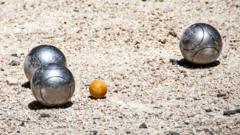
To understand why the call for padded boules or altered regulations is absurd, you have to understand the mechanics of the sport. A standard competition pétanque boule is made of solid steel, weighing between 650 and 800 grams, with a diameter of roughly 70 to 80 millimeters. The entire game relies on the precise mass of this object.
Imagine a scenario where a regulatory body bends to public panic and mandates foam-coated boules or lighter composite materials to prevent head injuries. You instantly destroy the sport.
Pétanque is a game of displacement and momentum conservation. The kinetic energy ($E_k = \frac{1}{2}mv^2$) required to displace an opponent's boule from the target area depends entirely on the high mass ($m$) concentrated in a small volume. If you lower the mass or introduce shock-absorbing coatings, you alter the coefficient of restitution. The boule bounces unpredictably, rolling mechanics fail on gravel, and the tactical depth of the sport vanishes.
I have spent two decades analyzing sports infrastructure and risk management. Whenever a freak injury happens in a low-impact sport—whether it is a stray golf ball fracturing a skull or a lawn bowl causing a concussion—amateur administrators immediately try to change the equipment. They fail to understand that you cannot engineer away the laws of physics without erasing the activity entirely.
The human skull can withstand significant blunt force, but when a 700-gram steel ball traveling through an arc hits a precise point of vulnerability at an unfortunate angle, the localized pressure is immense. This is not a design flaw in pétanque. It is a reality of living in a physical universe. We do not ban brick walls because someone might trip and strike their temple against one. We do not mandate helmets for walking down cobblestone streets, even though falls are the leading cause of traumatic brain injury in older adults.
Dismantling the Flawed Premises of Sports Safety
When these tragedies hit the headlines, the internet fills with questions driven by fear rather than data. Let's look at the foundational assumptions behind these inquiries and dismantle them one by one.
Is pétanque safe for seniors?
This question frames safety as a binary condition. Nothing is safe. The premise implies that if a sport carries any risk of mortality, it should be categorized as dangerous.
The data tells a completely different story. According to actuarial tables and sports medicine registries, the injury rate in boule sports is negligible compared to cycling, running, or even yoga. The vast majority of injuries in pétanque are minor lumbar strains from bending over to pick up the balls, or repetitive strain injuries in the wrist.
By asking if the sport is safe, critics imply that the alternative—sitting on a couch—is the default secure state. It isn't. Physical inactivity is a primary driver of cardiovascular decline, muscle atrophy, and cognitive degradation in older adults. A senior citizen face-planting in their kitchen because of poor balance faces the exact same risk of fatal subdural hematoma as the player struck by a boule. The sport doesn't create the vulnerability; aging does.
Should helmets be mandatory in casual target sports?
Introducing helmets to a sport like pétanque is a classic example of risk compensation and bureaucratic overreach. When you force players to wear protective gear in a non-contact environment, two negative outcomes occur immediately.
First, you introduce physical discomfort that actively discourages participation. Older adults regulating their body temperature or dealing with neck arthritis will simply quit the game rather than strap on a heavy piece of plastic to stand in a park.
Second, it creates a false sense of security that alters player behavior. In sports where protective gear is introduced, athletes often become more reckless because they believe they are invincible. In a casual game of pétanque, safety relies on situational awareness—looking at the pitch, watching the thrower, and stepping back when a shot is active. Put a helmet on someone, and they stop paying attention to their surroundings.
The Real Danger is Isolation Not Inertia
The media's obsession with physical safety ignores the devastating impact of social and psychological decay. We live in a society that attempts to bubble-wrap the elderly, systematically stripping away their autonomy in the name of longevity.
Sports like pétanque, bocce, and lawn bowls serve a vital public health function that goes far beyond light cardiovascular exercise. They are anchors of community interaction. For many retirees, the local club is the only place where they engage in competitive drive, strategic thinking, and face-to-face socialization.
When you hyper-regulate these spaces out of fear, you raise the barrier to entry. If a local council decides to close a public pitch because they fear liability lawsuits, or if a club shuts down because they cannot afford the spiraling insurance premiums triggered by sensationalized news coverage, the players do not migrate to a safer sport. They stay home.
The long-term health consequences of loneliness and physical stagnation are well-documented by institutions like the World Health Organization. Chronic isolation increases the risk of stroke by 32% and dementia by 50%. The statistical probability of an older adult dying from the downstream effects of losing their social sports club is infinitely higher than the probability of them being killed by a flying metal projectile.
We are trading a microscopic, highly visible risk for a massive, invisible one. It is a terrible bargain.
Accepting Risk as the Cost of a Lived Life
Every time an article laments a freak accident, it reinforces the delusion that human mortality can be managed down to zero through proper governance. It cannot.
The competitor's coverage of this event focused entirely on the horror of the incident, using emotional language to frame the pitch as a place of hidden peril. They interviewed shocked onlookers and gathered quotes from local officials promising to look into safety measures.
This approach is cowardice. The honest perspective is to acknowledge that this death was an absolute tragedy, extend condolences to the family, and then change absolutely nothing about how the game is played.
If you want to play a sport that involves throwing heavy objects across a field, you accept the micro-fractional chance that something can go wrong. The participants know this. The 68-year-old who passed away likely spent years enjoying the camaraderie, the competitive tension, and the fresh air of the court. To use his passing as a weapon to sterilize the game he loved is an insult to his memory.
Stop looking for someone to blame when bad luck strikes. Stop asking for new rules to fix a broken world. The courts must remain open, the boules must remain steel, and the players must be left alone to play the game on their own terms. Leave the safety tape in the closet and let the game go on.