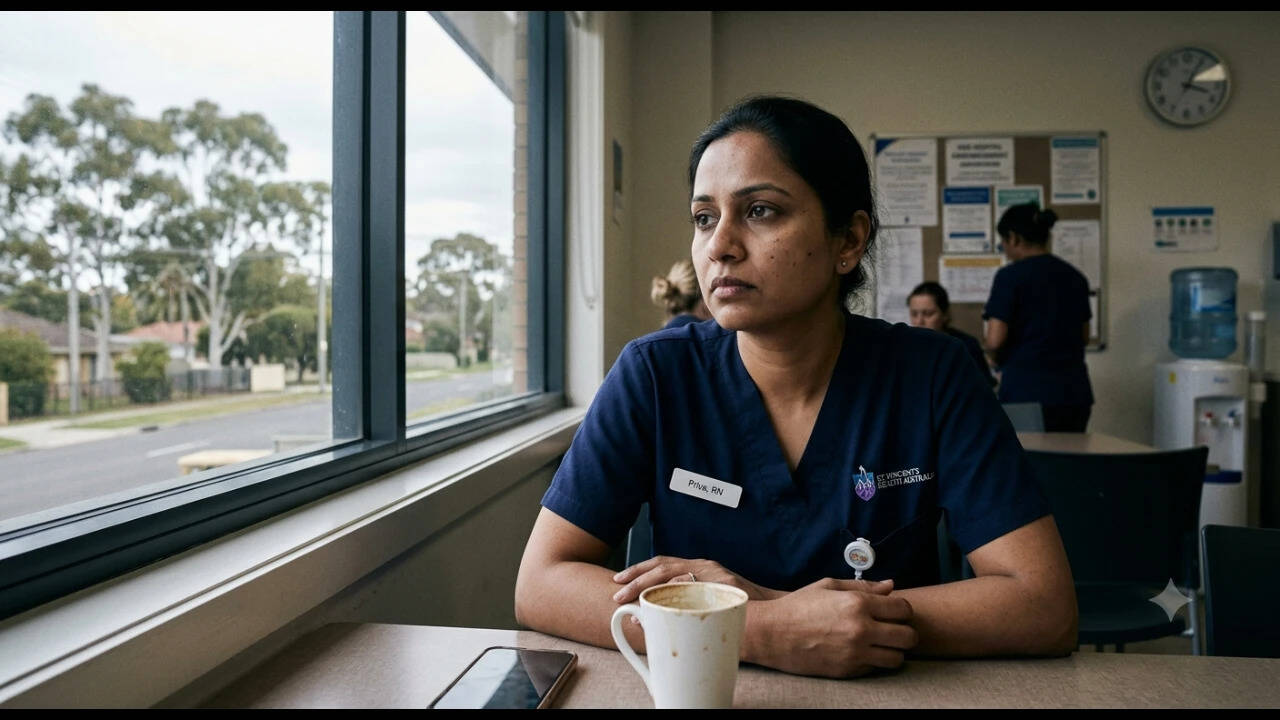
Fluorescent lights hum at a pitch you only notice when everyone else has gone home.
They buzz above the linoleum corridors of hospitals at three in the morning, bleaching the color out of tired skin and turning coffee into something that tastes faintly of copper. For a nurse who packed her life into two overweight suitcases, crossed an ocean, passed licensing exams that felt like climbing glass, and learned how to read unfamiliar slang at two hundred words a minute, that hum becomes a soundtrack.
You come for the stability. You come because the exchange rate makes your effort look like alchemy back home. You come because everyone on the group chat claps when you post a photo next to a palm tree or a harbor bridge, whispering settled as if migration were a destination rather than a daily negotiation with your own nervous system.
Then one Tuesday, an elderly patient refuses to let you adjust her IV line, looking past your name badge toward the doorway with a tight, sour jaw, asking if there is someone "local" who can do it instead. Or a stranger in a supermarket aisle steps slightly too wide around your trolley. Or a colleague laughs a fraction too sharply at the way a vowel slips off your tongue when you are exhausted after a twelve-hour shift.
None of it makes the evening news. No single moment looks big enough to justify blowing up a visa, a career trajectory, or a family's quiet pride.
Yet you go home, sit on the edge of a bed in a rental apartment that still smells faintly of the previous tenant's detergent, and wonder: Is not liking life here actually a good enough reason to leave?
The Quiet Arithmetic of Leaving
To understand why that question hurts so much, you have to look at how migration is sold versus how it feels.
On paper, the math is clean. A registered nurse in Australia earns substantially more than many healthcare workers in India. The working conditions often feature stricter nurse-to-patient ratios than overcrowded wards back home, clearer career ladders, and a currency that stretches when you send money back or visit for Diwali. When people weigh whether to stay or return, they usually reach for a spreadsheet: salary minus rent, plus savings, plus visa security, equals success.
Spreadsheets are wonderful at counting dollars. They are terrible at counting micro-exhaustion.
Think of emotional strain like carrying a backpack with an extra five kilos of wet sand every single day. On day one, you barely sag. By month four, your lower back aches. By year two, you don't even remember what walking upright without tension feels like—until you set the bag down for five minutes and realize how heavy it was.
Let's use a hypothetical scenario to make that weight concrete. Imagine a composite nurse—let's call her Kavita, though her story belongs to thousands of women and men working across Melbourne, Sydney, Brisbane, and Perth. Kavita is twenty-eight. She trained hard, cared deeply, and arrived in Australia full of quiet resolve. She loves the crisp mornings and the orderly buses. She does not hate the country. What wears her down is the constant, low-grade friction of being read before she even speaks: the assumptions about where she came from, the subtle testing of her competence, the feeling of being tolerated as useful labor rather than received as a whole human being.
When Kavita vents to friends or reads threads online where strangers trade opinions on whether homesickness or racial friction is "valid" grounds to pack up and go home, she runs into two opposing walls.
One wall says: * toughen up, every immigrant faces prejudice, don't throw away a golden ticket over bruised feelings.* The other wall says: your peace is priceless, leave immediately, no paycheck is worth your dignity.
Both walls miss the nuance. Life rarely comes down to a cartoon choice between martyrdom and dramatic retreat.
What Racism Actually Looks Like on a Tuesday Shift
When people hear the word racism, their minds often jump to slurs, shouting matches, or dramatic headlines. Most of the time, especially in professional settings like hospitals and clinics, it does not arrive with sirens. It arrives sideways.
It looks like a relative of a patient assuming the junior doctor standing six feet away is in charge while questioning the Indian nurse standing right beside the bed with ten years of clinical instincts. It looks like a joke at the nurses' station that only lands if you pretend not to hear the edge underneath it. It looks like having to work twice as hard to sound effortless, polite, and unthreatening so nobody can write you off as "difficult."
Over time, that vigilance changes how you inhabit your own body. You rehearse sentences before speaking. You swallow sharp comebacks because you are on a sponsored or skilled pathway and every conflict feels like a threat to your footing. Even when people around you are kind—and many colleagues and patients genuinely are—the memory of the unkind moments lingers longer than the praise. Human brains are wired that way; threat sticks like burrs to wool.
There is also a deeper layer that online comment sections rarely unpack: belonging is not a bonus perk; it is basic human infrastructure.
Psychologists often talk about social baseline theory—the idea that human nervous systems expect safe, predictable connection with other people. When you belong somewhere, your body spends less energy scanning the room. When you feel subtly out of place, your baseline stress sits a notch higher even on calm days. You can sleep eight hours and still wake up tired because your brain spent the night processing the day's social static.
So when an Indian nurse in Australia asks whether disliking life abroad is a good reason to return, she isn't necessarily saying, "I can't handle hard work." She is often saying, "I am tired of living in a body that feels slightly on trial."
Is "Not Liking It" Enough?
Honest answer.
Yes—and no.
If "not liking it" means you had a rough winter, miss street food at midnight, haven't found your rhythm yet, and feel lonely because building adult friendships in a new country takes time, returning right away might mean giving up before the soil settles. Migration has a well-documented emotional arc. The initial relief and novelty often give way to friction, homesickness, and culture shock around the first or second year. Plenty of people push through that valley and discover a life they genuinely love.
Wait.
What if it isn't just a rough winter? What if you have given it real time, tried joining community groups, worked on your clinical communication, sought support, and still feel like a guest in your own life? What if the racial bias or cultural alienation isn't a passing phase, but a constant drain on your mental health, self-worth, and joy?
Then "not liking it" is not trivial at all. It is data.
We have a strange cultural habit of treating migration like a marriage contract where leaving is seen as failure. If you move abroad and move back, people sometimes whisper that you "couldn't hack it" or "wasted your opportunity." That stigma keeps people stuck in places that are quietly eroding them.
Consider what happens next if you stay purely out of fear of looking like you quit:
You start counting down days instead of living them. You measure your worth by bank balances while your spark dims. You tell yourself you'll be happy once permanent residency comes through, or once you buy a house, or once you visit home—and then the goalpost moves again.
Moving back to India isn't a step backward into a vacuum, either. Returning comes with its own real trade-offs—lower pay scales, different workplace pressures, family expectations, reverse culture shock—and pretending those don't exist would be dishonest. Going home isn't a magic wand. It is simply trading one set of challenges for another set you might actually have the strength and belonging to carry.
The Hidden Cost of Staying Silent
One of the hardest parts of this dilemma is isolation.
Many nurses and skilled migrants carry heavy feelings in silence because they don't want to worry aging parents who sacrificed to help them go, or they don't want to sound ungrateful to peers back home who still dream of getting a visa. Gratitude and grief can sit in the same chest without canceling each other out. You can be thankful for good wages, safe streets, and career growth and still feel hurt by racism, disconnected from community, and exhausted by emotional labor.
When you read advice on forums or social media about questions like this, notice how quickly strangers flatten complex lives into slogans. One person says, "Move back immediately, mental health first!" Another snaps, "Stop complaining, people kill for your visa." Neither person has to live your Tuesday night shift or sit in your quiet kitchen on a Sunday afternoon.
External opinions can be mirrors, not maps. They can show you what other people value, yet they cannot tell you what kind of life your spirit can actually sustain over ten or twenty years.
A simple metaphor helps here. Imagine trying to grow a tree in rocky soil. With enough fertilizer and pruning, it might survive—even grow tall—while still leaning away from the wind. Moving it to softer soil doesn't mean the tree was weak; it means roots need room to take hold without fighting stone every inch of the way.
How to Tell Homesickness Apart from Misalignment
If you are standing at that crossroads—torn between staying in Australia for the career and financial upside or returning to India to reclaim warmth, familiarity, and relief—it helps to separate noise from signal.
Ask yourself what hurts most at the end of a hard week.
If what hurts most is distance—missing your parents' aging faces, missing festivals that feel electric only when everyone around you knows the songs without being told, missing the effortless shorthand of your own language—that is grief and longing. Those are real, heavy things. Sometimes they ease as you build chosen family abroad; sometimes they never fully shrink, and choosing to go home to be near the people you love is a deeply human choice.
If what hurts most is how you feel treated and seen—feeling smaller after shifts, brushing off repeated slights because speaking up feels risky, feeling invisible or stereotyped in spaces where you give your best care—that points toward environment and dignity. No salary can permanently buy self-respect when you feel it chipping away week after week.
And ask yourself one more question, stripped of pride and outside noise: If nobody in the world would judge me either way, and my bank account wouldn't collapse overnight, where would I breathe easier?
The answer won't solve visa rules, flights, or career transitions in a single stroke. Still, it tells you the truth about direction.
Choosing a Life You Don't Have to Recover From
Leaving is not always defeat. Sometimes it is discernment.
Staying is not always strength. Sometimes it is inertia wrapped in pride.
Whether a nurse stays in Australia, transfers to another city or health network with a healthier culture, or books a one-way flight back to Bengaluru, Kochi, Mumbai, or Delhi, the real measure of the choice isn't how impressive it looks from the outside. It is whether the life you build lets you take off the heavy backpack sometimes, sit under bright lights without flinching, and feel at home inside your own skin.
A passport can carry you across oceans, and a paycheck can buy comfort, yet neither can warm a room where your heart still feels out in the cold.