Watching Donald Trump, Vladimir Putin, and Xi Jinping stand shoulder-to-shoulder for group photos in Shenzhen this month looked like a scene straight out of 1945. Pundits immediately started throwing around phrases like "Yalta 2.0". They worried that three strongmen were carving up the globe behind closed doors while smaller nations waited nervously in the hallway.
Here's the truth. Most people completely misunderstand what the Asia-Pacific Economic Cooperation forum actually does, and they misread what happened in China on November 18 and 19, 2026.
APEC isn't the United Nations Security Council. It doesn't pass binding laws, deploy peacekeepers, or enforce trade sanctions. Yet every single year, the world's most powerful leaders drop everything to fly across the Pacific for it. Why? Because the real action never happens in the main conference hall. It happens in the hallways, the bilateral pull-asides, and the carefully choreographed photo ops that send unmistakable signals to global markets.
If you want to understand why Shenzhen mattered—and what the competitor headlines missed—you need to look past the surface-level summit recap.
APEC Runs on Peer Pressure Not Treaties
If you've ever sat through an international trade briefing, you know how quickly people glaze over when acronyms start flying. People routinely confuse APEC with the World Trade Organization or regional trade pacts like the CPTPP. That's a massive mistake.
Founded in 1989, APEC operates entirely on non-binding commitments and voluntary cooperation. Nothing agreed to in the official APEC leaders' declaration carries legal weight. Nobody gets fined if they miss a target. Every decision requires strict consensus among all 21 members.
Sounds toothless, right? In theory, yes. In practice, that lack of legal friction is the exact reason the organization survives.
Because leaders aren't forced to sign binding treaties that would get torn apart by domestic legislatures back home, they actually show up and talk. Over the past three decades, average tariff rates across the APEC region dropped dramatically—not because a court forced countries to lower them, but because governments used the forum to benchmark their economies against neighbors and match each other's reforms voluntarily.
Think of APEC less like a courtroom and more like an exclusive executive retreat. You don't go there to sign a binding contract. You go there to size up your competitors, test out new policy ideas, and make side deals while the cameras are pointed somewhere else.
Why Shenzhen Was a Calculated Power Play by Beijing
When China announced Shenzhen as the host city for the 2026 summit, seasoned Asia watchers immediately caught the subtext. China had hosted APEC twice before—first in its financial capital of Shanghai in 2001, and then in its political capital of Beijing in 2014.
Picking Shenzhen for round three wasn't random.
Forty-five years ago, Shenzhen was a quiet collection of fishing villages just across the border from Hong Kong. Today, it's the beating heart of China's hardware, electric vehicle, and telecommunications sectors. When foreign executives and heads of state landed there in November 2026, they were driving past the headquarters of BYD, Huawei, and Tencent.
Beijing wanted to prove a specific point. Despite years of Western export controls, semiconductor restrictions, and supply chain decoupling, China's tech ecosystem isn't collapsing. Hosting the 21 APEC economies right inside that manufacturing powerhouse allowed Xi Jinping to project technological resilience without saying a word.
The Economic Weight Behind the Optics
To understand why CEOs still flock to the APEC CEO Summit—which ran November 17–18 right before the leaders met—look at the sheer scale of the room.
The 21 APEC members account for roughly 62% of global GDP and about half of all international trade. You simply can't build a global supply chain in electronics, agriculture, energy, or consumer goods without crossing multiple APEC borders. Even when geopolitical tensions spike, corporate boards can't afford to ignore a room that controls nearly two-thirds of the world's economic output.
The Member Economies Trick That Keeps Taiwan in the Room
Pay close attention to the vocabulary used in official APEC documents. You will never see the phrase "member states" or "member nations." APEC officially refers to its participants as "member economies".
That two-word linguistic workaround is one of the cleverest diplomatic hacks in modern history.
Because membership is based on economic autonomy rather than sovereign statehood, APEC allows China, Hong Kong, and Taiwan to sit at the exact same table. All three joined in 1991. To keep Beijing from walking out, Taiwan participates under the name "Chinese Taipei" and doesn't send its sitting president to the annual leaders' meeting. Instead, Taipei sends a high-profile business or political envoy. For the 2026 Shenzhen summit, Taiwan tapped Acer founder Stan Shih to represent its economy.
Meanwhile, Hong Kong sends its Chief Executive, participating separately from Beijing's delegation despite being a Special Administrative Region of China.
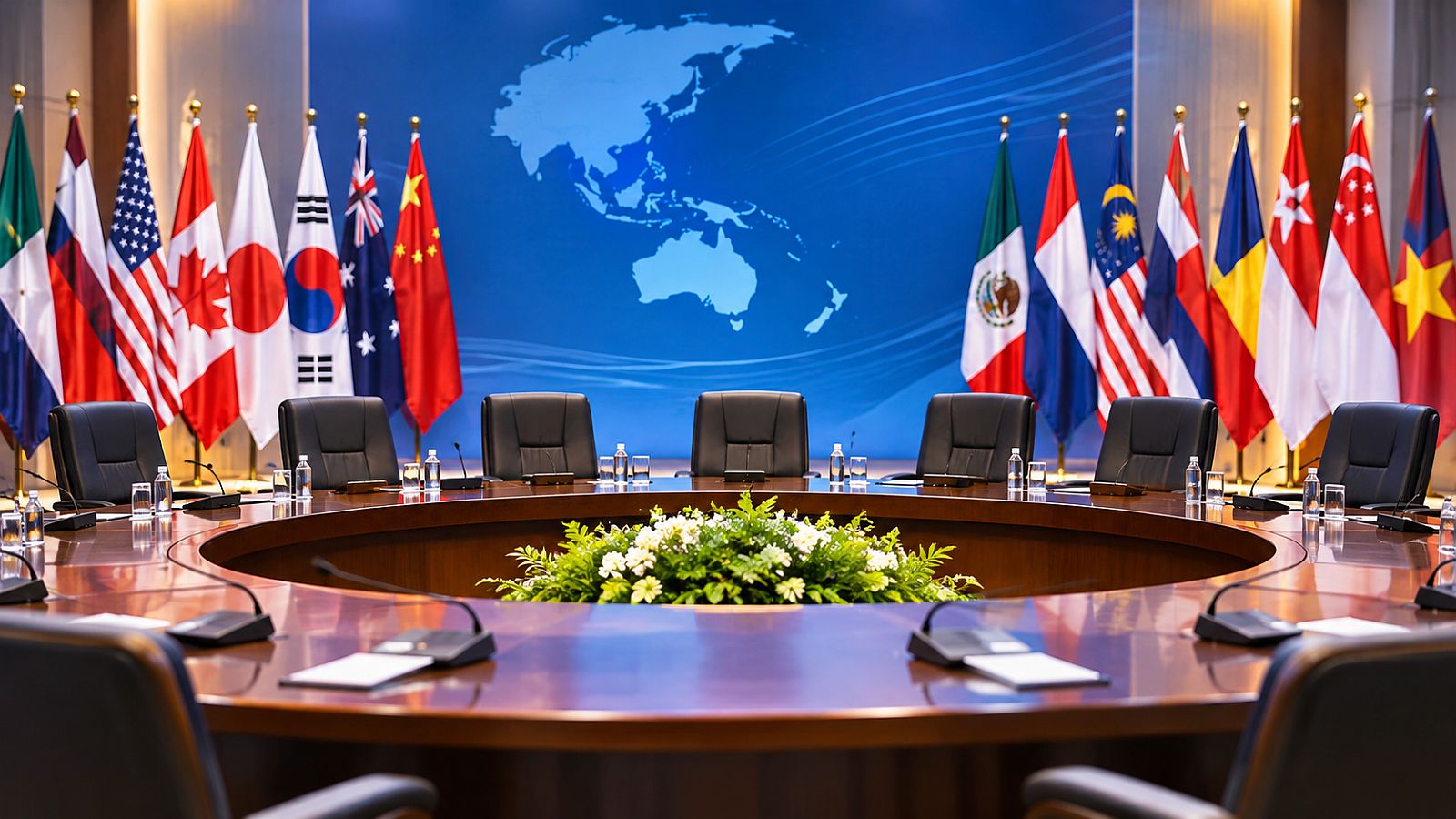
Here is the full roster of the 21 APEC member economies so you can see how broad the footprint actually is:
- North and South America including the United States, Canada, Mexico, Chile, and Peru
- Northeast Asia covering China, Hong Kong, Japan, South Korea, and Taiwan
- Southeast Asia spanning Brunei, Indonesia, Malaysia, the Philippines, Singapore, Thailand, and Vietnam
- Oceania and Eurasia bringing in Australia, New Zealand, Papua New Guinea, and Russia
Notice who isn't on that list. India—the world's most populous nation and a massive Indo-Pacific player—still isn't a member, largely due to a years-long moratorium on new admissions and lingering friction over trade liberalization standards.
What Actually Happened at the Trump Putin Xi Meeting
Let's cut through the noise surrounding the November 19 trilateral meeting between Donald Trump, Vladimir Putin, and Xi Jinping.
It was historic in one undeniable way. Leaders of the United States, Russia, and China had never held a formal three-way summit like this before. For 90 minutes on the margins of APEC, the three men sat down together while the rest of the world tried to read the tea leaves.
If you expected them to redraw the map of Europe or end major wars over coffee, you walked away disappointed. As analysts at the International Institute for Strategic Studies pointed out right after the summit, the meeting was heavy on theater and surprisingly light on concrete policy deliverables.
Nuclear Arms Control Without a Deal
The most urgent backdrop to the meeting was the expiration of the New START treaty back in February 2026. For years, that agreement capped deployed strategic nuclear warheads for both Washington and Moscow at 1,550. With the treaty dead, there are currently zero legally binding limits on the world's two largest nuclear arsenals.
Trump used the Shenzhen meeting to push his longstanding argument that any new arms control framework has to include Beijing, not just Moscow. Xi countered with China's standard diplomatic line calling for the eventual complete prohibition of nuclear weapons, while resisting binding caps on China's rapidly expanding stockpile. They agreed to keep talking about reducing nuclear risks, which sounds nice on paper, but nobody signed a freeze.
The Joint Swipe at International Courts
Where the three leaders actually found common ground wasn't on ending the war in Ukraine—which barely registered in their final communiqué—or resolving Middle East flashpoints. Instead, they aimed their fire at global legal institutions.
Trump openly attacked the International Criminal Court as "out of control". That line handed a massive diplomatic gift to Putin, who has faced an ICC arrest warrant since March 2023 over the unlawful deportation of Ukrainian children. Because neither China nor the United States is a party to the Rome Statute, Putin could travel safely to Shenzhen without worrying about arrest. The resulting joint declaration explicitly criticized international courts for overstepping state consent and violating the immunity of sitting officials.
Protocol Gymnastics
If you want to know how seriously Beijing took the optics, look at the group photos.
In Chinese diplomatic protocol, standing to the host's right is the spot of highest honor. Ahead of the gala dinner, Xi placed Trump to his right. By the time the closing leaders' photo was snapped at the end of the summit, Putin had rotated into that prime spot. Xi personally greeted Trump at the airport tarmac and sat next to him at dinner, signaling a G2-style peer relationship to Washington, while simultaneously reassuring Moscow that their "no-limits" partnership wasn't being sidelined.
Why Middle Powers Are Quietly Hedging Their Bets
While cable news obsessed over every handshake between Trump, Putin, and Xi, the real strategic shift in Shenzhen happened among the other 18 delegations.
Leaders like Philippine President Ferdinand Marcos Jr., Japanese Prime Minister Sanae Takaichi, and New Zealand Prime Minister Christopher Luxon didn't fly to southern China just to watch a three-man show. Middle powers across the Asia-Pacific are watching Washington, Beijing, and Moscow test out a transactional, great-power style of diplomacy—and they aren't waiting around to see if they get squeezed.
Take trade as an example. Prior to Shenzhen, the U.S. and China extended their bilateral tariff truce through January 2027, taking immediate pressure off the meeting. Analysts at the Brookings Institution noted that because the two superpowers had already paused their tariff escalation before arriving in China, the real diplomatic energy shifted toward side deals among smaller economies.
Southeast Asian nations, Australia, and Japan are actively diversifying their supply chains and trade agreements so they aren't overly dependent on either Washington's tariff whims or Beijing's export dominance. When the top three military powers start talking about reforming the United Nations and sidelining international courts, mid-sized economies double down on regional rules-based trade pacts to protect themselves.
How to Track What Actually Matters After an APEC Summit
If you follow global markets, supply chains, or foreign policy, watching the official APEC press conferences will mostly waste your time. The main communiqué is always scrubbed down to safe, consensus-approved platitudes so all 21 members can sign off without losing face.
To spot the real consequences of the Shenzhen summit over the coming months, track these specific indicators instead:
- Watch the January 2027 U.S.-China tariff deadline. The temporary truce that kept Shenzhen calm expires in just a few weeks. Look for whether Washington and Beijing announce follow-up ministerial talks in December 2026 to extend it, or if customs agencies start prepping new tariff schedules.
- Track working-level nuclear talks. Ignore the grand speeches about eliminating nuclear weapons. Check whether the U.S. State Department and China's Foreign Ministry actually schedule technical bilateral or trilateral risk-reduction meetings following the expiration of New START.
- Monitor semiconductor and EV supply chain announcements. Pay attention to corporate investment disclosures coming out of the APEC CEO Summit. When chipmakers, battery suppliers, or automakers announce new assembly plants in Vietnam, Malaysia, or Mexico right after APEC, that tells you where capital is actually moving regardless of political rhetoric.
- Follow APEC working group standards on digital trade and AI. While leaders argue over geopolitics, technical committees inside APEC quietly set interoperability rules for cross-border data flows, customs digitization, and AI governance. Those technical standards directly affect how companies operate across the Pacific.
Don't get distracted by the staged smiles on the summit riser. Treat APEC for what it actually is—a high-stakes networking forum where voluntary trade rules keep commerce moving even when the world's biggest powers are locked in a cold standoff. Start tracking those four concrete indicators this week, and you'll spot the real geopolitical shifts long before they hit the front page.