You don't need to buy a hard hat today.
Every few months, a terrifying headline sweeps through Indian social media warning that a massive chunk of NASA hardware is about to slam directly into Mumbai or Hyderabad. Usually, these viral alerts reference the Neil Gehrels Swift Observatory, the Van Allen Probe A, or older defunct satellites like RHESSI (Reuven Ramaty High Energy Solar Spectroscopic Imager) and UARS (Upper Atmosphere Research Satellite). While the orbital math behind these warnings is technically real, the panic is almost always manufactured for clicks.
Let's look at what's actually happening above your head right now. When a low-Earth orbit spacecraft runs out of propellant—or gets dragged down prematurely by a hyperactive sun—it doesn't fall straight down like a dropped brick. It spirals. Because Mumbai sits at roughly 19 degrees north latitude and Hyderabad sits at 17.4 degrees north, any spacecraft orbiting at an inclination of 20 to 29 degrees will pass directly over both cities multiple times a day.
That's it. That's the whole secret behind those scary debris maps.
If an orbital track crosses 19 degrees north, automated tracking software draws a giant red band wrapping all the way around the globe between 28 degrees north and 28 degrees south. That band covers Mexico City, Rio de Janeiro, Lagos, Bangkok, Mumbai, and Hyderabad. News aggregators spot Indian Tier-1 cities inside the red zone, slap a panic-inducing headline on a 300-word blurb, and watch the ad revenue roll in.
Why NASA Telescopes Actually Fall Out of the Sky
Space isn't a complete vacuum. Even at 500 or 600 kilometers above Earth, trace amounts of atmospheric gas slam into orbiting satellites at roughly 28,000 kilometers per hour. Over years, that microscopic friction acts like a relentless headwind, bleeding away orbital speed until gravity wins.
Normally, space agencies account for this decay over decades. Things get messy when the Sun wakes up. During a solar maximum—like the intense solar cycle peak we've seen through 2024, 2025, and into 2026—extreme ultraviolet radiation heats up Earth's upper atmosphere. The atmosphere expands outward like a rising loaf of bread, pushing dense air into altitudes that are supposed to be nearly empty.
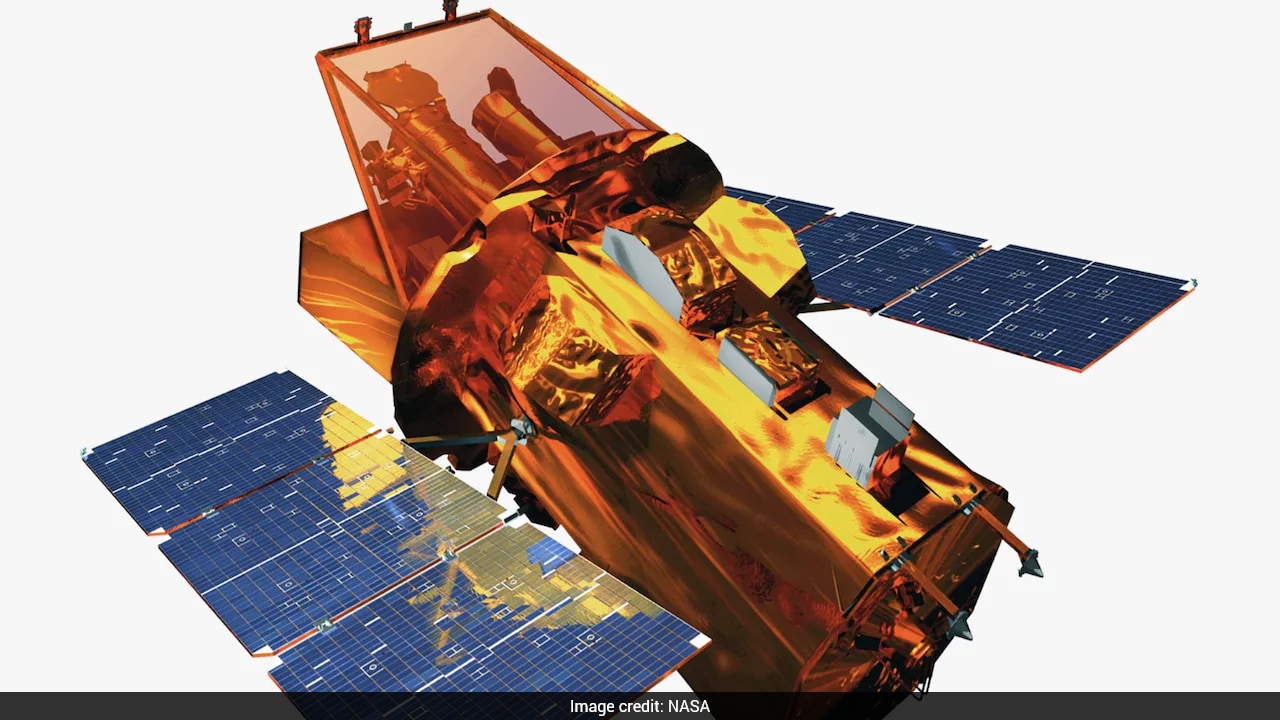
Take NASA's Neil Gehrels Swift Observatory, launched in 2004 to hunt gamma-ray bursts. Swift was built without an onboard propulsion system because engineers never planned to boost it back up. As solar drag intensified recently, Swift's altitude dropped faster than expected, forcing NASA to temporarily pause science operations to reduce aerodynamic drag—essentially turning the spacecraft edge-on into the wind—while prepping a commercial robotic servicing mission to boost it higher.
When a spacecraft lacks a controlled deorbit engine, nobody on Earth knows the exact reentry spot until roughly two hours before impact. Even then, the margin of error stretches across thousands of kilometers.
What Happens When Space Hardware Hits the Atmosphere
People imagine a school-bus-sized telescope crashing intact into Marine Drive or Banjara Hills. Physics doesn't allow that.
When a spacecraft hits the dense upper atmosphere around 80 to 100 kilometers up, aerodynamic heating turns the exterior into plasma. Temperatures exceed 1,600 degrees Celsius. Aluminum structures, solar panels, and thin outer skins vaporize completely long before reaching the ground.
Only the heaviest, highest-melting-point components survive the fire:
- Titanium propellant tanks (often spherical and hollow, which slows them down like a badminton shuttlecock)
- Silicon carbide mirrors or heavy optical housings used in X-ray and gamma-ray telescopes
- Tungsten or stainless steel reaction wheels used to point the telescope at distant stars
Even when those pieces survive, they don't hit at orbital velocity. Atmospheric drag slows falling debris down to terminal velocity—usually between 100 and 300 kilometers per hour. That's certainly lethal if it hits a person or punches through a roof, which is why NASA and the Indian Space Research Organisation (ISRO) track every piece closely.
The Real Odds of Debris Hitting Mumbai or Hyderabad
Let's talk actual numbers instead of viral rumors. NASA's Orbital Debris Program Office calculates human casualty risk for every uncontrolled reentry using a strict threshold. Before a mission even launches, engineers must prove the odds of a single person anywhere on Earth getting injured by falling debris are lower than 1 in 10,000.
Compare that to your daily life in urban India. Your odds of getting struck by lightning in your lifetime are roughly 1 in 15,000. Your odds of dying in a road accident in a major Indian metro are vastly higher than getting hit by space junk.
Furthermore, look at a globe. Water covers 71 percent of Earth's surface. Within that tropical latitude band where low-inclination NASA telescopes orbit, the percentage of open ocean—the Pacific, Atlantic, and Indian Oceans—is even higher. Deserts, jungles, and uninhabited farmland account for most of the remaining landmass. Densely packed concrete cities like Mumbai (roughly 603 square kilometers) and Hyderabad (roughly 650 square kilometers) represent microscopic pinpricks inside a reentry corridor spanning hundreds of millions of square kilometers.
In the entire history of the Space Age since 1957, only one person is confirmed to have been struck by falling space debris—Lottie Williams in Oklahoma back in 1997, who was brushed on the shoulder by a lightweight piece of blackened mesh from a Delta II rocket and walked away completely unharmed.
How ISRO and Global Agencies Actually Track Reentries
You don't need to rely on sketchy clickbait blogs to know if something is coming down over India. Both NASA and ISRO maintain dedicated orbital tracking networks that monitor every object larger than a softball.
ISRO operates NETRA (Network for Space Object Tracking and Analysis), a multi-million-dollar system based in Bengaluru that uses dedicated radar and optical telescopes to track space debris and predict reentries over Indian territory. Whenever a rocket body or defunct satellite approaches India's airspace, NETRA feeds live trajectory updates directly to civil aviation authorities so flights can be rerouted if necessary.
Meanwhile, the US Space Force's 18th Space Defense Squadron publishes public TIP (Tracking and Impact Prediction) messages on Space-Track.org. Independent astrophysicists—like Jonathan McDowell at the Harvard-Smithsonian Center for Astrophysics—routinely translate those raw military orbital parameters into plain English on social media hours before reentry.
How to Verify Space Debris Warnings Yourself
Next time a WhatsApp forward or sensational news alert claims a NASA telescope is headed straight for your neighborhood, run through three quick checks before sharing it:
- Check the orbital inclination. Look up the spacecraft's name on N2YO.com or NASA's official mission page. If the inclination is listed as 28.5 degrees (the standard launch angle from Cape Canaveral, Florida), the satellite flies over every city between 28.5° North and 28.5° South every single day. Seeing Mumbai or Hyderabad on that map means nothing unusual.
- Look at the reentry window uncertainty. If an article claims a satellite will hit India "next Tuesday" and names a specific city, close the tab. Orbital decay cannot be predicted to a specific city more than 60 to 90 minutes before impact because upper-atmosphere density fluctuates hour by hour.
- Never touch fallen metal. On the microscopic off-chance you ever find a scorched sphere or twisted titanium bracket in a field after a bright fireball crosses the night sky, step back and call local authorities or ISRO. Unburned hydrazine fuel residue inside propellant tanks is toxic to skin and lungs.
Keep your eyes on the sky for meteor showers and rocket launches, not falling telescopes. If a fireball ever does streak across the night over Maharashtra or Telangana, grab your phone and film it—you'll be watching a multi-million-dollar light show burning up harmlessly 80 kilometers above your head.