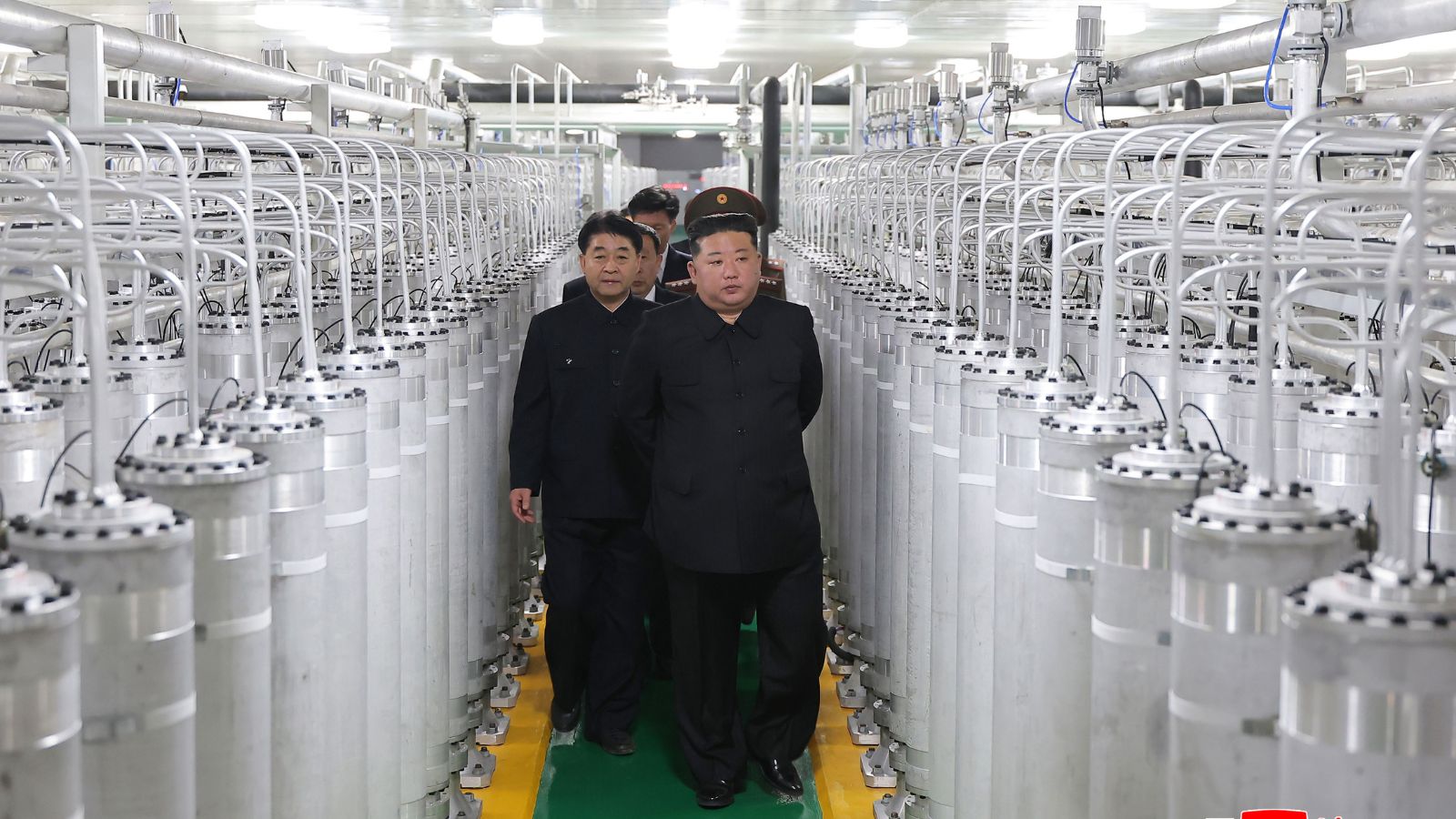
North Korea just did something it has never done publicly before. The regime dropped high-resolution photographs of its uranium enrichment facility, showing Kim Jong Un walking past rows of spinning centrifuges.
State media reported that Kim wants an exponential increase in tactical nuclear weapons. Most Western commentary immediately panicked, treating this as a sudden, terrifying leap in capability.
That reaction misses the point entirely.
This is not a sudden breakthrough. It is a highly calculated political stunt. Pyongang chose this exact moment to show off its centrifuges because the US presidential election is around the corner. They want to force their way to the top of Washington foreign policy agenda.
Understanding what this reveal actually means requires looking past the scary photos and looking at the raw logistics of North Korea nuclear program.
Inside the Uranium Enrichment Facility
The images released by the official Korean Central News Agency show Kim Jong Un walking through a long room packed with cascades of gas centrifuges. These machines spin at incredible speeds to enrich uranium hexafluoride gas into fissile material. This is the stuff needed to build atomic bombs.
Experts from the James Martin Center for Nonproliferation Studies quickly analyzed the imagery. The layout, the ceiling height, and the specific structural pillars strongly suggest this is the Kangson enrichment site. Satellite tracking has monitored this facility just outside Pyongyang for years, but Western intelligence rarely gets an unobstructed look inside.
Kim praised the technical prowess of North Korea nuclear scientists, stating the facility makes his heart feel robust just looking at it. He stressed the need to increase the number of centrifuges to aggressively expand the weapon stockpile.
The message is clear. They want the world to know they can mass-produce weapons-grade fuel whenever they want.
The Timing Explains the Strategy
North Korea does not do things by accident. Every major test, military parade, or photo release corresponds with external geopolitical events.
The US election is looming. Pyongyang knows that Washington is currently distracted by wars in Europe and the Middle East. By putting their nuclear facility on display, they are sending a direct message to the next US administration. They are declaring that denuclearization is off the table, and any future talks must be about arms control, not disarmament.
South Korea Ministry of Unification condemned the reveal, stating that North Korea illegal development of nuclear weapons violates multiple UN Security Council resolutions. But condemnation does not change the reality on the ground. Pyongyang uses these reveals to build leverage. They want sanctions relief, and they believe a larger nuclear arsenal gives them a stronger hand.
How Much Material Does North Korea Actually Have
Let's look at the numbers. Estimates on the exact size of North Korea nuclear arsenal vary, but leading independent organizations like the Stockholm International Peace Research Institute provide a clear baseline.
- Assembled Warheads: Experts estimate North Korea has built roughly 50 to 60 operational nuclear warheads.
- Fissile Material Supply: They likely possess enough enriched uranium and plutonium to quickly assemble dozens more if needed.
- Production Sites: Kangson is not alone. The primary nuclear complex at Yongbyon remains highly active, giving the regime multiple redundant production pipelines.
The phrase "exponential production" sounds terrifying. In reality, North Korea faces severe material limits. They have a finite supply of raw uranium ore and limited electricity to run massive centrifuge cascades continuously. They can grow their arsenal, but it will be a steady, incremental climb, not an overnight explosion in numbers.
The Technical Reality Behind the Photo Op
An image of a centrifuge does not tell you how well it operates. Western nuclear physicists note that while the facility looks clean and modern, we cannot verify the efficiency of these specific machines from a photograph.
Building a nuclear weapon requires mastering three distinct steps. You need the fissile material, which this facility produces. You need a functioning warhead design. Crucially, you need a delivery system that can survive atmospheric reentry.
North Korea has proven it can build bombs and launch long-range missiles. However, mating a miniaturized warhead to an intercontinental ballistic missile that can successfully hit a distant target remains an unproven capability. The regime wants you to focus on the spinning machines so you assume the rest of the puzzle is already solved.
What Happens Next
Do not expect North Korea to slow down. The regime thrives on tension, and they will likely follow up this photo reveal with physical hardware tests.
Keep an eye on the Punggye-ri nuclear test site. Analysts have spotted ongoing activity at the location for months. A seventh underground nuclear test would be the natural next step in their escalation playbook, likely timed to maximize political impact around key global summits.
应对 this reality requires a shift in Western strategy. Decades of demanding complete, verifiable, irreversible denuclearization have failed. The regime has tied its survival to these weapons. Moving forward, international efforts will likely have to pivot toward risk reduction, deterrence, and preventing the proliferation of nuclear technology to other state actors. The focus must shift from stopping a program that already exists to managing the very real danger it presents.