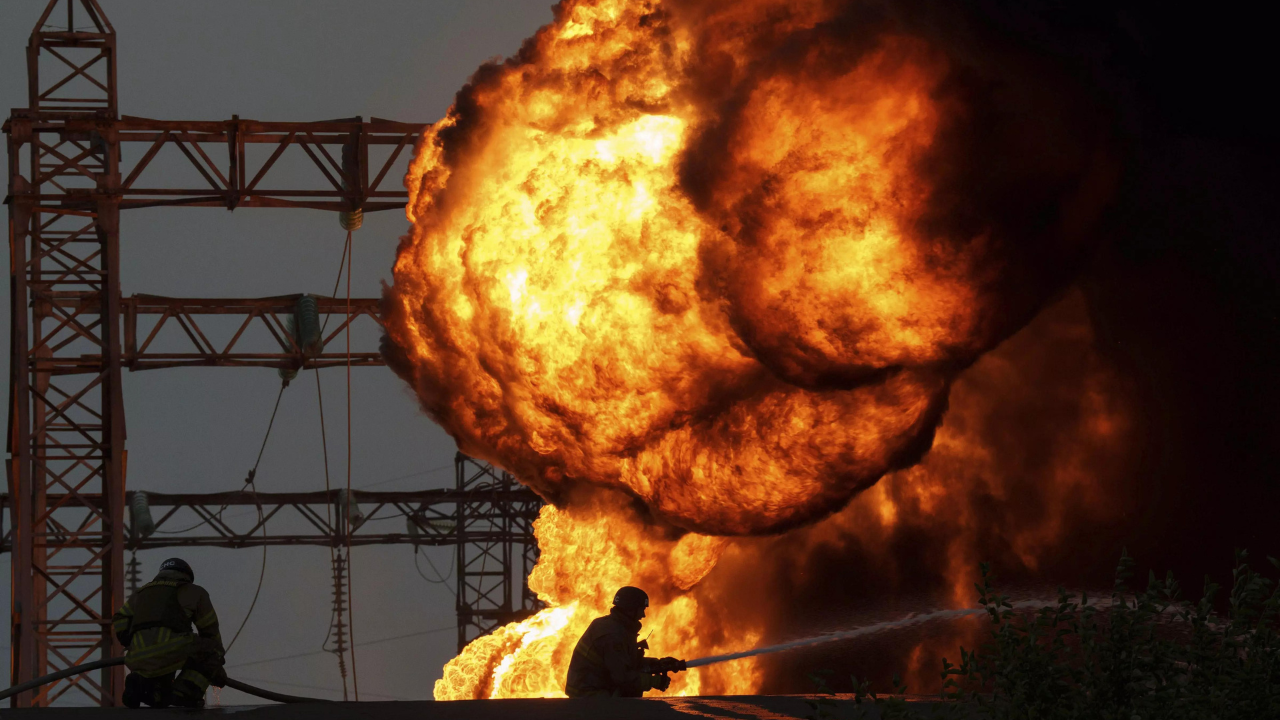
When six major power substations across four Ukrainian regions took direct hits overnight on November 10 and 11, 2026, most news outlets treated it like another routine headline from a long war. They counted the injured, listed the affected oblasts, and moved on to the next story.
They missed the real story entirely.
If you look closely at what actually happened in Vinnytsia, Kirovohrad, Zhytomyr, and Cherkasy, you aren't seeing a random barrage. You're seeing a calculated shift in how modern grid warfare is fought. Russia didn't just try to turn off the lights for a few hours. It attacked the exact choke points where Ukraine's central and northern power networks hand electricity off to the rest of the country, and it changed the weapons it used to make sure repair crews couldn't bounce back quickly.
Why Those Six Power Substations Matter More Than Power Plants
Most people assume that if you want to take down a country's electricity, you blow up the power plants. That's intuitive. It's also wrong when you're dealing with a heavily defended, decentralized grid like Ukraine's.
Power plants generate electricity, sure, but high-voltage substations are the nervous system that actually moves it where it needs to go. Think of a major substation like a massive highway interchange. If you destroy a single factory at the end of a road, one town loses goods. If you wreck the central cloverleaf interchange connecting four major interstates, traffic backs up for hundreds of miles in every direction.
That's precisely why Prime Minister Serhii Koretskyi's announcement on November 11 carried so much weight. The six substations hit during that overnight assault sit in Vinnytsia, Kirovohrad, Zhytomyr, and Cherkasy oblasts. Look at a map of Ukraine. Those four regions form the geographic spine of central and northern Ukraine.
When those nodes go down, the damage doesn't stay local. Ukrenergo, Ukraine's state grid operator, immediately had to enforce rolling blackouts across eight regions. Even Kyiv, Dnipropetrovsk, and Odesa felt the squeeze, despite being miles away from the primary substation craters. You can have plenty of power spinning out of nuclear plants in the west, yet still leave millions of people sitting in the dark because the transmission bridges in the center are burned out.
The Collateral Damage Nobody Tracks
Energy strikes rarely stay confined to the electrical grid. During the same November 11 wave, Russian forces didn't stop at the substation fences.
- District heating took a direct blow. In Kryvyi Rih, strikes slammed into a district heating facility, cutting warmth to residential apartment blocks just as November temperatures started biting.
- Transmission lines snapped across multiple voltage classes. Crews in Kirovohrad and Rivne had to scramble to restring damaged high-voltage lines while air raid sirens kept blaring.
- Railways stalled. Strikes hit railway infrastructure in both Dnipropetrovsk and Zhytomyr oblasts. When electric substations fail, electric locomotives stop moving, forcing operators to swap in scarce diesel engines and slowing down everything from civilian evacuations to freight.
- Civilian life absorbed the shockwave. At least 14 people were injured across the country that night, alongside five damaged apartment buildings in Kharkiv and a bombed school in Kherson.
The Tactical Shift That Changed Everything
Here is the detail that separates a surface-level news summary from what's actually happening on the ground. For the past couple of years, Ukraine got remarkably good at two things: shielding its giant autotransformers behind concrete blast walls and fixing damaged lines at breakneck speed.
According to Ivan Yuryk, a member of Ukrenergo's management board, Ukrainian repair crews had reached a point where—barring a follow-up strike—they could patch up major missile or drone damage in just two to three hours.
Moscow noticed. So it changed its playbook.
Speaking at the European Business Association's Energy Day 2026 event on November 24, Yuryk pointed directly to the November 11 attack on those six substations as textbook proof of Russia's new approach. Instead of firing single, pinpoint warheads aimed at the heavily armored autotransformers, Russian forces have shifted to wide-area "carpet" strikes using cluster warheads.
Why does that matter? Because a substation isn't just one giant transformer sitting in an empty field. Surrounding that protected transformer is an open-air switchyard packed with hundreds of delicate, exposed components:
- Circuit breakers and disconnect switches
- Protective relays
- Current and voltage transformers
- Porcelain insulators and control cabling
You can't easily wrap an entire multi-acre switchyard in thick concrete. When a missile bursts overhead and scatters dozens of cluster submunitions across the yard, it shreds the secondary equipment all at once.
A single damaged switch takes minutes to bypass. Fifty shredded switches, ruptured voltage transformers, and severed relay lines turn a two-hour patch job into a multi-day or multi-week nightmare. Russia realized it didn't need to destroy the invincible heart of the substation if it could shred every artery connected to it.
The Double-Tap Trap Facing Repair Crews
If cluster munitions weren't bad enough, engineers working in regions like Odesa, Kyiv, and Vinnytsia are dealing with a second, far darker tactic.
President Volodymyr Zelensky called it out explicitly following recovery meetings in late November 2026: Russian reconnaissance drones are loitering over damaged grid sites, waiting for Ukrainian crews to finish stringing new cables, and then calling in fresh strikes on the exact same spot. They're also actively hunting down the temporary bypass routes engineers build to keep hospitals and water pumps alive.
Think about what that does to restoration timelines. Under normal peacetime safety rules, you don't send high-voltage linemen up into steel towers while active munitions are overhead. In Ukraine, workers have to wait out hours-long air raid alerts, rush into unexploded submunition fields once the all-clear sounds, work under floodlights, and duck back into shelters the second another jet-powered Shahed drone appears on radar.
Honestly, the fact that Ukraine's grid hasn't suffered a total nationwide collapse after repeated waves like the November 11 strikes—or the massive October 28 barrage that hit 28 substations in a single night—is nothing short of a minor engineering miracle.
The Global Supply Chain Bottleneck Nobody Can Solve Quickly
Even when international donors write massive checks, money doesn't instantly turn into high-voltage hardware.
Since early 2022, Ukrenergo has received more than €1 billion in direct donor aid from partners including USAID, the World Bank, the European Bank for Reconstruction and Development, Germany, France, and Japan, alongside even larger loan packages. Nearly all of that capital goes straight into buying emergency replacement gear.
Yet Yuryk highlighted two brutal bottlenecks that cash alone can't fix overnight:
- Global manufacturing scarcity. Only a handful of factories worldwide produce specialized high-voltage transformers, switches, and relays. Even in peacetime, ordering custom grid equipment involves lead times of 12 to 24 months. Ukraine is competing against Western utilities that are simultaneously trying to upgrade their own aging grids.
- A shortage of specialized contractors. You can't pull a residential electrician off the street and ask them to wire a 330-kilovolt substation switchyard. The pool of certified contractors capable of building physical blast shelters and installing high-voltage switchgear is small, exhausted, and stretched thin across the entire country.
When six major substations get peppered with cluster munitions in one night, every piece of spare equipment pulled from Ukrenergo's warehouse shrinks the buffer available for the next wave. And as the November 25 overnight strikes across Zaporizhzhia, Odesa, Dnipropetrovsk, and Poltava proved just two weeks later, the next wave is always coming.
What Winter Looks Like for Ordinary Households and Businesses
If you're trying to understand what these six substation hits actually mean for daily life in Ukraine right now, forget abstract megawatt statistics. Look at the blackout schedules.
By late November 2026, families across large swaths of Ukraine were already living through scheduled power cuts lasting anywhere from four to 18 hours a day. On November 24 alone, Ukrenergo had to apply up to 3.5 outage queues simultaneously just to keep grid frequency from crashing.
For businesses, the math is brutal. Companies like Biosphere, one of Ukraine's largest household goods manufacturers, have had to spend millions on backup generation and decentralize their warehouses just to keep production lines moving under constant shelling. Small bakeries, pharmacies, and apartment buildings rely on noisy diesel generators humming on sidewalks from dawn until curfew.
Even street lighting and municipal water pumps operate on razor-thin margins. In affected cities, lights tied to public air-raid warning systems stay prioritized until 10 p.m., while non-essential municipal power gets cut first. When district heating plants like the one in Kryvyi Rih take hits alongside electrical substations, residents lose both electricity and radiator heat at the exact same moment.
How to Track and Verify Grid Developments Without Falling for Panic
Whether you're monitoring supply chain risks in Eastern Europe, reporting on the conflict, or supporting humanitarian relief efforts on the ground, reading sensationalist headlines won't help you make good decisions. Most breaking news alerts exaggerate either an imminent total blackout or an effortless recovery.
To get an accurate picture of what's actually happening on Ukraine's grid after major substation strikes, stick to primary operational signals rather than social media rumors:
- Watch Ukrenergo's "outage queue" announcements. Don't just look at whether blackouts are happening—look at how many queues (from 1 to 4) are scheduled simultaneously across central and eastern oblasts. Jumping from 1.5 queues to 3.5 queues tells you immediately that high-voltage transmission capacity was lost, not just local distribution lines.
- Track European electricity import ceilings. Whenever central substations in Vinnytsia, Zhytomyr, or Rivne take damage, Ukraine leans heavily on emergency imports from Poland, Romania, Slovakia, and Hungary through the ENTSO-E continental grid. Rising import requests signal acute domestic transmission bottlenecks.
- Monitor regional military administration alerts for Kryvyi Rih, Odesa, and Kharkiv. Industrial hubs with heavy district heating networks are the early warning indicators for cascading infrastructure stress.
- Support decentralized backup power rather than macro grid fixes. If you're directing charitable aid or corporate relief funds toward Ukraine this winter, prioritize portable battery stations, inverter systems for hospital wards, and mobile boiler units—tools that keep critical clinics and apartment blocks running even when a regional substation goes dark for weeks.