Three oil tankers were hit around the Strait of Hormuz on the exact same Saturday that Tehran aired state television footage of a new underground dual-missile launcher. If you read standard wire dispatches, those events read like disconnected items in a routine regional roundup. They aren't.
Tehran isn't throwing random punches. Look closely at the November 21, 2026 incidents alongside Israeli strikes in Gaza and quiet diplomatic backchannels in Qatar, and a calculated strategy snaps into focus. Iran is combining maritime chokepoint warfare with subterranean deterrence to force Washington out of a naval blockade without triggering an all-out aerial campaign that could wipe out its leadership.
I've tracked Persian Gulf maritime security and Iranian asymmetric doctrine for years, and the pattern here is unmistakable. Wire summaries give you the body count and the hardware specs, yet they rarely connect the economic pressure in the water to the psychological theater underground. Let's break down what actually happened, why the engineering behind that new launcher matters, and how Gaza and Doha fit into the same board.
Why Iran Hit Three Oil Tankers in the Strait of Hormuz
Maritime chokepoint warfare works through insurance premiums and shipping delays rather than decisive naval battles. On Saturday, November 21, 2026, at least three oil tankers came under attack in or near the Strait of Hormuz. According to the United Kingdom Maritime Trade Operations Center (UKMTO), two tankers exiting the Persian Gulf were struck separately by projectiles early that morning—one in the stern and the other in the engine room—without reported casualties. Hours later, before noon, Iran's navy announced via state media that a third tanker struck a naval mine east of the strait and caught fire.
Iranian state media boasted that its forces executed their most "intense and varied" overnight operations yet to stop vessels and foil U.S. Navy escort efforts. By the following Monday, the Islamic Revolutionary Guard Corps (IRGC) went even further, claiming three tankers caught fire after hitting naval mines despite operating under U.S. military protection—an assertion U.S. Central Command did not immediately confirm. Between November 16 and November 23 alone, the Joint Maritime Information Centre logged seven tankers hit in the waterway.
Here's why Tehran is escalating at sea right now. Since April 2026—briefly paused during a collapsed June draft understanding and reimposed on July 14—the United States has enforced a crippling naval blockade on Iranian ports and oil exports. Washington even followed up with Task Force Iron Gate to choke off sanctioned cargo moving across Iran's land borders and the Caspian Sea.
Tehran can't match the U.S. Fifth Fleet ship-for-ship. It doesn't have to. By mining approaches near Oman's port of Khasab and targeting engine rooms with low-cost projectiles, the IRGC raises global energy prices and forces Gulf Arab states to lobby Washington against further military escalation. In fact, reporting from Bloomberg indicates that Britain and several Persian Gulf Arab states have privately urged the White House not to launch fresh strikes out of fear of Iranian retaliation and a prolonged energy supply shock.
- Projectiles vs. mines create a two-tier threat. Projectiles disable propulsion systems like engine rooms without necessarily sinking a hull, creating towage nightmares and environmental liabilities. Naval mines introduce unpredictable geographic risk that slows down even escorted convoys.
- Asymmetric cost favors the attacker. A drifting mine or short-range coastal projectile costs a fraction of a naval interceptor, while forcing commercial shippers to pay astronomical war-risk insurance rates.
- Plausible ambiguity buys diplomatic time. Notice how Tehran didn't immediately comment on the UKMTO's morning projectile reports while loudly taking credit for mining operations and convoy interdictions. That gap keeps adversaries guessing about command-and-control thresholds.
Inside the New Liquid-Fuel Dual Missile Launcher
While tankers burned in the Gulf of Oman, Iranian state television broadcast footage from an undisclosed underground complex—part of what Tehran calls its network of "missile cities". Appearing alongside IRGC commander Ahmad Vahidi, Aerospace Force commander Brig. Gen. Seyyed Majid Mousavi unveiled a new launcher built to fire two liquid-fueled missiles.
Most casual observers gloss over the propellant distinction. Don't make that mistake.
Previously, Iran relied on dual launchers designed for solid-fuel missiles. Solid-fuel rockets are famous for rapid launch readiness because their propellant is pre-cast inside the casing, making them ideal for quick shoot-and-scoot tactics. Liquid-fueled missiles, by contrast, historically required lengthy fueling procedures before firing—a glaring vulnerability when American and Israeli satellites are hunting for heat signatures and fueling trucks.
So why build a dual launcher for liquid-fueled missiles inside a hardened tunnel? Two reasons stand out:
- In-flight trajectory and speed control. Liquid propellant engines are far more efficient per unit of mass and allow operators to throttle thrust, adjusting a missile's speed and flight path mid-course to complicate missile defense calculations.
- Protected underground staging. When you house fueling and loading operations deep inside subterranean mountain complexes, you neutralize the pre-launch exposure window that usually makes liquid-fuel systems vulnerable to preemptive airstrikes.
Brig. Gen. Mousavi claimed during the broadcast that Iran's aerospace capabilities had expanded between conflicts and that the Guard had integrated "surprises" into its combat structure. Stripping away the propaganda, the message aimed straight at Washington. U.S. officials had previously claimed American strikes destroyed much of Iran's missile infrastructure. Showing off intact underground tunnels equipped with upgraded twin launchers signals that Tehran still holds surviving long-range firepower if fighting resumes.
The Gaza Food Truck Strike and Ceasefire Friction
News roundups often treat Gaza and the Strait of Hormuz as separate stories, yet the diplomatic oxygen linking them is shared across every capital in the region. On the same Saturday as the tanker attacks, an Israeli airstrike hit a pickup truck carrying food in Gaza City's Tel al-Hawa neighborhood.
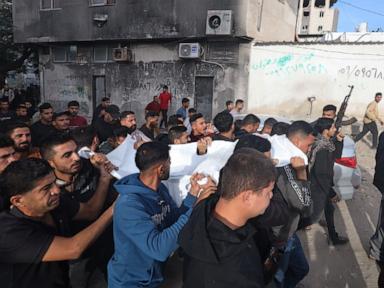
Dr. Mohamed Abu Selmiya, director of Shifa Hospital, confirmed to The Associated Press that three men inside the truck were killed. Footage shared online showed the pickup reduced to twisted scrap metal with torn boxes of cooked rice scattered across the truck bed. Because most of Gaza's population of over two million people remains displaced and reliant on United Nations and international aid deliveries, strikes involving food transport immediately trigger fierce scrutiny.
The Israel Defense Forces (IDF) offered a starkly different account later that day. Military officials stated the strike targeted three Palestinian Islamic Jihad militants using an unmarked vehicle to ferry food and logistical supplies to fellow fighters. An anonymous Israeli military official added that one of the targeted men had previously been fired by a humanitarian organization after the IDF alerted the group to his militant ties, and accused the cell of advancing attacks against Israeli troops and civilians in recent weeks.
This clash of narratives reflects a grim reality on the ground. Even after a ceasefire agreement with Hamas took effect in October 2025, Israeli airstrikes have continued almost daily. According to Gaza's Health Ministry—whose casualty records are viewed as broadly reliable by U.N. agencies and independent analysts, though they don't separate civilians from combatants—more than 1,650 Palestinians have been killed since the truce began. Seven Israeli soldiers have also died over that period. Every flare-up in Gaza hardens regional public opinion and complicates Arab mediation efforts on every other front.
Quiet Diplomacy Behind the Military Theater
If you only watch state TV broadcasts of underground missile tunnels, you'd assume diplomacy is dead. It isn't.
On Friday, November 20—just hours before the dual-missile broadcast and the morning tanker strikes—a Qatari delegation visited Tehran for a two-hour meeting with Iranian officials. Iranian Deputy Foreign Minister Kazem Gharibabadi confirmed on Saturday that Tehran remained in active contact with Qatari mediators to explore "whether another opportunity can be given to diplomacy".
This dual-track approach—escalating kinetic pressure while keeping backchannels open—is classic Iranian statecraft. Gharibabadi has publicly outlined Tehran's core conditions for any arrangement that would reopen the Strait of Hormuz:
- A permanent end to hostilities across all fronts.
- The complete lifting of the U.S. naval and economic blockade.
- The release of frozen Iranian assets and removal of sanctions imposed after Washington walked away from the previous draft understanding.
- Concrete steps to scale back recent U.S. military deployments in the region.
According to Gharibabadi, after roughly two months of talks facilitated by Qatar and Pakistan, Tehran compressed its proposed implementation timeline from seven days down to two days. Meanwhile, Israeli Prime Minister Benjamin Netanyahu has reportedly urged U.S. President Donald Trump to launch new military strikes against Iran immediately, even as senior U.S. officials note there is no imminent threat to the American homeland. Parliament Speaker Mohammad Bagher Ghalibaf warned that Iran's current state of "neither war nor peace" cannot last indefinitely.
How to Read Middle East Escalation Signals Going Forward
When regional tensions spike like this, headlines inevitably blur military posturing with genuine strategic shifts. If you want to track where this crisis is actually heading without getting whipsawed by daily propaganda, focus on four concrete indicators instead of press releases:
- Watch maritime insurance and freight routing, not just IRGC statements. Tehran routinely exaggerates battle damage, while military commands often delay confirming minor hull hits. When commercial tankers start rerouting away from Fujairah or war-risk premiums jump in London, the economic blockade-versus-chokepoint standoff is genuinely tightening.
- Separate solid-fuel alerts from liquid-fuel demonstrations. Footage of liquid-fuel launchers inside hardened tunnels signals long-term deterrence messaging aimed at Washington and Tel Aviv. By contrast, dispersal of mobile solid-fuel transporter-erector-launchers out of underground bases points toward imminent operational readiness.
- Track Qatari and Omani diplomatic traffic. As long as envoys from Doha are flying into Tehran for multi-hour sessions, both Washington and Iran are still testing off-ramps despite public threats.
- Monitor U.S. naval interdictions off Bandar Abbas. Watch whether CENTCOM continues disabling blockade-running vessels in the Gulf of Oman—as it did days after the Hormuz tanker strikes—because every interdiction triggers a predictable tit-for-tat response in the shipping lanes.