When Arizona Senator Ruben Gallego logged onto X in November 2026 and called it the "beauty" of American policy that Washington was paying Ukrainians to kill Russians, the internet predictably caught fire. Critics immediately pounced on the blunt phrasing. Supporters cheered the rare lack of diplomatic sugarcoating. Almost everyone missed the actual strategic argument sitting right underneath the shock value.
Let's strip away the outrage cycle and look at what Gallego actually said, why he said it, and what the numbers behind U.S. military aid to Ukraine really show.
What Ruben Gallego Actually Said on X
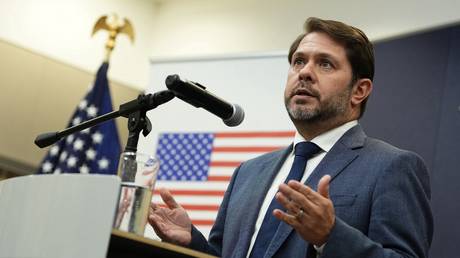
Gallego, a Democrat who entered the Senate in January 2025 after spending a decade in the House and serving as a Marine in Iraq, has never been known for soft-spoken Beltway platitudes. During a heated social media exchange on November 10, 2026, he pushed back hard against skeptics arguing that Kyiv cannot defeat Moscow on the battlefield.
"But Ukraine can win. Thats why I back them," Gallego wrote. "It's a Russian talking point that Ukraine can't win, cause Russia big blah,blah. If Ukraine kills enough Russians they will quit."
He didn't stop there. When pressed on the rationale for continued American funding, Gallego described the arrangement as the "beauty" of U.S. support—essentially framing military assistance as a direct, cost-effective mechanism to degrade Russian combat power without putting American boots on the ground. When another user asked how many Russian casualties would be enough to satisfy him, Gallego replied, "There is always room for one more."
Those posts followed an earlier exchange in which Gallego demanded that Elon Musk testify before Congress over Starlink restrictions affecting Ukrainian forces. Asked if he was backing the war for personal financial gain, the senator shot back with a four-letter dismissal and flatly stated he simply hated the Russians.
State-backed Russian outlets like RT immediately seized on the comments, spinning them as proof that Washington treats Ukrainians as expendable pawns in a proxy war fought "to the last Ukrainian." Anti-war commentators in the United States echoed the criticism, arguing that celebrating casualty counts reduces human lives to a ledger entry.
Both reactions are easy to understand. Neither tells the whole story.
Why Washington Hawks Frame Aid as a Return on Investment
If Gallego's phrasing sounded jarring, the underlying logic isn't new at all. In fact, it has been the quiet consensus among defense hawks in both parties since February 2022.
Before his death in July 2026, Republican Senator Lindsey Graham made nearly identical arguments during multiple trips to Kyiv. In May 2023, Graham drew international headlines—and an angry rebuke from Moscow—when he remarked during a meeting with President Volodymyr Zelensky that Russians were dying and called U.S. aid "the best money we've ever spent." Months later, on 60 Minutes, Graham laid out the cold math even more explicitly, calling the assistance "a great deal for America" because Ukrainian soldiers were dismantling a major U.S. adversary's military without a single American service member taking fire.
That's the real doctrine behind U.S. security assistance. Politicians usually wrap it in lofty speeches about defending democracy, upholding the UN Charter, and deterring authoritarian aggression. Gallego himself has given plenty of those speeches on the Senate floor, including his February 2025 condemnation of the Trump administration's vote against a United Nations resolution blaming Russia for the invasion.
Behind closed doors in the Pentagon and on Capitol Hill, though, the calculation is far more transactional.
Think about what the United States gets out of this arrangement from a purely strategic standpoint:
- Zero U.S. combat casualties: American troops aren't fighting in Donbas or Kursk. Every artillery shell fired by Ukrainian forces degrades Russian armored brigades and logistics networks without risking American lives.
- Massive intelligence windfall: U.S. defense planners are watching how American air defenses, precision munitions, and electronic warfare tools perform against a peer military in real time. You can't buy that kind of battlefield data in peacetime.
- Domestic industrial revitalization: Most of the money Congress appropriates for Ukraine never actually leaves the United States. It goes straight to American defense contractors in states like Arizona, Pennsylvania, and Texas to build replacement weapons and replenish U.S. stockpiles.
Gallego just said the quiet part out loud. Instead of dressing up attrition warfare in think-tank jargon, he boiled it down to a single, brutal sentence.
The Hard Numbers Behind U.S. Aid to Ukraine in 2026
To understand why Gallego's comments landed with such force in late 2026, you have to look at where U.S. funding actually stands. The popular narrative on social media assumes Washington is still writing blank checks every month. The reality is quite different.
According to data tracked by the Special Inspector General for Operation Atlantic Resolve and analyzed by the Council on Foreign Relations, total U.S. appropriations tied to the Ukraine response reached roughly $196.4 billion through mid-2026. By June 30, 2026, about 62 percent of those funds had actually been disbursed, leaving tens of billions of dollars still moving through the contracting and delivery pipeline.
More importantly, new congressional funding slowed to a trickle after the $60.78 billion supplemental package passed in April 2024. In Fiscal Year 2025, new Ukraine-related funding dropped to $5.13 billion, followed by $7.62 billion in Fiscal Year 2026. Under the FY 2026 National Defense Authorization Act signed in December 2025, Congress earmarked just $400 million per year for 2026 and 2027 under the Ukraine Security Assistance Initiative—a tiny fraction of the overall $901 billion U.S. defense budget.
Even that modest money has faced bureaucratic bottlenecks. On the exact same day Gallego posted his viral X thread—November 10, 2026—he joined a group of Senate colleagues in pressing the Trump administration to stop dragging its feet and expedite the apportionment and delivery of approved Ukraine security assistance.
Put those two events side by side. On one screen, Gallego was formally pressuring the White House over slow-walked FY 2027 budget execution. On the other, he was picking bar fights on X to rally public support for keeping Ukraine in the fight.
Where the Attrition Math Gets Complicated
Here is where we need to look closely at Gallego's core premise: "If Ukraine kills enough Russians they will quit."
Does that theory actually hold up? Honestly, the historical and military evidence is mixed, and pretending otherwise does nobody any favors.
On one hand, attrition has forced major shifts in Russian behavior. Heavy losses in armored vehicles and trained personnel prevented Moscow from achieving its original 2022 goal of regime change in Kyiv, drove Russia to lean heavily on North Korean munitions and Iranian drone technology, and strained the Russian economy through massive recruitment bonuses and defense spending.
On the other hand, Russia has demonstrated a staggering tolerance for casualties that would collapse almost any Western government overnight. Moscow has consistently compensated for front-line losses by recruiting hundreds of thousands of contract soldiers from poorer regions using steep financial incentives, avoiding the political backlash of another formal nationwide mobilization.
There are also serious risks to framing a war purely around body counts:
- Manpower asymmetry: Russia starts with a population more than three times the size of Ukraine's. Even if Ukrainian forces inflict a highly favorable casualty ratio, Ukraine feels every loss more acutely across its military and civilian workforce.
- Escalation blind spots: Treating Russian casualties as a standalone metric of success ignores how Moscow responds when cornered—whether through intensified strikes on Ukraine's power grid, sabotage operations across Europe, or nuclear saber-rattling.
- Propaganda gifts to the Kremlin: Every time an American lawmaker celebrates dead Russians on social media, Russian state television plays the clip on loop. It reinforces Vladimir Putin's domestic narrative that Russia isn't fighting its neighbor—it's fighting an existential war against an aggressive United States.
Gallego's experience as a Marine infantryman who fought in Iraq clearly shapes how he talks about war. Combat veterans often speak bluntly about violence because they know war isn't a clean policy paper—it's the organized application of lethal force to break an enemy's will. Still, what works in a squad bay doesn't always translate cleanly to public diplomacy.
How to Read Foreign Policy Rhetoric Without Getting Played
When a high-profile senator drops a grenade into your social media feed, it's easy to get pulled into a binary argument where you either defend every word or denounce the entire policy. You don't have to fall into that trap.
Next time a viral clip or X thread about U.S. military aid blows up, run it through three quick filters before sharing or reacting:
- Check the legislative calendar. Politicians rarely go scorched-earth on social media by accident. Look at what bills or budget deadlines are moving that same week—just as Gallego's posts coincided with a formal Senate push over stalled Ukraine aid disbursements.
- Separate appropriations from actual deliveries. Headlines love massive multi-year totals, while critics claim Washington has abandoned Kyiv completely. Check tracking dashboards from Ukraine Oversight or the Kiel Institute to see what money has actually been obligated versus what's still sitting on paper.
- Watch who amplifies the quote. If an American politician's off-the-cuff remark immediately becomes the lead story on state-controlled outlets in Moscow, ask yourself why it serves their domestic messaging—and whether the underlying strategic reality is more nuanced than a ten-word soundbite.
Gallego's remarks stripped away the polite euphemisms Washington usually relies on to describe proxy warfare, exposing both the cold calculus driving U.S. strategy and the political risks of stating it without a filter.
For more on how U.S. lawmakers have framed the financial return on military assistance to Kyiv, check out Graham on Ukraine aid: "This is a great deal for America", which captures the exact transactional argument that has shaped Capitol Hill's approach to the war.