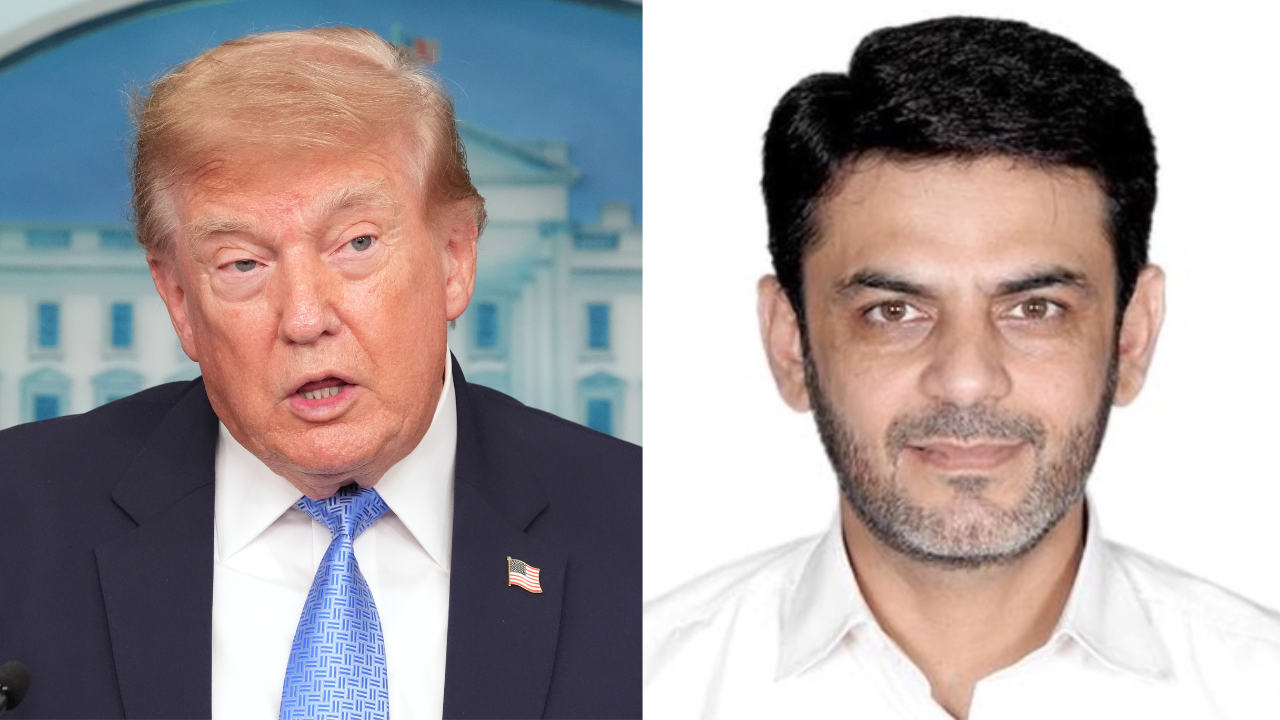
Twenty-seven years in a federal prison. That's the price a Pakistani national just paid for trying to hire hitmen on American soil to assassinate U.S. political figures, including Donald Trump. Most headlines treat this like an open-and-shut spy thriller, where a foreign operative flies in, gets caught by the FBI, and disappears behind bars.
They're missing the real story.
If you look closely at the federal court filings from the Eastern District of New York, the actual operation wasn't some slick, James Bond-style covert mission. It was messy, remarkably amateurish in its execution, and yet deeply alarming for what it tells us about how Tehran outsources lethal operations. The defendant, Asif Merchant—a 46-year-old Pakistani citizen with deep ties to Iran—didn't bring a team of elite commandos into the United States. Instead, he walked straight into an FBI sting operation in New York, handed over $5,000 in cash as an advance payment, and essentially laid out a blueprint for political violence to undercover agents posing as contract killers.
When a foreign intelligence apparatus relies on desperate, debt-ridden, or compromised middlemen to recruit street-level muscle inside America, you get a very different kind of national security threat. It's less predictable. Harder to track until they make a mistake. And honestly, way closer to organized crime than traditional espionage.
How the FBI Dismantled the Iran-Backed Plot to Kill Trump
Let's strip away the cable news sensationalism and look at the actual timeline of events laid out by federal prosecutors. In April 2024, Asif Merchant arrived in the United States from Pakistan after spending time in Iran. He wasn't traveling light in terms of baggage, though his luggage didn't hold weapons. His real cargo was instructions.
Prosecutors demonstrated through recorded conversations and financial records that Merchant had a clear mandate. He needed to recruit individuals inside the U.S. to carry out a multi-stage operation. It wasn't just about pulling a trigger. His shopping list for the operation included three distinct tasks:
- Stealing sensitive documents or USB drives from a target's home.
- Planning protests at political rallies to create chaos and distraction.
- Executing targeted assassinations of high-profile American politicians and government officials.
Donald Trump wasn't the only name on the radar, though he was clearly the primary prize. According to U.S. officials and court documents, the broader retaliatory list tied to Tehran's desire to avenge the January 2020 U.S. drone strike that killed Islamic Revolutionary Guard Corps (IRGC) Quds Force commander Qasem Soleimani also threatened figures like President Joe Biden and former U.N. Ambassador Nikki Haley.
Merchant made a fatal operational error almost immediately upon arriving in New York. He reached out to an acquaintance he believed could connect him with local criminals who wouldn't ask questions. That acquaintance didn't connect him to the underworld. They went straight to law enforcement and became a confidential source.
By June 2024, Merchant was sitting in a New York hotel room with men he thought were hitmen. In reality, he was speaking directly to undercover FBI agents. During those recorded meetings, Merchant didn't speak in vague riddles. He literally drew diagrams on a napkin to illustrate how the assassination would go down at a public event, discussing crowd dynamics, security perimeters, and escape routes.
Even more telling was the money. An international assassination plot backed by a state actor sounds like it would involve millions in untraceable cryptocurrency or offshore shell accounts. Instead, Merchant scrambled to get $5,000 in physical cash from an overseas associate to pay the undercover agents an advance. The FBI arrested him on July 12, 2024, right as he was preparing to fly out of the country—before any actual attack could even reach the planning stages on the ground.
Why Tehran Outsources Assassinations to Middlemen
You might wonder why Iran's intelligence services, which have spent decades building sophisticated networks across the Middle East, would use a Pakistani businessman who couldn't even spot basic FBI surveillance.
I've spent years studying state-sponsored proxy networks, and the answer comes down to plausible deniability and operational insulation. When the IRGC sends its own officers into Western countries, they leave a massive intelligence footprint. Western counterintelligence agencies know who they are, watch their embassies, and track their travel patterns. If an IRGC officer gets caught with a silencer in Manhattan, that's an immediate act of war.
Using third-country nationals—especially individuals with business ties, family connections, or financial vulnerabilities—creates a buffer. If the asset gets burned, Tehran simply shrugs and denies involvement.
Look at the profile of Asif Merchant. He had a wife and children in Iran, alongside another family in Pakistan. He had worked in banking before pivoting to various struggling businesses, including clothing and banana exports. He wasn't a hardened ideological zealot trained in covert tradecraft at a secret base outside Tehran. He was a guy with cross-border mobility, existing travel history, and leverage points that intelligence handlers love to exploit.
This isn't an isolated tactic. Over the last few years, the U.S. Department of Justice and European intelligence services have uncovered a distinct pattern:
- In 2022, federal prosecutors charged Shahram Poursafi, an IRGC member, with offering $300,000 to individuals in the U.S. to murder former National Security Advisor John Bolton.
- That same network allegedly looked into targeting former Secretary of State Mike Pompeo for an even higher price tag.
- Across Europe, Iranian intelligence has repeatedly hired local criminal gangs, drug traffickers, and motorcycle clubs in countries like Sweden, Germany, and the United Kingdom to attack Iranian dissidents and Israeli diplomatic sites.
When you outsource murder to the lowest bidder or rely on untrained cut-outs, operational security falls apart. Criminals talk. Middlemen cut corners. Undercover agents walk right through the front door. Yet from Tehran's perspective, the strategy is cheap, repeatable, and keeps their own hands technically clean.
Breaking Down the 27-Year Federal Prison Sentence
When the federal judge handed down the 27-year sentence in Brooklyn, some commentators asked why he didn't get life without parole. After all, plotting to assassinate a former and future U.S. president sounds like the ultimate capital or life offense.
The legal reality is much more specific. Merchant was convicted on charges of murder-for-hire and attempting to commit an act of terrorism transcending national boundaries. Under federal sentencing guidelines, judges weigh several concrete factors before deciding on a number:
- Lack of actual physical harm: Because the FBI infiltrated the plot from day one, no weapons were ever purchased by the conspirators, no targets were physically approached, and nobody was injured.
- Role in the hierarchy: Prosecutors proved Merchant was a vital operative on the ground, but the court also recognized he was acting as a recruiter and facilitator taking orders from handlers abroad, rather than the mastermind directing state policy.
- Age and deterrence: At nearly fifty years old, a 27-year sentence in a high-security federal facility—where there is no parole in the federal system—effectively functions as a near-life sentence. Even with maximum good-time credits, he won't see the outside of a prison wall until he's in his seventies, at which point he faces immediate deportation.
During the trial and sentencing phases, Merchant's defense team tried to paint him as a reluctant pawn who was coerced into cooperating to protect his family living in Iran. Federal prosecutors dismantled that narrative using Merchant's own words from the FBI recordings. On tape, he sounded calm, methodical, and fully committed to seeing the scheme through, even bragging about his connections back home and discussing future operations once the first target was eliminated.
What Most Coverage Gets Wrong About Domestic Political Security
Here is where the public conversation usually goes off the rails. Whenever news breaks about a foreign plot targeting a major American politician, people immediately conflate separate security failures.
Let's be crystal clear. Asif Merchant's plot had zero connection to the July 2024 assassination attempt in Butler, Pennsylvania, where gunman Thomas Matthew Crooks opened fire at a Trump rally, or the September 2024 incident involving Ryan Routh at Trump's golf club in West Palm Beach. Those were domestic actors operating independently.
However, intelligence officials did confirm that credible intelligence regarding the Iranian threat—specifically stemming from the investigation into Merchant—prompted the U.S. Secret Service to significantly ramp up protective measures around Donald Trump in the summer of 2024. That intelligence is why counter-sniper teams and heavier perimeter security were deployed in the first place.
The real lesson here isn't that foreign hit squads are roaming American suburbs undetected. It's the exact opposite. The U.S. intelligence community and the FBI's Joint Terrorism Task Forces are actively penetrating these networks before they ever acquire hardware.
Still, relying on the incompetence of foreign middlemen isn't a long-term defense strategy. As state actors get desperate, they throw more darts at the board. Most miss wildly. Some get intercepted in a New York hotel room by an undercover agent with a hidden microphone. The danger is that a state adversary only needs one recruit to get lucky, while law enforcement has to be right every single time.
How to Read National Security Reporting Without Falling for Hype
When major terrorism or espionage sentences hit your news feed, the framing often obscures the actual legal and intelligence mechanics. Next time a similar Department of Justice indictment drops, look past the headline and check three things immediately:
- Read the actual criminal complaint or indictment: Outlets like the DOJ's official press room publish the unsealed affidavits. Searching for the specific statutory charges tells you whether prosecutors actually proved state direction or just freelance criminal conspiracy.
- Check the timeline between arrest and sentencing: High-profile national security cases rarely move fast. Tracing the gap from initial arrest to trial reveals whether the defendant cooperated with investigators to trade intelligence for a lighter sentence.
- Separate domestic lone-wolf threats from state-sponsored proxies: Watch how officials describe the funding and communications. State-backed plots almost always leave a trail of encrypted overseas handlers, travel through third-party transit hubs, and structured cash transfers that domestic extremists simply don't have.
Understanding those mechanics keeps you grounded in facts rather than cable news noise. The 27-year sentence closes the courtroom chapter on Asif Merchant, locking away a key operative in a brazen overseas scheme while exposing just how aggressively federal investigators are hunting these proxy networks on American soil.