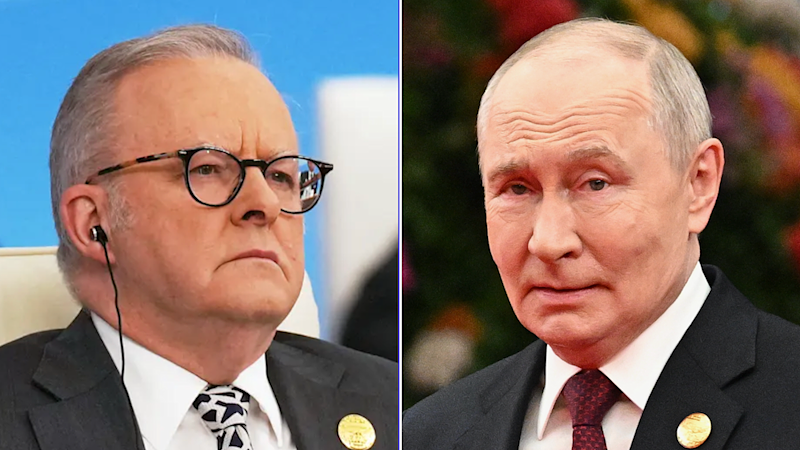
"I say very directly to President Putin: end your war, end it now."
Eight words. Spoken in Shenzhen, China, on November 19, 2026, straight across the table at the 33rd APEC Economic Leaders' Meeting. Most news outlets treated Australian Prime Minister Anthony Albanese's rebuke of Russian President Vladimir Putin like a standard diplomatic soundbite—a Western leader checking a moral box before moving on to trade talks.
They missed the real story.
Albanese didn't drop that line in a vacuum. He delivered it hours before US President Donald Trump, Chinese President Xi Jinping, and Putin sat down for an unprecedented trilateral meeting on the sidelines of the summit. And he delivered it inside a trade forum hosted by Beijing, while standing beside the very leaders whose backroom compromises could decide Ukraine's fate without Kyiv in the room.
When you look at the timing, the economics, and the domestic political blowback Albanese absorbed that same week, his confrontation looks very different. It wasn't theater. It was a calculated warning shot aimed at Washington and Beijing just as much as Moscow.
Why Albanese Confronted Putin Inside a Trade Summit
If you've followed Asia-Pacific diplomacy for any length of time, you know APEC isn't built for security showdowns. It's a voluntary economic forum designed to lower tariffs, streamline customs, and keep supply chains humming. Leaders usually stick to polite scripts about growth and connectivity.
So why bring a European land war into a Shenzhen conference hall?
Because in 2026, separating trade from security is a fantasy. Albanese spelled out the exact connection during Thursday's opening session. He pointed out that the conflicts in Ukraine and the Middle East are two of the biggest drivers of global trade disruption, fueling inflation and squeezing household budgets across the Pacific.
Look at the numbers behind Australia's stake in that room:
- APEC's sheer weight: The 21 member economies accounted for 61 percent of global GDP and 46 percent of world trade in 2025.
- Canberra's exposure: APEC partners absorb more than 73 percent of Australia's trade in goods and services, worth roughly AUD 933 billion in the 2024–25 financial year.
- Domestic jobs on the line: As Albanese reminded reporters in Shenzhen, one in four Australian jobs relies directly on international trade.
When Russia invades a neighbor, blocks grain corridors, and weaponizes energy markets, Australian exporters and consumers pay the bill. Albanese's message to the room was blunt. You can't talk about free trade while pretending territorial conquest has no price tag.
Russia is still a full APEC member. Moscow has even floated interest in hosting the summit in 2035. By calling Putin out to his face inside the leaders' chamber, Albanese refused to let Russia's seat at the table normalize its invasion. Engagement inside multilateral forums doesn't have to mean silence.
The Shadow of the Trump, Xi, and Putin Trilateral Talks
Here's the context that makes Albanese's timing so sharp.
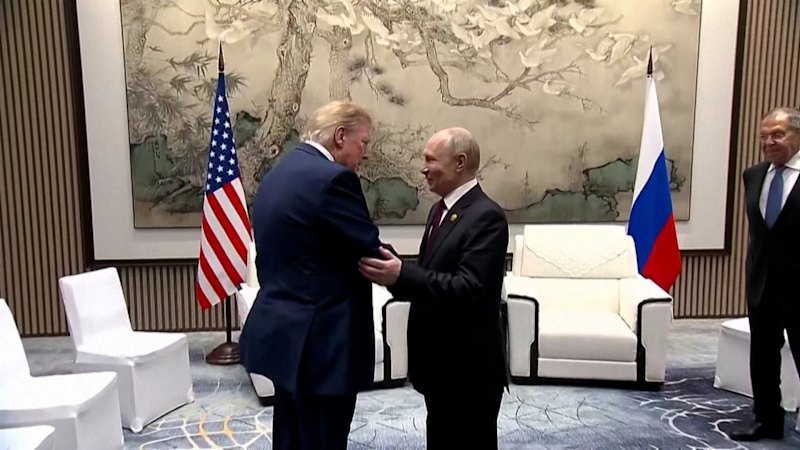
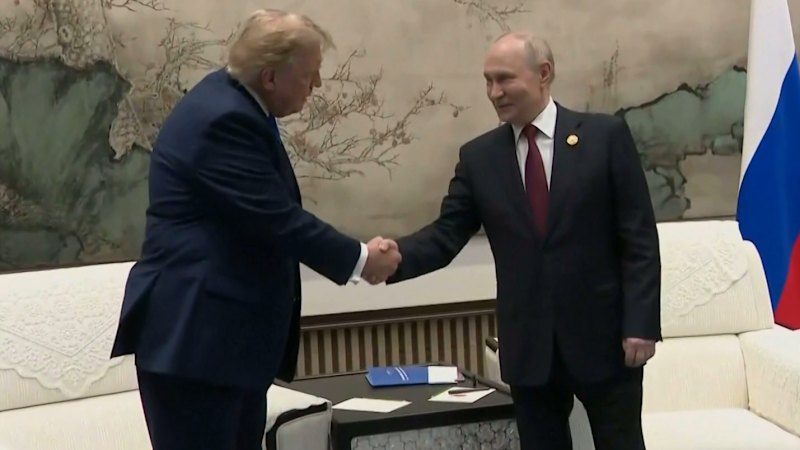
On the sidelines of the Shenzhen summit, Trump, Xi, and Putin held their first-ever three-way meeting. Ukraine—alongside the US-Israeli conflict with Iran—sat right at the top of their agenda.
For middle powers like Australia, a private bargain between Washington, Beijing, and Moscow triggers immediate alarm bells. Ukrainian President Volodymyr Zelenskyy has repeatedly warned against a modern "Yalta" scenario, where great powers carve up spheres of influence over the heads of smaller nations.
Think about the competing incentives in that trilateral room:
- Moscow wants permanence: Putin wants to freeze current battle lines and lock in territorial gains.
- Washington wants an exit: While the United States remains Ukraine's most consequential military backer, the scale and conditions of ongoing American support remain fiercely contested in US politics.
- Beijing wants leverage: China has avoided Western sanctions and kept economic lifelines open to Russia while marketing itself as a neutral broker for dialogue.
If those three leaders cut a deal that rewards border changes by force, every small and medium-sized country in the Indo-Pacific loses its main shield—international law. Australia doesn't have nuclear weapons or a massive standing army to deter aggression on its own. Canberra relies on predictable rules, maritime norms, and the principle that big states don't get to swallow smaller ones.
The next morning, when reporters pressed Albanese on his exchange with Putin, he doubled down. He confirmed he told Putin directly that the war had to stop immediately, adding that Australia stands firmly with President Zelenskyy and Ukrainians defending their national sovereignty. He wasn't just lecturing Putin. He was putting Trump and Xi on notice that US allies won't rubber-stamp a settlement that sells out Kyiv.
The Family Photo Controversy Nobody Ignored Back Home
Diplomacy rarely looks clean up close, and Albanese's week in Shenzhen proved it.
Hours before his speech, Albanese stepped onto the stage for the traditional APEC leaders' "family photo" alongside Xi, Trump, and Putin. The optics hit Canberra like a brick.
Australian opposition politicians and Greens MPs immediately slammed the Prime Minister for standing in the same frame as Putin. Their anger wasn't abstract. In July 2014, Russian-backed forces shot down Malaysia Airlines Flight MH17 over eastern Ukraine, killing all 298 people aboard—including 38 Australians. For many Australian families, Putin isn't just a geopolitical adversary. He's the leader shielding the perpetrators of a mass murder of Australian citizens.
Critics argued Albanese should have boycotted the photo session entirely. Albanese pushed back, explaining he joined the group shot out of respect for host Xi Jinping and the forum's protocol.
Honestly, this is where pure moral posturing runs straight into real-world statecraft. Had Albanese boycotted the host's ceremony, he would have antagonized Beijing right before his fifth bilateral meeting with Xi. China buys roughly a quarter of all Australian exports. After years of punishing Chinese trade tariffs on Australian wine, barley, coal, and lobster, Canberra has spent enormous diplomatic capital stabilizing that relationship.
Sitting out the photo would have burned goodwill with China for a symbolic gesture. Showing up—and then using the formal plenary session to tell Putin to his face to end the war—gave Albanese both the bilateral access Australia's economy needs and the public accountability Australians demanded.
Balancing Beijing Without Blinking on Values
Albanese's Friday morning sit-down with Xi showed how tightly Canberra is walking that line. He described the meeting as constructive and friendly, repeating his government's core mantra on China: engage where interests align, manage disagreements, and refuse to be defined by differences.
That balancing act stretches across the whole region. Earlier in the week at the ASEAN meetings in Manila, Albanese joined the first Quad leaders' summit in two years alongside the United States, Japan, and India. That group agreed on joint military exercises and deeper cooperation on critical minerals—moves clearly designed to counter Chinese dominance in Indo-Pacific security and supply chains.
Then he flew to Shenzhen, met Xi, backed APEC's work on human-controlled artificial intelligence, touted Australia's removal of over 1,000 nuisance tariffs, and rebuked Putin in front of the entire Asia-Pacific leadership.
That's what middle-power diplomacy actually looks like in 2026. You don't get to pick one lane. You deter coercion with security partners on Tuesday, protect trade flows in Beijing's backyard on Friday, and call out war crimes in between.
What to Watch Next in Pacific and Ukraine Diplomacy
Soundbites fade fast, so if you want to know whether Albanese's Shenzhen intervention actually shifts anything, track these concrete developments over the coming months:
- The aftermath of the Trump-Xi-Putin talks: Watch whether any proposed ceasefire framework demands Russian troop withdrawals—matching the March 2022 UN General Assembly resolution backed by 141 nations—or tries to pressure Ukraine into ceding occupied territory.
- Allied pushback against imposed settlements: Pay attention to joint statements from Australia, Japan, South Korea, and European partners. If middle powers stay unified around Ukrainian sovereignty and credible security guarantees, it becomes much harder for Washington or Beijing to force a lopsided deal on Kyiv.
- Russia's standing inside APEC: Keep an eye on Moscow's bid to host APEC in 2035. Whether member economies quietly shelve that proposal will tell you whether Albanese's argument—that aggression disqualifies a state from normal regional leadership—gained real traction behind closed doors.
- Australian trade and defense alignment: Watch how Canberra implements its new Quad critical minerals and military exercise commitments while preparing for the Annual Leaders' Dialogue with Chinese Premier Li Qiang. Any retaliation from Beijing will test how durable Australia's "manage our differences" formula really is.
Albanese said eight words to Putin in Shenzhen, and the cameras caught the headline. The real test now is whether the major powers sitting at that table listen—or try to cut a deal behind closed doors anyway.
Albanese Delivers Direct Message to Putin at APEC Summit
This clip captures Prime Minister Anthony Albanese's direct plenary remarks to Vladimir Putin in Shenzhen right ahead of the trilateral talks between the US, Russia, and China.