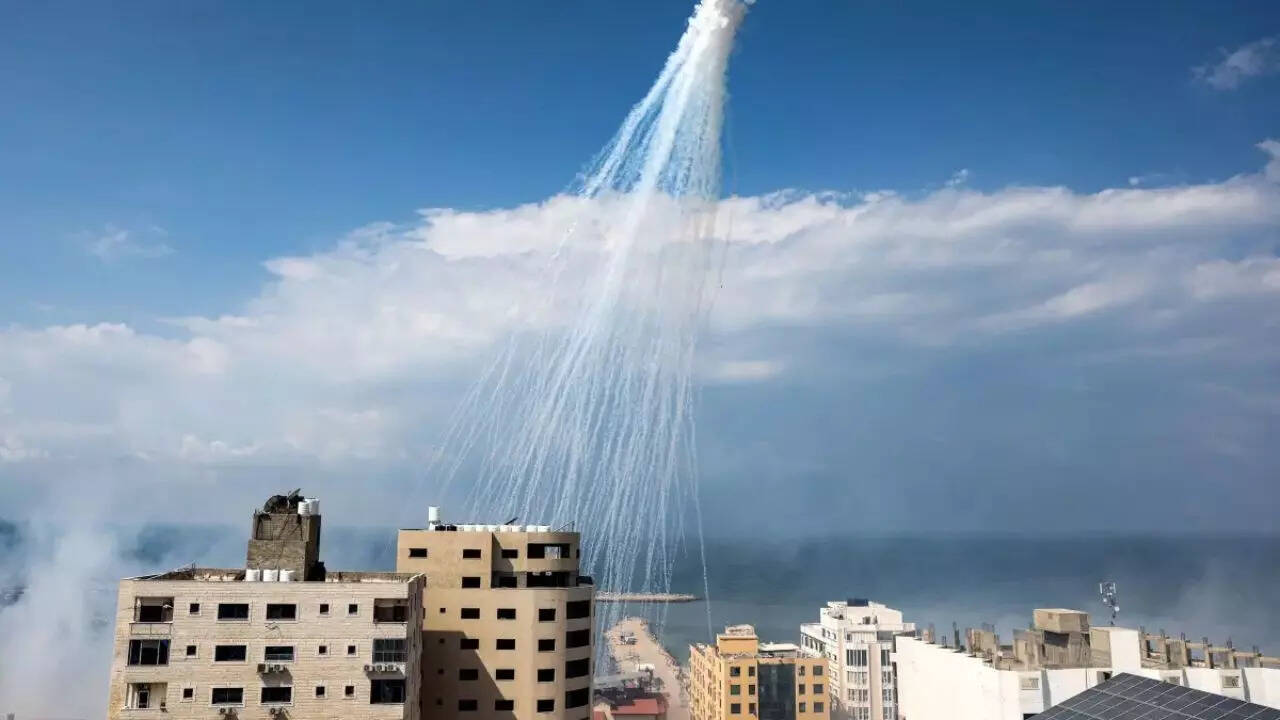
White phosphorus is not classified as a chemical weapon under international law, yet it remains one of the most feared substances on the modern battlefield. This distinction is more than a semantic quirk; it is a massive legal gap that allows militaries to deploy a substance capable of melting human tissue to the bone while claiming adherence to global treaties. Technically an incendiary agent, white phosphorus (WP) is primarily used for creating smoke screens, signaling, or "marking" targets. However, when these munitions explode over populated areas, the primary function of the weapon becomes secondary to its horrific biological impact.
The Chemistry of an Unstoppable Fire
To understand why white phosphorus is so devastating, you have to look at its chemical behavior. It is an allotrope of the element phosphorus that ignites spontaneously upon contact with oxygen. Once it starts burning, it reaches temperatures of up to 1,500 degrees Fahrenheit. It does not stop until it is completely consumed or deprived of oxygen. Read more on a related issue: this related article.
This creates a unique nightmare for field medics. If a fragment of WP hits a person, it will continue to burn through skin, muscle, and fat until it hits the bone. Because it is fat-soluble, it can seep deeper into the body, causing systemic poisoning and organ failure even if the initial burn area seems small. If a doctor tries to wash the wound with water, the chemical can sometimes continue to react. If they remove a piece of the phosphorus and leave it on a table, it may reignite the moment it dries.
The physical mechanics of the weapon are equally precise. Most modern militaries use air-burst munitions. A shell explodes high above the ground, dispersing felt wedges soaked in the chemical. These wedges fall in a wide arc, trailing thick white smoke. Anything—or anyone—unlucky enough to be under that arc becomes a target for a fire that cannot be easily extinguished. Additional analysis by The New York Times delves into comparable views on this issue.
The Legal Fiction of Intent
The Geneva Conventions and the Convention on Certain Conventional Weapons (CCW) are the primary frameworks governing these tools. Specifically, Protocol III of the CCW prohibits the use of incendiary weapons against civilians or against military targets located within "concentrations of civilians."
Here is where the veteran analyst sees the cracks in the system.
The military's defense almost always rests on intent. If a commander orders a white phosphorus strike to hide the movement of their tanks, the smoke is the "intended" effect. If civilians happen to be in the area and suffer burns, the military argues that these are "incidental" injuries, not the result of using a chemical weapon. Because WP is not designed primarily to kill through its chemical action on life processes (the definition of a chemical weapon under the CWC), it escapes the absolute bans placed on nerve agents like sarin or VX.
This loophole has been exploited in almost every major urban conflict of the last two decades. From the streets of Fallujah to the dense neighborhoods of Gaza and the bunkers of Eastern Ukraine, the "smoke screen" excuse provides a thin layer of deniability for what is effectively a scorched-earth tactic.
Beyond the Burn the Long Term Damage
We often focus on the immediate, visceral horror of the burns. But the impact of white phosphorus extends far beyond the emergency room. When these munitions are used in urban environments, they leave behind a toxic legacy that persists in the soil and water.
- Environmental Persistence: In anaerobic conditions, such as buried in deep silt or wet soil, white phosphorus can remain stable for years. If that soil is later disturbed by farming or construction, the chemical can reignite or leach into the water supply.
- Psychological Warfare: The sight of the "creeping white tentacles" of a phosphorus burst is a potent tool for displacement. It signals to a population that nowhere—not even deep inside a concrete building—is safe from the fire.
- Resource Strain: Treating a single phosphorus victim requires specialized irrigation, debridement, and often long-term intensive care. In a war zone where hospitals are already at a breaking point, a handful of WP casualties can paralyze a medical facility.
The Industrial Necessity Argument
Why hasn't the international community closed the loophole? The answer lies in the utility of phosphorus in the industrial-military complex. Beyond its use in smoke shells, phosphorus is a critical component in tracers, incendiary bombs, and even certain types of fertilizer and semiconductors.
Major powers are hesitant to sign a blanket ban because it would strip their infantry of one of the most effective tools for "obscuration." In a high-stakes firefight, being able to pop a smoke curtain instantly can save a platoon from an ambush. The military logic is cold: the tactical advantage of the smoke outweighs the humanitarian risk of the fire.
However, this logic fails to account for modern technology. We now have infrared-screening smoke and other non-incendiary alternatives that can hide troop movements without the risk of burning a city to the ground. The persistence of white phosphorus in military inventories isn't a matter of necessity; it's a matter of cost and legacy. Phosphorus is cheap to produce and the shells have a long shelf life.
A Shift in Accountability
The tide of international opinion is slowly turning, not through new treaties, but through better documentation. In the past, a military could deny using WP and it was difficult to prove otherwise. Today, every smartphone is a sensor. High-definition video of the characteristic "jellyfish" smoke patterns makes it impossible to hide the deployment of these weapons.
Human rights organizations are now using this digital trail to bypass the "intent" argument. They argue that if a weapon is known to have a high probability of causing indiscriminate harm in a dense urban area, the intent becomes irrelevant. The act of firing it becomes a de facto war crime.
This isn't just about changing the law; it's about changing the cost-benefit analysis for commanders on the ground. When the use of white phosphorus brings more diplomatic heat than tactical advantage, it will finally be relegated to the history books alongside mustard gas and phosgene.
Until then, the loophole remains open. It is a gap wide enough for a white-hot rain of fire to fall through, protected by the very laws meant to shield the innocent from the worst impulses of man.
Keep a close eye on the specific munitions being shipped in current aid packages to active conflict zones. Look for the designation M825A1. That is the 155mm projectile that carries the white phosphorus felt wedges. Its presence in a shipping manifest is a clear indicator that the "smoke screen" defense is being prepped for the next urban offensive.


