Deploying heavy mechanized forces at elevations exceeding 14,000 feet breaks the foundational mathematics of armored warfare. Along the Line of Actual Control (LAC) in Eastern Ladakh, the Indian Army faces a structural asymmetry: its primary mechanized inventory—consisting of 46-ton T-90S Bhishma and 41-ton T-72 Ajeya main battle tanks (MBTs)—was engineered for the plains of Punjab and the deserts of Rajasthan, not the oxygen-starved, vertical terrain of the Himalayas. While China rapidly fielded the Type 15 (ZTQ-15) light tank specifically optimized for the Tibetan plateau, India was forced to adapt legacy heavy armor to an environment that degrades engine output, snaps suspension components, and limits tactical mobility. Resolving this capability gap requires replacing the traditional heavy-armor doctrine with a high-altitude mobility framework centered on power-to-weight ratios, strategic airlift capacity, and modular active protection.
The Thermodynamic Penalty of Elevation
To understand why a 46-ton tank fails in Ladakh, you must examine the mechanics of internal combustion at extreme altitudes. Atmospheric pressure drops exponentially as elevation increases. At 15,000 feet—the baseline elevation for contested sectors like the Depsang Plains, Galwan Valley, and the Kailash Range—air density is roughly 55 to 60 percent of what it is at sea level. Meanwhile, you can explore similar developments here: What Actually Happens Inside the UK Prime Minister's Diwali Party at Downing Street.
Naturally aspirated diesel engines suffer a direct, linear loss of horsepower proportional to this drop in air density because there are simply fewer oxygen molecules available per intake stroke to combust fuel. Even turbocharged engines, such as the V-92S2 engine in the T-90S, hit mechanical and thermal limits. To compensate for thin air, the turbocharger must spin at significantly higher revolutions per minute (RPM) to compress enough oxygen into the cylinders. This generates extreme exhaust gas temperatures and accelerates turbine wear, while ambient freezing temperatures—often dropping below minus 30 degrees Celsius—thicken lubricants and degrade battery efficiency.
When a 46-ton tank loses 20 to 30 percent of its rated horsepower due to altitude, its power-to-weight ratio collapses. A platform designed to operate at 21 horsepower per ton drops to roughly 15 horsepower per ton. In practical terms, the tank becomes sluggish, struggles to climb gradients steeper than 20 degrees, and risks transmission burnout during sustained low-gear operations. To understand the complete picture, check out the detailed analysis by The Guardian.
The Infrastructure and Mobility Bottleneck
The second limitation of heavy armor in the Himalayas is logistical and structural rather than mechanical. The physics of ground pressure and bridge classification dictate where a tank can go before a single shot is fired.
Eastern Ladakh is defined by narrow river valleys, scree slopes, and high mountain passes (such as Chang La and Khardung La, which exceed 17,500 feet). Moving a 46-ton MBT from the staging bases in Leh to forward deployment zones requires specialized Heavy Equipment Transporters (HETs). Navigating hairpin bends on mountain roads with a combined vehicle weight exceeding 70 tons slows strategic reinforcement to a crawl and exposes convoys to interdiction.
Once off the road network, infrastructure limits take over:
- Bridge Classification Limits: Most legacy Bailey bridges and modular spans erected by the Border Roads Organisation (BRO) in forward sectors were historically rated for Class 40 or Class 50 loads. Moving T-90s across these waterways required rapid, resource-intensive engineering upgrades to Class 70 standards, or forced tanks to ford freezing rivers—a high-risk maneuver when water levels fluctuate due to glacial melt.
- Ground Pressure Dynamics: Heavy tanks exert high nominal ground pressure, causing them to sink in soft alluvial soil near riverbeds or lose traction on loose scree and permafrost.
- Airlift Constraints: Strategic mobility relies on the Indian Air Force’s C-17 Globemaster III fleet. A C-17 has a maximum payload capacity of roughly 77 tons. It can carry only one T-90S tank per sortie, requiring massive airlift cycles to build up a single armored regiment (typically 45 tanks). A light tank weighing under 25 tons allows a single C-17 to transport two vehicles simultaneously, instantly doubling strategic airlift throughput during a crisis.
The Three Pillars of the Light Tank Solution
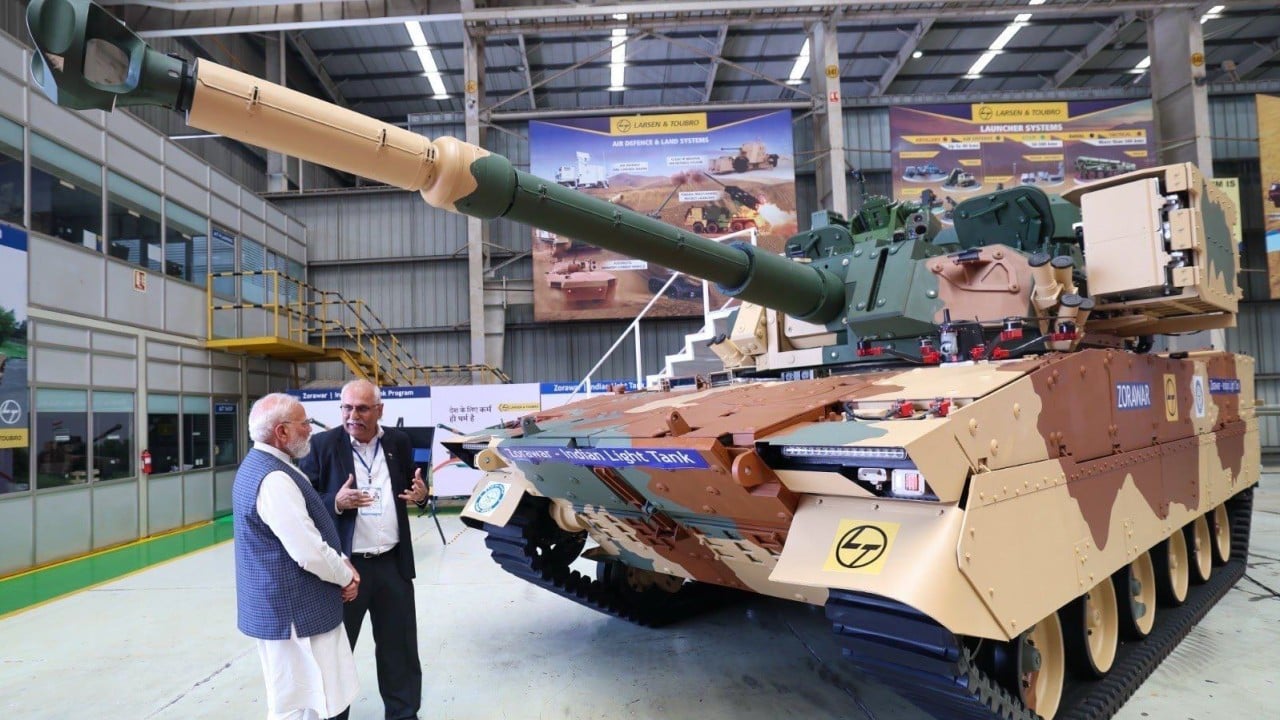
To counter China’s deployment of the 33-to-36-ton Type 15 light tank, India initiated Project Zorawar—a joint development effort between the Defence Research and Development Organisation (DRDO) and Larsen & Toubro (L&T) to field an indigenous light tank under 25 tons. Evaluating the viability of this platform requires breaking down the design trade-offs across three competing engineering pillars: mobility, lethality, and survivability.
1. High-Altitude Power-to-Weight Optimization
The primary metric for Himalayan armor is not maximum top speed on a paved road, but torque and acceleration at 16,000 feet. By capping vehicle weight at 25 tons and pairing it with a high-output, multi-stage turbocharged diesel engine (such as the Cummins 750–1,000 hp powerpack selected for the Zorawar prototype), engineers target a baseline power-to-weight ratio exceeding 30 horsepower per ton at sea level. Even after accounting for the altitude-induced power loss at 15,000 feet, the platform retains roughly 22 to 24 horsepower per ton. This restores the climbing agility, pivot-steering responsiveness, and cross-country speed that heavy MBTs lose in thin air.
2. Modular Lethality Over Brute-Force Penetration
A common misconception in armored warfare is that a lighter tank must carry a drastically weaker gun. While a 25-ton chassis cannot absorb the recoil impulse of a high-pressure 125mm smoothbore cannon firing full-charge Armor-Piercing Fin-Stabilized Discarding Sabot (APFSDS) rounds without risking structural fatigue or rollovers, modern metallurgy and ammunition design bypass this constraint.
A light tank utilizing a low-recoil 105mm rifled or smoothbore gun—such as the John Cockerill 3105 turret integrated on the Zorawar—achieves operational parity in mountain warfare through two mechanisms:
- Elevation Angles: Heavy MBTs typically have limited main gun elevation (around +14 to +18 degrees), making it impossible to engage enemy bunkers or infantry entrenched on ridgelines towering above a valley floor. Modern light tank turrets offer gun elevations up to +42 degrees, transforming the vehicle into a direct-fire mountain assault gun.
- Gun-Launched Anti-Tank Guided Missiles (ATGM): Rather than relying solely on kinetic energy penetrators, which lose velocity over distance and require heavy gun breeches, a 105mm gun can fire tandem-warhead ATGMs out to 4 or 5 kilometers. Because chemical energy warheads (HEAT) rely on explosive shaped charges rather than projectile velocity, a 25-ton light tank retains the lethality required to destroy a 46-ton heavy MBT at long range.
3. Active Survivability Replacing Passive Steel
The fundamental trade-off of a 25-ton weight ceiling is the elimination of thick composite and rolled homogeneous armor (RHA). A light tank cannot survive a direct hit from a 125mm kinetic penetrator or a heavy anti-tank missile using passive hull armor alone. Attempting to bolt on heavy Explosive Reactive Armor (ERA) blocks pushes the vehicle back into the 35-ton class, negating its airlift and bridge-crossing advantages.
Survivability must therefore shift from absorbing hits to preventing them entirely. This relies on an integrated defensive suite:
- Signature Management: Thermal camouflage nets, infrared-suppressing exhaust systems, and low-profile hulls reduce detection probability against electro-optical sensors and thermal sights across barren, treeless terrain.
- Hard-Kill and Soft-Kill Active Protection Systems (APS): Radar-guided APS launchers intercept incoming rocket-propelled grenades (RPGs) and ATGMs meters away from the hull, providing the defensive equivalence of heavy armor without the weight penalty.
- Unmanned Aerial Integration: Tethering loitering munitions and reconnaissance drones directly to the tank’s fire-control system allows the crew to detect and neutralize enemy tank-hunter teams hiding behind reverse slopes before entering their line of sight.
The Strategic Asymmetry with the Type 15
Comparing India’s emerging 25-ton light tank concept directly against China’s Type 15 reveals two distinct operational philosophies shaped by differing geography.
China controls the Tibetan plateau—a relatively flat, elevated tableland with extensive rail and high-speed highway networks running parallel to the border. Because Chinese logistics rely on heavy rail transport rather than tactical airlift to move armor to the plateau, the People's Liberation Army (PLA) accepted a higher weight ceiling for the Type 15. Weighing 33 tons in its base configuration and up to 36 tons with full add-on armor packages, the Type 15 is technically a medium-light hybrid. It sacrifices dual-carriage tactical airlift capability in exchange for heavier passive frontal protection and a hydropneumatic suspension system that allows the tank to adjust its ride height on rocky terrain.
India faces the exact opposite geographic reality. The Indian side of the LAC is a steep, vertical ascent from the plains up through narrow mountain passes. India cannot rely on plateau rail networks; it must push armor up the mountain wall and reinforce sectors across valleys via airlift. Consequently, India cannot afford a 36-ton compromise. Keeping the platform strictly at or below 25 tons is an operational necessity dictated by C-17 payload limits, Class 40 bridge ratings, and steep approach gradients.
Operational Limitations and Doctrine Risks
Fielding a light tank fleet solves the mobility bottleneck, but it introduces severe tactical vulnerabilities if commanders deploy these vehicles improperly. No engineering solution eliminates the core physics of armored combat.
First, light tanks cannot win attritional tank-on-tank slugfests in open terrain. In sectors like the Depsang Plains or the Chushul valley, where the terrain flattens out into wide corridors capable of supporting multi-brigade armored maneuvers, a 25-ton vehicle will be outgunned and out-armored by T-90s or China’s heavy Type 99A tanks if forced into a frontal duel. Light tanks must operate as cavalry—using speed, superior elevation angles, and long-range missiles to flank, ambush, and dominate high ridgelines—while heavy MBTs hold the flat valley floors.
Second, logistical complexity increases. Introducing a new 25-ton platform alongside T-72s and T-90s creates a third distinct supply chain in one of the harshest logistical environments on earth. If the light tank uses a Western engine, a European turret, and an Indian chassis, maintaining spare parts, specialized ammunition (105mm versus the legacy Russian 125mm standard), and diagnostic tooling at 15,000 feet will strain forward maintenance echelons.
Third, the proliferation of low-cost First-Person View (FPV) drones and top-attack loitering munitions threatens all armored vehicles equally, regardless of weight class. A 25-ton light tank has thinner roof armor than a 46-ton MBT, making it acutely vulnerable to top-down drone strikes unless every platoon is organically paired with short-range electronic warfare (EW) jammers and anti-drone kinetic interceptors.
The Deployment Blueprint
To maximize the return on investment for a high-altitude light tank fleet, procurement and doctrinal integration must follow three strict operational rules:
- Enforce the 25-Ton Hard Ceiling: Resist the bureaucratic temptation to add modular armor packages that push the vehicle over 28 tons. The entire strategic value of the platform rests on fitting two units inside a C-17 transport and crossing existing Class 40 mountain bridges without engineering delays. Survivability upgrades must come exclusively from lightweight Active Protection Systems and electronic countermeasures, not steel plates.
- Standardize Fire-Control and Drone Integration at the Platoon Level: Never deploy light tanks as isolated steel boxes. Every troop of three to four light tanks must operate with an integrated organic drone detachment—comprising both tethered ISR (Intelligence, Surveillance, and Reconnaissance) quadcopters to see over ridgelines and loitering munitions to strike enemy ATGM teams before the tanks expose their hulls.
- Establish a Dual-Tier Himalayan Armored Doctrine: Permanently bifurcate armored deployments along the LAC by terrain profile. Concentrate legacy T-90S and T-72 regiments in flat, wide valley corridors (such as Chushul and Depsang) where their heavy frontal armor and 125mm cannons remain decisive. Reallocate the 25-ton light tank regiments exclusively to vertical, road-constrained, and river-segmented sectors (such as Tawang in Arunachal Pradesh and the rugged sub-sectors of Eastern Ladakh) where speed, high-angle fire, and rapid air-mobility dictate battlefield control.