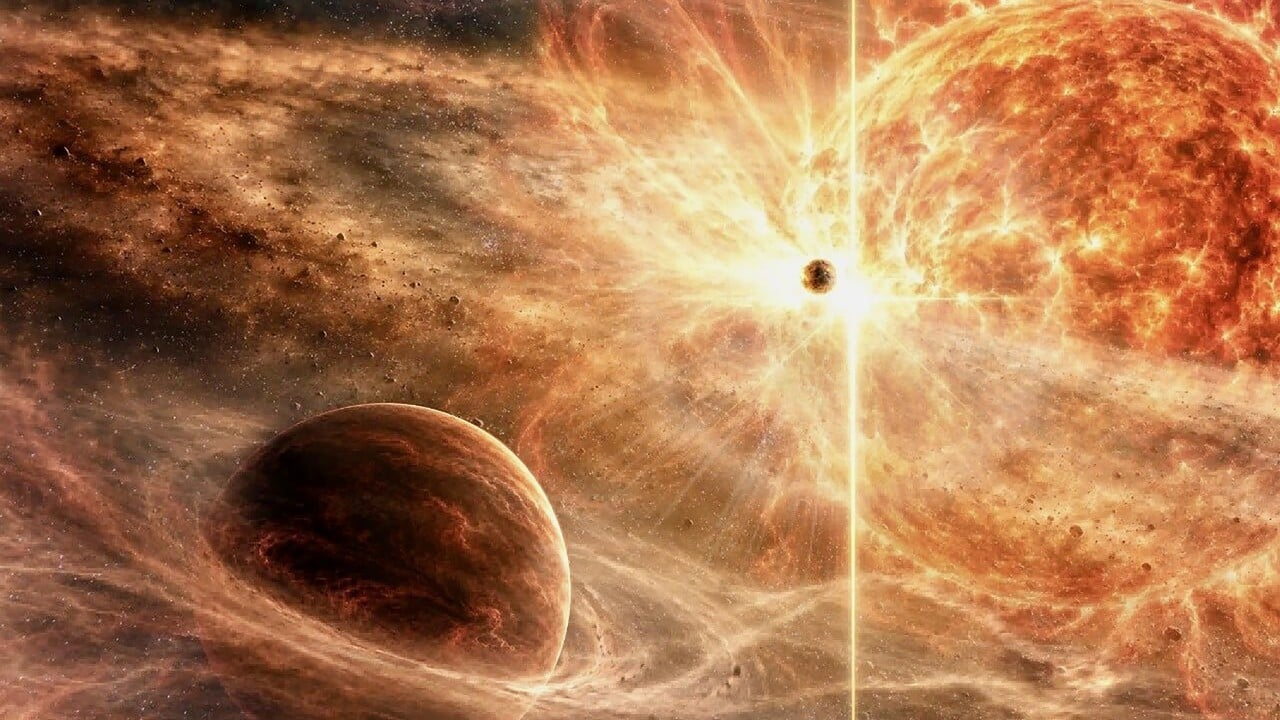
Planets orbiting inside the space their stars once filled shouldn't exist. Yet a team led by astronomers at Yunnan University in China has identified three companions circling red clump giant stars that already swelled up and shrank back, forcing a rethink of how planetary systems survive stellar old age.
Here's the twist that makes this discovery so hard to ignore. The planets themselves aren't brand-new finds. Astronomers spotted them earlier by tracking the tiny gravitational tugs they put on their host stars. What's new is reading the internal vibrations of those aging stars—called starquakes—using data from NASA's Transiting Exoplanet Survey Satellite, or TESS, and realizing the stars had already passed their peak bloat without wiping out their close-in companions.
Published in the Proceedings of the National Academy of Sciences by Sheng-Bang Qian, Lin, and their colleagues, the study focuses on 24 Boötis b (24 Boo b), HD 12648 b, and TYC 4282-605-1 b. Only one comparable survivor, 8 Ursae Minoris b reported in 2023, had previously stood out as a major puzzle of this kind. Adding three more turns a lone oddball into a genuine pattern that tests our models of stellar evolution—and raises uncomfortable questions about what happens to Earth when our own Sun eventually grows old.
How a Swelling Star Usually Dooms Close Worlds
To see why these survivors matter, you have to look at what happens when a star like our Sun burns through the hydrogen fuel in its core. Once core fusion runs out, the core contracts while the outer layers balloon outward, turning the star into a massive, cooler red giant.
For worlds tucked in tight, that expansion is brutal. A bloated star doesn't just turn up the heat. Its sheer size can swallow inner planets outright, and even before physical contact happens, strong gravitational tides can sap a planet's orbital energy and drag it inward toward destruction. Classical models predict that planets orbiting inside roughly 1 astronomical unit—the average distance between Earth and the Sun—around a Sun-like star face severe peril during this phase.
A 2025 TESS survey underscored that danger, finding that close-in giant planets become noticeably scarcer as host stars begin expanding. That makes total sense on paper. Big stars grow big, drag nearby worlds down, and clear the neighborhood.
Except nature keeps finding loopholes.
Listening to Starquakes to Catch Stars Red-Handed
If you just point a standard camera or spectrometer at two aging stars, they can look frustratingly similar on the surface. Both might look like big, cool orange giants. One could still be swelling for the first time, while the other has already reached the tip of its red giant expansion, shrunk back somewhat, and ignited helium fusion in its core—a stage astronomers call a red clump giant.
You can't tell which movie you're watching from a single snapshot of the outside. You have to listen to the inside.
That's where asteroseismology comes in. Stars constantly ring with acoustic waves that cause microscopic flickers in their brightness. By analyzing TESS light curves for those subtle starquake oscillations, the Yunnan University team determined that all three host stars are red clump giants. In plain terms, each star has already gone through its dramatic swelling phase—and its companion is still there.
When the researchers reconstructed how large each star likely grew at its maximum red giant radius, they found a striking mismatch. The planets' current orbits sit inside the volume of space their stars once occupied. By standard expectations, at least two of them—and potentially all three depending on model assumptions—should have been engulfed.
Three Defiant Companions and Their Odd Orbits
Each of the three systems brings its own quirk to the survival puzzle, and honestly, the details show just how varied these outcomes can be.
24 Boötis b is the headliner. Located roughly 308 light-years away in the constellation Boötes, its host star is visible to the naked eye on a dark night, carries about 1.5 times the mass of the Sun, and now spans roughly 10 times the Sun's width. The companion orbits at about 0.183 to 0.19 astronomical units—less than half of Mercury's distance from our Sun—completing a circuit every 30 days. Its minimum mass is roughly 0.76 to 0.79 times that of Jupiter, making it the closest known companion to a red clump giant. Across every stellar model tested by the team, its orbit lies inside the star's past maximum reach.
HD 12648 b, sitting about 594 light-years away, orbits at roughly 0.516 astronomical units with an orbital period around 133 to 134 days and a minimum mass near 2.5 Jupiter masses. Here, model sensitivity becomes clear. Depending on how stellar models treat convection—the churning motion that moves heat through a star's outer envelope—the engulfment calculation shifts. Under one convection setting, the likelihood of past engulfment drops from near certainty to roughly 43 percent. That nuance matters because it reminds us that stellar interiors aren't settled arithmetic.
TYC 4282-605-1 b lies roughly 1,500 light-years away, circling at about 0.489 astronomical units every 102 days. Like 24 Boo b, its orbit falls inside the star's maximum former radius across the tested models. It also carries a label check. Because radial-velocity wobble measurements only give a minimum mass unless the orbit's tilt is known, its minimum mass of about 14.3 Jupiter masses puts it right around or above the roughly 13-Jupiter-mass threshold where deuterium fusion begins—meaning it may actually be a brown dwarf rather than a strict planet. Calling everything in the headline a "planet" is catchy, sure, but astronomers draw that mass line for a reason.
How Could a World Dodge Being Swallowed?
Saying a planet survived is one thing. Explaining how it pulled off the escape is where things get messy and speculative.
The researchers point to a few plausible escape routes rather than claiming a single smoking gun. One possibility involves stellar mergers or binary interactions. If a star once had a companion star or merged with another stellar body, that history could have altered how the star expanded or shed mass, changing the danger zone over time.
Another idea involves sacrificing an inner world. If a star swallowed an inner planet first, angular momentum exchange or orbital reshuffling might have pushed a surviving outer companion into a safer or altered path. A third possibility is that a companion somehow slipped free or shifted orbits as the star shrank back from its peak size.
Notice what the authors themselves emphasize. These scenarios are plausible pathways, not proven histories reconstructed with certainty in this paper. In exoplanet science, jumping from "the orbit is inside the old radius" to "therefore X happened" is a classic trap. Good science separates the observation from the hypothesis.
Even measurements of the stars themselves carry caveats. For 24 Boötis, independent interferometric observations with the CHARA array align with the starquake size estimate, yet differ on mass, and the team notes that formal error bars don't capture every potential systematic uncertainty. Still, the broader conclusion—that these hosts are helium-burning red clump stars—stands on solid ground.
What This Means for Earth and the Dying Sun
Whenever headlines mention red giants swallowing planets, people immediately ask the same question: What about Earth?
Billions of years from now, our Sun will exhaust its core hydrogen, swell into a red giant, and eventually settle down as a white dwarf after shedding its outer layers. Mercury and Venus are widely expected to be consumed. Earth sits right on the razor's edge. Some widely cited models—such as work by Schröder and Smith—suggest even Earth could be engulfed as tidal drag pulls it inward while the Sun expands. Other researchers note that orbital changes as the Sun loses mass might give Earth a narrow escape.
Vincent Van Eylen of University College London, who worked on the 2025 TESS red-giant planet survey, put the stakes in perspective: Earth might physically survive the Sun's red giant phase, yet life on Earth almost certainly wouldn't. Intense heat and radiation would strip away habitability long before the star's surface reached 1 astronomical unit.
Still, discoveries around red clump stars—and intact giant planets like WD 1856 b found orbiting a white dwarf—show that planetary systems don't always end as neatly as our simplest textbooks suggest. Even if Earth doesn't make it, studying close companions around post-red-giant stars helps refine the tidal and convective physics that govern a system's final act.
Practical Ways to Follow This Research Yourself
If you want to go beyond surface-level news recaps and track how this puzzle evolves, you don't need observatory access or a PhD in astrophysics.
- Look up the primary paper and preprint. Search for "The Survival Paradox of Close-In Planets Orbiting Red Clump Giants" by Lin, Qian, and colleagues in the Proceedings of the National Academy of Sciences (or on arXiv) to read how they compare maximum stellar radii against current orbital separations.
- Check the NASA Exoplanet Archive. Pull up entries for 24 Boo b, HD 12648 b, and TYC 4282-605-1 b to compare reported orbital semi-major axes, periods, and minimum masses (
M sin i). - Spot 24 Boötis in the night sky. Because 24 Boötis is bright enough to be seen with the unaided eye under dark skies in Boötes, use a sky chart app to locate the constellation and ground an abstract astrophysics paper in a real point of light.
- Watch upcoming TESS and asteroseismology follow-ups. Pay attention to studies combining starquake analysis with orbital inclination constraints—especially for massive companions near the 13-Jupiter-mass mark—to see which survivors are true planets and which are heavier substellar companions.


