The rain in the Pacific Northwest doesn’t just fall. It searches. It finds the gaps in your jacket, the cracks in the sidewalk, and the hidden channels of the earth. On a Friday night in autumn, under the humming halogen glow of a suburban high school stadium, that rain is doing something else. It is washing a chemical ghost out of the ground.
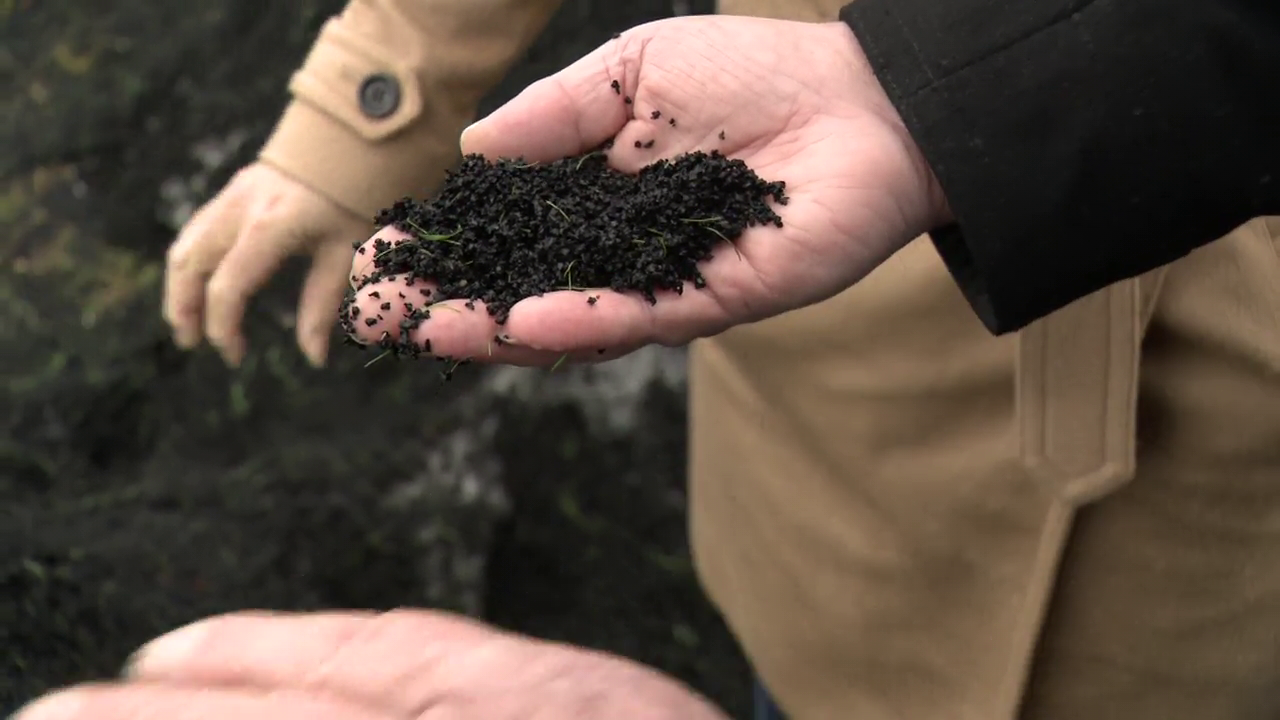
Ten-year-old Leo slides across the turf to make a tackle. He rises with black rubber crumbs clinging to his damp shins. He brushes them off, oblivious. Above him, the scoreboard flickers. Beneath him, a silent, molecular migration has begun.
We built these fields to save money. We built them so the season would never end, so the mud wouldn't claim the jerseys, and so the maintenance crews wouldn't have to mow. We thought we were outsmarting nature. Instead, we’ve wired a direct line from our playgrounds to the graves of one of the most iconic species on the planet.
The University of British Columbia recently confirmed what many scientists had long feared. The very surface we celebrate for its durability is a factory for a specific, lethal toxin called 6PPD-quinone. It doesn’t stay on the field. It hitches a ride on the rainwater, slipping through the drainage pipes and into the creek beds where the Coho salmon are trying to come home.
The Chemistry of a Ghost
To understand why a Coho salmon suddenly rolls onto its back and dies within hours of entering a stream, you have to look at the tires on your car. 6PPD is an antioxidant. Its job is to keep your tires from cracking and degrading under the stress of the road. It is a preservative for rubber.
But when 6PPD meets the ozone in the air, it transforms. It becomes 6PPD-quinone.
For years, we knew this chemical was shedding off our highways. Every time it rained, the "road grime" washed into the rivers, and the salmon died. We called it Urban Runoff Mortality Syndrome. It sounded clinical. Distant. But then we started grinding those same tires into billions of tiny black pellets to cushion our children’s soccer games.
The UBC study found that artificial turf fields—specifically those using crumb rubber infill—are significant sources of this toxin. They aren't just passive slabs of plastic. They are active contributors to the chemical load of our waterways.
Imagine a tea bag. When the rain hits the turf, the field acts like a giant, stadium-sized steeper. The water filters through the rubber crumbs, picks up the 6PPD-quinone, and carries it out through the perforated pipes designed to keep the field dry. This "tea" is a concentrated neurotoxin for the Coho.
The Invisible Stakes
It happens fast. A Coho salmon enters a freshwater stream, fueled by a primal urge to spawn. It has survived years in the open ocean, dodging orcas and seals. It is a silver muscle of pure determination.
Then it hits a plume of runoff from a nearby sports complex.
Within minutes, the fish loses its sense of direction. It gasps at the surface. It circles aimlessly. The 6PPD-quinone crosses the blood-brain barrier and disrupts the vascular system. The fish doesn't just die; it suffocates in the very water it needs to live. Sometimes, 100% of a returning run can be wiped out in a single afternoon of heavy rain.
We often talk about conservation as a battle of "us versus them"—development versus the wilderness. But this is different. This is a design flaw in our own backyard. We chose a product for its convenience, never realizing it was a chemical weapon aimed at the heart of the ecosystem.
The scale is staggering. There are thousands of these fields across North America. Each one is a potential point-source of pollution. We’ve traded the muddy knees of our children for the survival of a species that defines the spirit of the West.
The Human Element
Consider the parents standing on the sidelines. They see a safe, level playing surface. They see a place where their kids can burn off energy without the risk of a twisted ankle on a gopher hole. They don't see the 6PPD-quinone.
But they do see the salmon. They take those same children to the local hatchery or the neighborhood creek to watch the "miracle of the return." They point at the red-streaked fish struggling upstream and talk about the beauty of the life cycle. They don't realize that the very shoes they are wearing, and the field they just left, are the reasons those fish won't make it to the next bend in the river.
The guilt isn't theirs to bear alone. It belongs to a system that prioritizes "low maintenance" over ecological integrity. We were told these fields were recycled, a way to keep tires out of landfills. It was marketed as an environmental win.
It was a lie of omission.
A Path Forward
The solution isn't as simple as ripping up every field tonight. That’s a billion-dollar impossibility. But the UBC research gives us a map.
First, we have to stop the bleeding. There are alternative infills—cork, wood fiber, or even specialized sands—that don't contain tire rubber. They cost more. They require more care. But they don't kill fish.
Second, we have to fix the plumbing. If a field already exists, we can't let its "tea" reach the creek. We need sophisticated filtration systems, rain gardens, and bioswales that can catch the 6PPD-quinone before it leaves the property. We have to treat our sports complexes like industrial sites, because, chemically speaking, that’s exactly what they are.
Third, we have to rethink our relationship with "perfect." We’ve become obsessed with surfaces that never change, never fade, and never die. But a surface that cannot die is often a surface that does not support life.
The Last Return
The Coho salmon is a bellwether. It is telling us that our chemistry is leaking. It is a warning that the "away" we throw things to—the landfill, the gutter, the drain—doesn't actually exist. Everything is connected by the water.
Tonight, the rain will fall again. It will hit the roof of the high school, the asphalt of the parking lot, and the bright green plastic blades of the football field. It will gather in the shadows, picking up the invisible ghosts of our industry.
Somewhere downstream, a silver fish is waiting for the signal to move. It is waiting for the cool, clean rush of the storm to guide it home. It has no way of knowing that the water bringing it life is also carrying the very thing that will end it.
We are the ones holding the bottle of poison. We are also the only ones who can put the cap back on.
The scoreboard lights finally dim. The players go home to warm showers. The stadium is silent, save for the rhythmic dripping of the drainage pipes. In the dark, the water continues its long, toxic journey toward the sea, carrying the cost of our convenience one drop at a time.