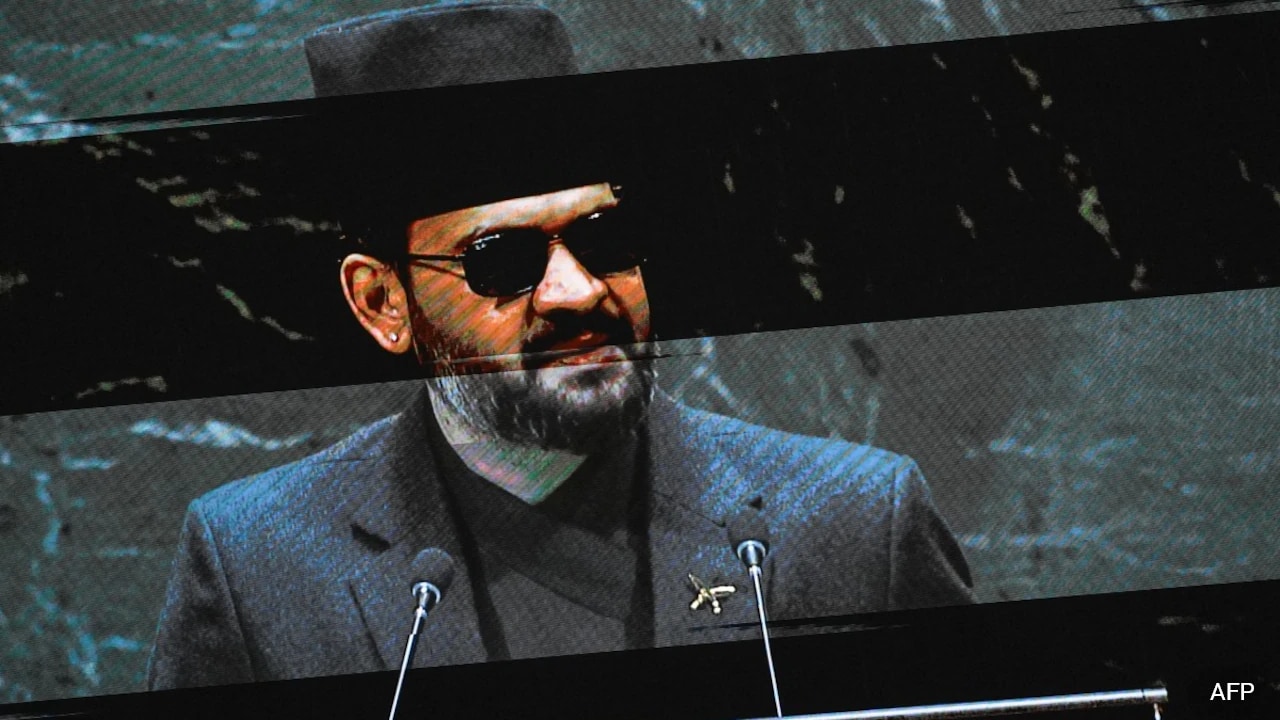
When Nepal Prime Minister Balendra Shah stepped to the podium at the United Nations General Assembly, the immediate focal point for international media was not the substance of his address, but his face. Specifically, his signature dark sunglasses. While mainstream commentary trivialized the accessory as a quirky remnant of his past life as an underground rapper, treating it as a superficial fashion choice or an eccentric diplomatic breach, a structural examination of modern political signalling reveals a calculated framework of identity preservation, populist messaging, and strategic disruption.
The utility of a persistent visual trademark in contemporary statecraft operates on precise psychological and communicative mechanics. Political actors continuously battle attention scarcity. Traditional diplomats rely on institutional uniforms—subdued bespoke suits, predictable ties, and standardized body language—designed to blend into the bureaucratic architecture of multilateral forums. This uniformity lowers cognitive friction for international bodies, but it also strips individual agency and erodes memorability.
Shah’s refusal to abandon his dark sunglasses, traditional black Nepali hat, and black blazer subverts this dynamic. By maintaining his domestic political "uniform" on the global stage, he rejects assimilation into elite international standards. The eyewear functions as an anchor of authenticity for a domestic constituency that rejected traditional political parties in favor of an independent movement. It signals that the wearer answers to an internal electorate rather than external diplomatic expectations.
Beyond branding, the functional mechanics of political communication require a mechanism to control access and project authority. Eye contact is a primary tool of diplomatic appeasement and vulnerability. By obscuring his eyes, Shah neutralizes the traditional micro-expressions that international counterparts and media analysts use to gauge hesitation, anxiety, or deference. This creates an asymmetric information environment. The speaker observes the room without granting the room reciprocal emotional access. While his office offered a medical explanation regarding light sensitivity, the structural effect remains an impenetrable visual barrier that reinforces his anti-establishment positioning.
This visual disruption served as the delivery system for a substantive economic and geopolitical critique. When stripped of commentary about his appearance, Shah’s address targeted the foundational inefficiencies of international climate finance and regional security frameworks. Two core arguments structure his critique of the global order.
First, he identified a structural asymmetry in resource allocation: the disparity between logistics for conflict versus logistics for survival. His assertion that the international system maintains flawless logistics for war while sustaining broken logistics for food and climate mitigation highlights a profound misallocation of global capital. For climate-vulnerable states, this translates into an inverted cost function. Nepal contributes a negligible fraction of global greenhouse gas emissions yet absorbs catastrophic adaptation and recovery costs.
Second, Shah attacked the bureaucratic friction of existing mechanisms such as the Loss and Damage Fund and the Global Environment Facility. His critique noted that current disbursement architectures demand administrative burdens—symbolized by his remark about completing dozens of forms while a house burns—that fundamentally mismatch the velocity of environmental crises. Climate shocks do not respect administrative delays or international borders; glacial melt and transboundary floods operate entirely outside the control of immigration counters and bureaucratic filing systems.
The strategic alternative he proposed, however, exposes the limits of rhetorical diplomacy when confronted with realpolitik. Shah called for the Hindu Kush Himalaya region to become a laboratory of international cooperation, specifically urging coordinated data sharing and joint environmental management between regional powers. Yet this proposal collides with structural geopolitical friction. The Himalayan frontier remains one of Asia's most sensitive fault lines, characterized by acute strategic competition between India and China. These states historically treat hydrological and ecological data as matters of national security rather than shared public goods. Recommending open cooperation across a heavily militarized and mutually distrustful border ignores the zero-sum security dynamics that govern bilateral relations in South Asia.
The juxtaposition between Shah's tactical mastery of domestic branding and the systemic constraints of international diplomacy exposes a core tension for populist leaders operating on the global stage. Visual non-conformity and sharp rhetoric generate domestic political capital and command temporary international attention. However, translating symbolic disruption into durable multilateral policy requires institutional leverage that a small, landlocked state cannot easily command through speech acts alone.
The strategic play for developing economies facing disproportionate climate burdens is clear. Rhetorical framing must transition from moral appeals to hard-nosed economic leverage, tying regional stability and ecological collapse directly to the security interests of major powers. Until climate vulnerability is priced as an immediate threat to regional security rather than a distant humanitarian concern, systemic frameworks will continue to prioritize bureaucratic delay over rapid capital deployment.


