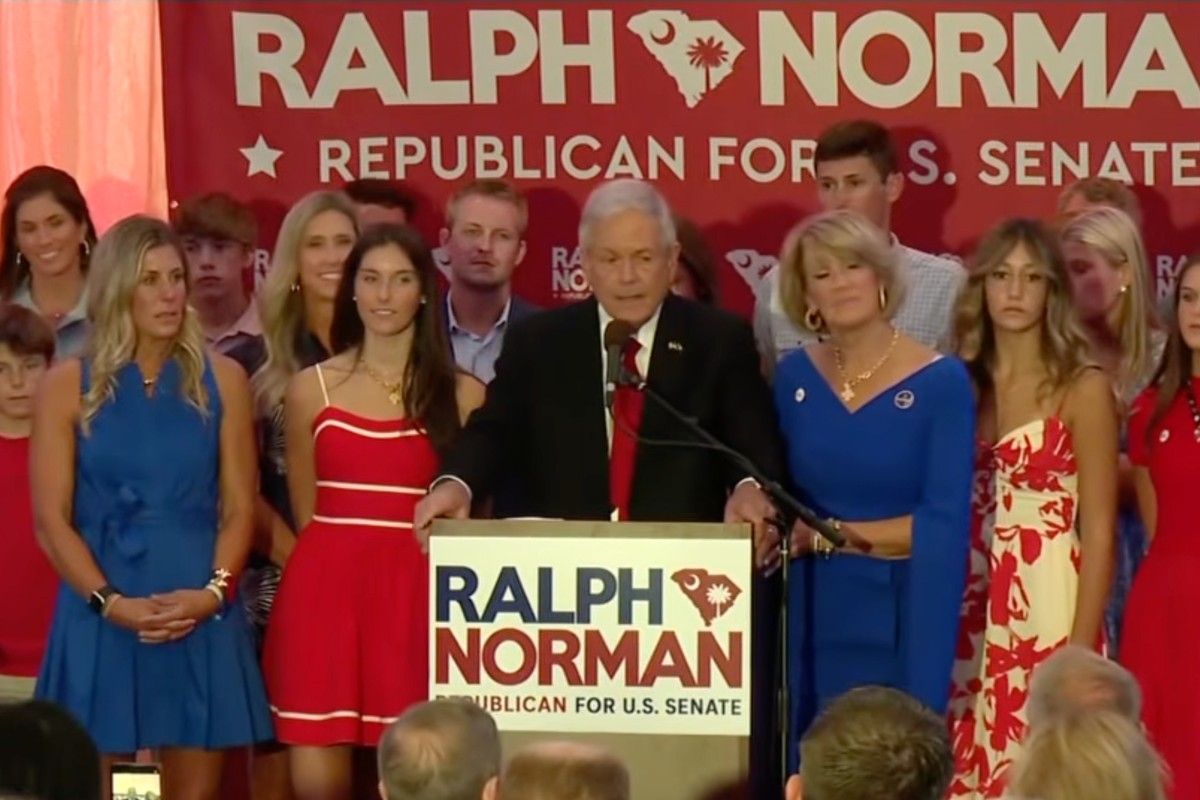
Political behavior models frequently fail when national brand loyalty collides with localized economic and social friction. During a recent concession speech in South Carolina featuring outgoing Representative Ralph Norman, an audible wave of negative crowd feedback erupted at the mention of Donald Trump. Observers consuming surface-level media narratives categorized this reaction as an anomalous local glitch or a sudden ideological defection. Analyzing this event through structured behavioral and political frameworks reveals a distinct structural friction point: the divergence between centralized party brand utility and localized voter utility functions.
The Dual-Market Dynamic of Intraparty Politics
Political candidates operate within a dual-market structure. On the supply side, they require national party infrastructure, donor networks, and brand alignment to clear primary hurdles and secure institutional backing. On the demand side, they rely on localized precinct sentiment, distinct demographic alignments, and specific issue satisfaction.
When a politician integrates a national figurehead into a localized platform, they transfer the national brand equity onto their personal balance sheet. Under normal conditions, high national brand affinity acts as a multiplier for local turnout. However, when the national brand incurs debt—whether through legislative fatigue, policy misalignment, or exhaustion with personality-driven rhetoric—the multiplier inverts into a negative coefficient.
The South Carolina event illustrates a precise point of brand saturation. The micro-constituency present at the venue was no longer evaluating the national figurehead through abstract ideological loyalty, but through a localized cost-benefit analysis. The audience response was an empirical signal that the marginal utility of referencing the national leader had dropped below zero.
The Three Vectors of Voter Disillusionment
To understand why a traditionally aligned crowd reacts with hostility to a central party figure, one must dissect the operational drivers of voter defection. This behavior is governed by three distinct structural vectors.
- Policy Fatigue: Voters calculate the return on investment for long-term loyalty. When persistent alignment with a central figure yields stagnant local outcomes or prolonged legislative gridlock, support shifts from unconditional to conditional.
- Narrative Exhaustion: Constant exposure to high-friction political messaging creates diminishing emotional returns. Audiences reach a threshold where populist performance art ceases to mask systemic local concerns.
- Identity Friction: National figures often project a homogenized identity that overrides local nuances. When a candidate attempts to bridge the gap between regional priorities and centralized mandates, the local base frequently perceives a dilution of their specific interests.
These vectors do not operate in isolation. They compound over time, creating an invisible structural deficit that manifests abruptly during high-stress moments like election night losses.
The Mechanics of Concession Rhetoric
A concession speech functions as a diagnostic tool for a political campaign's post-mortem. Traditionally, these addresses serve a stabilizing function: they consolidate the base, preserve future viability, and gracefully transfer legitimacy to the victor. Referencing a polarizing national figure during this specific ritual is a strategic choice designed to signal ongoing alignment with higher party structures.
When Ralph Norman referenced Trump and faced immediate vocal opposition, the speech failed its primary risk-management objective. Instead of reinforcing unity, the reference exposed a fracture line between the candidate's elite-level networking strategy and the precinct-level reality. The crowd's vocal rejection was a direct audit of that strategic misalignment.
In microeconomic terms, the audience exercised a localized veto. They demonstrated that their political capital belongs to the community entity rather than the hierarchical apparatus.
Strategic Reallocation of Political Capital
For political strategists observing these dynamics, the primary takeaway is the necessity of decoupling local viability from rigid national dependencies. As electoral margins tighten and voter loyalty becomes increasingly transactional, candidates can no longer rely on blanket national association to sustain local enthusiasm.
The operational imperative moving forward requires rigorous sentiment mapping at the district level prior to deploying national rhetoric. Campaign architects must build localized feedback loops that measure voter exhaustion before it registers as public dissent. Strategy must prioritize localized economic and social responsiveness over top-down brand compliance, ensuring that local representatives remain insulated from centralized brand volatility.


