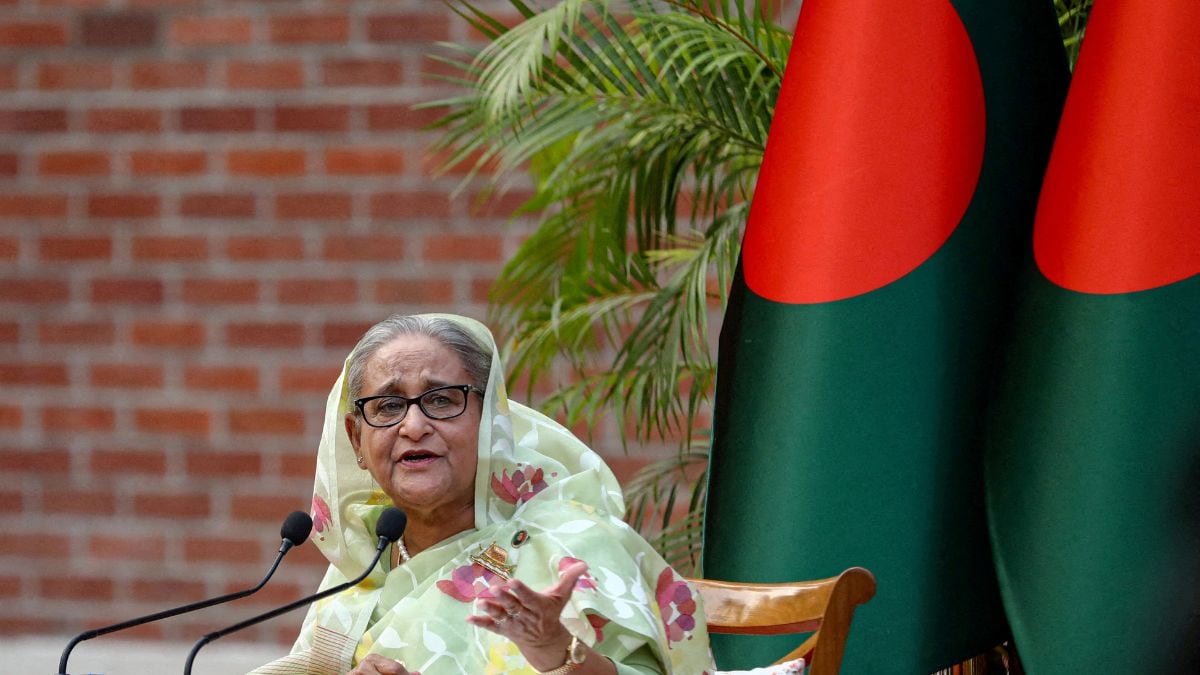
Political exile alters the calculus of power by separating a leader from their domestic institutional base while simultaneously freeing them from immediate territorial jurisdiction. When former Bangladeshi Prime Minister Sheikh Hasina asserts that she requires no external patronage to return to Dhaka, she is deploying a calculated rhetorical counter-offensive against narratives framing her political survival as dependent on regional sponsors. To understand the operational reality behind this declaration, analysts must separate public political signaling from the hard structural constraints governing cross-border political re-entry in South Asia.
The Architecture of Exile Rhetoric
Standard media coverage treats statements from exiled leaders as literal declarations of intent or mere emotional defiance. In geopolitical reality, such statements function as multi-audience signaling mechanisms designed to manage three distinct constituencies simultaneously.
- The Domestic Party Cadre: Following the August 2024 upheaval and her subsequent departure to India, the Awami League suffered severe organizational fragmentation. Local leaders went underground, faced legal prosecution, or defected. A public refusal of foreign dependency signals to this fractured base that the party leadership retains autonomous agency and is not a passive instrument of external powers. This prevents total organizational collapse by maintaining the perception of an eventual, self-directed restoration.
- The Interim Administration in Dhaka: By framing her potential return as an internal matter driven by domestic political necessity rather than foreign intervention, Hasina attempts to delegitimize the interim government's narrative that the previous administration was an externally propped-up autocracy. It forces Dhaka to treat her not as a foreign-backed proxy, but as an unresolved domestic political variable.
- The Host State: For New Delhi, hosting a deposed head of state creates acute diplomatic friction with the incoming regime in Dhaka. By publicly disavowing the need for a foreign "blessing," Hasina relieves diplomatic pressure on India, creating plausible deniability for New Delhi regarding any future political maneuvering she undertakes while on Indian soil.
The Three Constraints on Physical Re-entry
Rhetorical autonomy does not translate into operational capability. For any exiled leader to transition from external commentary to physical re-entry, three structural conditions must align. Currently, all three present severe bottlenecks.
1. Judicial and Carceral Exposure
Unlike an opposition leader returning to contest an election under established rules, Hasina faces an active, multi-tiered legal apparatus constructed specifically to neutralize her political viability. The International Crimes Tribunal (ICT) in Dhaka and domestic courts have issued arrest warrants and initiated proceedings covering charges ranging from corruption to crimes against humanity linked to the 2024 protest crackdowns.
In political science, this represents a high-cost entry barrier. Returning without a negotiated political settlement or an institutional amnesty guarantees immediate detention. Once incarcerated, a leader's ability to command a political network degrades rapidly, shifting their utility from an active operational commander to a passive symbol. A symbol cannot direct street mobilization or manage factional disputes within a party.
2. The Loss of State Apparatus Control
During her fifteen-year tenure, political durability relied heavily on institutional capture—specifically, alignment within the judiciary, the civil bureaucracy, the Directorate General of Forces Intelligence (DGFI), and the police force. The post-August 2024 restructuring systematically dismantled these loyalty networks through forced retirements, transfers, and prosecutions.
Without sympathetic nodes inside the security establishment, physical re-entry lacks a protective perimeter. An exiled leader returning to a hostile security apparatus cannot guarantee their own physical safety, let alone secure the logistical freedom required to organize a political comeback. The mechanism of return requires either a fractured military willing to broker a power-sharing agreement or an institutional vacuum that allows a party to seize physical spaces. Neither condition currently exists in Dhaka.
3. Asymmetric Regional Leverage
While Hasina explicitly rejects the necessity of foreign backing, the geopolitical geometry of South Asia dictates that no major political transition in Bangladesh occurs in a vacuum. Bangladesh is geographically surrounded by India on three sides, creating an inescapable structural interdependence involving water sharing, border security, transit rights, and trade.
However, New Delhi's strategic calculus prioritizes state-to-state stability over individual political personalities. India’s primary security objective in its eastern neighborhood is preventing the rise of anti-Indian militancy and limiting Chinese strategic encroachment in the Bay of Bengal. If supporting Hasina’s return threatens to destabilize Bangladesh further or alienate the permanent state institutions in Dhaka—such as the Bangladesh Army—New Delhi will withhold the logistical and diplomatic cover necessary to facilitate her return. Thus, her claim of needing no foreign blessing masks a reality where foreign tacit consent is a baseline requirement for transit and security.
The Mechanism of Political Re-legitimization
To overcome these physical and judicial barriers, an exiled political movement cannot rely on immediate physical return. Instead, it must execute a sequential strategy aimed at eroding the legitimacy of the incumbent administration while rebuilding domestic organizational capacity.
The first phase involves economic and governance attribution. Transitional governments inevitably face macroeconomic headwinds, inflation, and administrative friction as they dismantle old networks and build new ones. The exiled leadership’s objective is to link every governance failure, price hike, or security lapse directly to the absence of the previous regime's administrative stability. By contrasting current volatility with past predictability, the exiled faction attempts to induce collective nostalgia among the electorate, particularly within the business community and the middle class.
The second phase requires international narrative inversion. Initially, the international community—particularly Western democracies and multilateral lending institutions—welcomed the 2024 transition as a democratic renewal. Hasina’s rhetorical strategy seeks to invert this narrative by highlighting instances of mob violence, minority insecurity, or political persecution under the new order. If the interim administration can be framed internationally as illiberal or unable to maintain basic law and order, external diplomatic pressure on Dhaka increases, creating political space for the Awami League to demand inclusion in future electoral processes.
The third phase is asymmetric organizational reconstitution. Because open political rallies are impossible under current security constraints, party structures must shift from mass-mobilization models to cellular, clandestine networks. Communication relies on encrypted channels and diaspora-funded media ecosystems. The objective is not to overthrow the state immediately, but to preserve enough latent organizational muscle to disrupt governance or negotiate from a position of residual strength when elections are eventually called.
Limitations of the Autonomy Narrative
Relying on a narrative of pure domestic self-reliance carries distinct strategic vulnerabilities for the Awami League.
- The Credibility Deficit: A significant portion of the Bangladeshi electorate views the previous administration's longevity as the direct result of compromised elections (specifically in 2014, 2018, and 2024) backed by external diplomatic support. Asserting sudden independence from foreign powers triggers skepticism among voters who attribute past governance survival precisely to those external alignments.
- Alienation of Necessary Allies: Publicly minimizing the role of regional powers risks offending the very diplomatic establishments currently providing refuge. Host nations tolerate exiled leaders on the condition that they do not complicate the host's broader foreign policy objectives. Overly assertive rhetoric can force the host state to restrict the exile's communications or movement to appease the government in Dhaka.
- The Succession Bottleneck: Focusing the entire narrative of return on a single individual prevents the party from developing a credible second-tier leadership. If the party’s sole viable strategy is the physical return of a leader facing severe legal jeopardy, the organization remains paralyzed until that specific—and highly improbable—event occurs.
Strategic Trajectory and Operational Forecast
The assertion that no foreign blessing is required is best understood not as an operational blueprint for an imminent flight to Dhaka, but as a negotiating posture designed to set the terms for an eventual political settlement. In the immediate term, physical re-entry remains operationally unviable due to the intact consensus between Dhaka's interim civilian leadership and the military establishment regarding judicial accountability.
For the exiled leadership to convert rhetorical defiance into tangible political leverage, the strategy must shift from demanding personal restoration to forcing institutional inclusion. Rather than attempting a high-risk physical return that would result in immediate incarceration, the Awami League’s optimal play is to utilize its diaspora network and international lobbying to condition future multilateral economic aid and trade concessions to Bangladesh on the execution of fully inclusive, internationally monitored elections. By making the interim government's economic legitimacy contingent on the Awami League's participation, the exiled leadership can negotiate the gradual dismantling of judicial barriers from abroad—turning a physical impossibility into a diplomatic necessity before any plane ever lands in Dhaka.