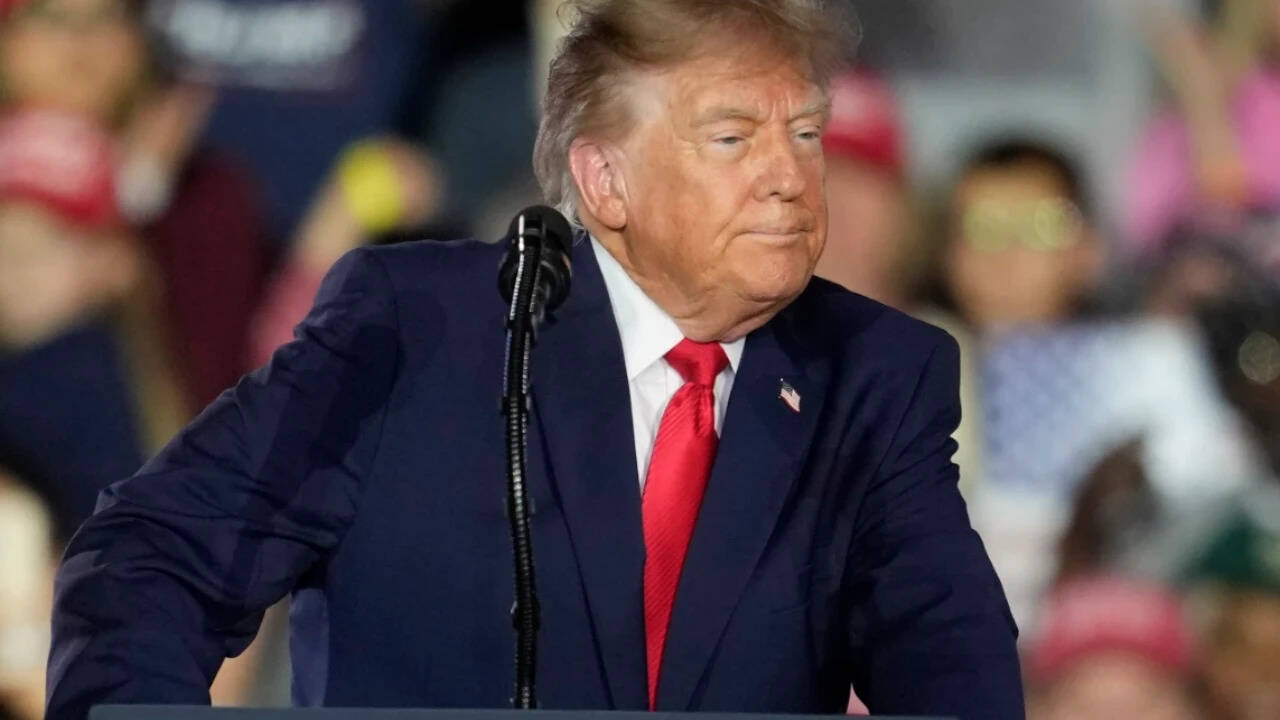
Political pundits love a simple cause-and-effect headline. According to recent survey reporting, conflict in the Middle East and persistent inflation are dragging Donald Trump's approval rating toward historic lows. On the surface, the narrative makes sense to casual observers. Voters feel pain at the grocery store, see instability abroad, and blame the person sitting in the Oval Office.
That explanation is lazy. It relies on an outdated playbook that assumes modern voters evaluate presidents the same way they did in 1992. For a different perspective, consider: this related article.
When analysts look at approval ratings solely through the lens of daily headlines—blaming a specific foreign conflict or a single quarter of price hikes—they miss the structural shifts happening beneath the surface. Polling data does not just reflect immediate dissatisfaction; it captures decades of institutional erosion, polarized media ecosystems, and fundamental changes in how Americans experience economic pressure.
The Myth of the Single-Issue Approval Drop
Traditional political commentary treats presidential approval like a barometer responding to daily weather. If gas prices rise or foreign tensions flare, the needle drops. If consumer confidence ticks up, the needle recovers. Further analysis on this trend has been shared by NPR.
Political scientists and veteran campaign strategists know the reality is far more rigid. Over the past twenty years, presidential approval ratings have become heavily calcified. According to long-term tracking from institutions like the Pew Research Center and Gallup, the ceiling and floor for any modern president are locked within a narrow band. Roughly 40% of the electorate will support a president regardless of economic conditions or foreign policy crises, while another 40% will oppose them no matter what happens.
The remaining sliver of swing voters—the group that actually moves polling averages by three or four percentage points—rarely reacts to a single news cycle. Instead, their frustration accumulates over years.
When a survey shows declining approval tied to "cost of living" and "foreign conflict," respondents are not necessarily expressing a nuanced critique of current tariff structures or Middle Eastern deterrence strategies. They are using the pollster's multiple-choice options to register a broader exhaustion with systemic instability.
Why "Cost of Living" Means Different Things to Different Voters
Economists often point to macroeconomic indicators—like cooling headline inflation, wage growth, or low unemployment—to argue that the economy is performing well on paper. Political reporters then express confusion when voters tell pollsters the economy is terrible.
Both groups are looking at incomplete data.
To understand why cost-of-living dissatisfaction persists regardless of who holds power, you have to separate inflation from price levels:
- Inflation is the rate at which prices increase over time. Even when inflation slows down to 2% or 3%, prices do not go back to where they were four years ago. They simply stop rising as fast.
- Price levels represent the cumulative cost of housing, groceries, insurance, and childcare compared to household income.
For a household paying 40% more for auto insurance and 30% more for groceries than they did five years ago, a government report celebrating "disinflation" feels disconnected from reality. Voters do not care about the second derivative of the Consumer Price Index. They care about whether their paycheck covers fixed monthly expenses without forcing them to rely on credit cards.
Furthermore, economic pain is no longer distributed evenly across income brackets. Higher-income households—who often hold equities and fixed-rate mortgages—have largely absorbed higher prices. Lower- and middle-income households, particularly renters and younger workers, face a structural affordability crisis in housing and healthcare that no single administration can fix in two years.
Blaming a president's polling dip on immediate cost-of-living complaints ignores the fact that American households have been dealing with a multi-year affordability squeeze that transcends party lines.
The Foreign Policy Paradox in Modern Polling
The second pillar of the conventional narrative is that conflict involving Iran drags down domestic approval. Historically, foreign crises produced a "rally 'round the flag" effect, temporarily boosting a president's numbers as the country united behind the commander-in-chief.
That dynamic no longer functions in a fractured information environment.
Today, foreign policy events are immediately filtered through domestic partisan lenses. When military escalation or regional conflict occurs in the Middle East, voters do not rally together; they retreat into preexisting beliefs:
- Interventionist critics argue that military entanglement wastes resources and risks American lives without clear strategic objectives.
- Hawkish critics argue that anything short of overwhelming force projects weakness and invites further aggression from adversaries.
- Economic pragmatists worry exclusively about how conflict in the Strait of Hormuz or the broader Persian Gulf will disrupt global supply chains and spike energy costs at home.
Because these three groups want mutually exclusive outcomes, any action a president takes alienates at least two of them. Polling numbers reflect this structural trap. A drop in approval during a foreign crisis does not necessarily mean voters prefer the opposition party's approach; it often means the electorate has no consensus on what American foreign policy should look like in the first place.
What Pollsters Actually Measure—And What They Miss
If you have ever worked behind the scenes on national issue campaigns, you learn quickly that public polling is a blunt instrument. Survey questions force complex human anxieties into binary choices: Approve or Disapprove. Better or Worse.
Consider how a typical survey frames economic and foreign policy questions. When a pollster asks, "Do you approve or disapprove of the way the president is handling the cost of living?" a voter struggling with medical debt or rising rent will almost always say "disapprove"—even if they recognize that global supply chains, Federal Reserve interest rate policies, and corporate pricing strategies play massive roles outside the White House's direct control.
There is also the problem of response bias in modern polling:
- Partisan non-response: Voters who feel alienated by mainstream institutions are significantly less likely to answer calls or complete online surveys from traditional polling firms.
- Thermostatic public opinion: Political scientist Christopher Wlezien famously described public opinion as a thermostat. Regardless of who is in office, the public tends to push back against the party in power whenever conditions feel uncomfortable, turning the dial in the opposite direction without necessarily endorsing the alternative.
When media outlets treat a two- or three-point dip in an approval poll as a definitive verdict on a presidency, they mistake short-term noise for long-term political realignment.
The Strategic Blind Spot for Decision-Makers
Relying on headline approval numbers creates a dangerous blind spot for business leaders, investors, and policymakers alike.
In corporate boardrooms and policy shops, executives routinely misread approval polls as predictive indicators of future consumer behavior or legislative outcomes. They assume a president with a low approval rating is politically paralyzed, or that voter anger over inflation guarantees a sweeping shift in economic policy after the next election.
History shows the opposite. Presidents with underwater approval ratings frequently pass major legislation, reshape regulatory agencies, and execute consequential foreign policy decisions—precisely because they recognize they have little left to lose in short-term popularity contests.
At the same time, consumers who tell pollsters the economy is in terrible shape often continue spending at steady rates, creating a massive divergence between stated preferences (what people say in surveys) and revealed preferences (what people actually do with their money and votes).
A Better Framework for Reading Political Data
To cut through the noise of weekly polling headlines, stop looking at top-line approval ratings as a scorecard of presidential performance. Instead, track three underlying metrics that actually drive political and economic outcomes:
- Issue salience versus issue ownership: Watch which issues voters rank as their top priority, not just whether they approve of current handling. A president can survive low approval on foreign policy if domestic economic metrics stabilize, and vice versa.
- Real disposable personal income: Look past headline inflation rates and examine whether after-tax income adjusted for inflation is rising or falling for the bottom 50% of earners. That single metric predicts electoral frustration far more accurately than opinion surveys.
- Enthusiasm gaps among core constituencies: Modern elections are rarely decided by swaying the shrinking pool of undecided moderates. They are decided by whether frustrated voters stay home or show up at the ballot box.
The limitation of this approach is obvious: it does not fit neatly into a breaking news alert or a 15-second cable news graphic. Nuance requires patience, and patience does not generate clicks.
Headlines claiming that war and inflation are sinking a president's numbers offer the comforting illusion that complex historical forces can be reduced to a single poll. They cannot. The approval rating is just a reflection on the surface of the water; the real currents are moving underneath.