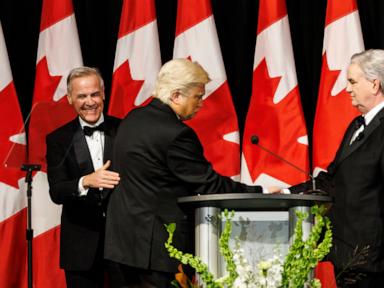
Political comedy at the Canadian Parliamentary Press Gallery Dinner operates as an informal diplomatic pressure valve rather than mere entertainment. On November 21, 2026, Prime Minister Mark Carney bypassed conventional self-deprecation by importing professional comedic proxies—Kids in the Hall alumnus Mark McKinney to play himself and This Hour Has 22 Minutes veteran Mark Critch to impersonate United States President Donald Trump—directly onto the Ottawa stage. While wire services framed the sixteen-minute routine as a lighthearted roast of bilateral friction, the execution exposes a calculated communications strategy: outsourcing high-risk diplomatic mockery to third-party performers while simultaneously liquidating domestic political capital through abrupt protocol breaches.
The Architecture of Outsourced Satire
Standard political roasts rely on first-person vulnerability. A head of government absorbs criticism directly to project confidence and disarm adversaries. Carney inverted this model by declaring he was pressing the "emergency comedy button," shifting the performance burden onto McKinney and Critch. This structural choice achieves three distinct operational outcomes:
- Plausible Deniability in Bilateral Relations: When a sitting prime minister directly mocks a volatile foreign counterpart, the transcript becomes an official diplomatic artifact. By letting Critch deliver the sharpest barbs—specifically mocking Trump's physical fixation on men's appearances, his reluctance to use the "governor" moniker to Carney's face, and the erratic nature of trade negotiations—Carney created an acoustic buffer. The laughter in the room registered globally, yet the exact phrasing remained attributable to a Canadian sketch comedian rather than the Prime Minister's Office.
- Visual Subversion of Dominance Rituals: Diplomacy relies heavily on physical semiotics. Critch replicated Trump's aggressive, pull-in handshake with both Carney and McKinney. Staging a choreographed parody of a known bilateral power move neutralizes its intimidating effect for domestic audiences without requiring Carney to engage in public confrontation.
- Persona Correction for a Technocratic Leader: Carney's public profile remains anchored in central banking—former Governor of the Bank of Canada and the Bank of England. Technocrats routinely struggle with perceived rigidity and elitism. Deploying McKinney as a body double allowed Carney to lampoon his own reputation for dense economic jargon, specifically referencing his prior week's remarks suggesting an oligopoly in the proposed Quebecor-Telus acquisition could somehow increase competition.
The Economics of Bilateral Friction and Domestic Scandal
Satire at state-adjacent dinners never exists in a vacuum; it functions as a ledger of current political vulnerabilities. Every joke delivered during the November 2026 event mapped directly onto an active policy dispute or reputational liability across the Canadian political spectrum.
- Trade and Sovereign Friction: Carney restricted his direct jokes about Trump to the aesthetic overhaul of the Oval Office, quipping about sitting alone with its "new interior decorator" in reference to the gilded portraits and gold accents installed during Trump's second term. Meanwhile, Critch addressed the underlying economic anxiety, stating that a bilateral trade deal was imminent with only one obstacle remaining—Trump himself. This division of labor kept Carney focused on harmless decor while the impersonator voiced the substantive Canadian frustration over tariff threats, border bridge disputes, and 51st-state rhetoric.
- Executive Absenteeism: Governor General Louise Arbour, representing King Charles III, targeted Carney's extensive international travel schedule. Her comparison—that God is everywhere while Carney is everywhere except Ottawa—crystallized an emerging domestic critique that the prime minister prioritizes global summits over parliamentary presence.
- Leadership Temperament and Media Subsidies: Conservative Leader Pierre Poilievre weaponized reports of Carney's demanding management style, claiming the prime minister was "stealing all my ideas" by yelling at staff and treating journalists poorly. Poilievre further dramatized the ideological divide over state-funded journalism by carrying a bag of cash onstage to mock federal newsroom subsidies.
- Electoral Marginalization: New Democratic Party Leader Avi Lewis, lacking a seat in the House of Commons, contrasted his party's diminished parliamentary footprint with his willingness to remain at the dinner table for the entire evening—a direct strike at Carney's immediate departure following his remarks.
The Operational Cost of the Read-and-Run
A communications strategy succeeds only if the delivery mechanism reinforces the message. In Ottawa, Carney's tactical execution undermined his strategic gains through a failure of institutional etiquette.
The Parliamentary Press Gallery operates on an implicit social contract: politicians and journalists suspend adversarial roles for one night to affirm mutual institutional respect. Carney's office repeatedly altered his arrival window prior to the dinner, withheld the participation of professional comedians from event organizers, exceeded the allotted speaking time despite warnings, and exited the venue immediately after finishing his set.
"No, we had no idea that comedians would be in attendance. And no, we didn't grant Mark Carney the right to deliver his speech and then immediately leave. We were not amused." — Boris Proulx, President of the Parliamentary Press Gallery
This sequence illustrates a classic principal-agent breakdown in political communications. By treating the Press Gallery dinner like a television taping rather than a stakeholder gathering, the Prime Minister's Office generated a secondary news cycle focused entirely on procedural arrogance. Opposition figures, including Conservative Deputy Leader Melissa Lantsman and MP Michelle Rempel Garner, immediately capitalized on the exit, framing it as evidence that the government subsidizes newsrooms financially while holding working reporters in contempt.
Asymmetry in Political Humor Risk
Evaluating the efficacy of Carney's appearance requires comparing the risk profiles of the participants. Political humor carries asymmetric consequences depending on the speaker's institutional position and baseline public perception.
- The Incumbent Executive (Carney): High upside for humanization, extreme downside for perceived aloofness. Leaving early validated existing narratives regarding his centralized, insular leadership style. Furthermore, inviting viral clips of a room full of Canadian elites laughing at a Trump caricature introduces unquantifiable tail risk into ongoing bilateral trade negotiations, given the U.S. president's documented sensitivity to public ridicule.
- The Official Opposition (Poilievre): Moderate upside for base mobilization, severe downside for alienating swing demographics. Poilievre's remarks targeting former Prime Minister Justin Trudeau's personal life—specifically referring to Katy Perry in terms widely criticized online as sexist—demonstrate how partisan red meat tailored for an insider room degrades rapidly when exposed to broader digital distribution.
- The Ceremonial Head of State Representative (Arbour): Low risk, high precision. By delivering a single, structurally clean joke about Carney's travel schedule, Arbour fulfilled the traditional press dinner mandate without overextending her non-partisan constitutional role.
Calibration Protocols for Executive Communications
When senior leaders utilize satire in high-stakes environments, communications teams must enforce strict operational guardrails to prevent tactical wins from turning into strategic liabilities.
- Audit the Exit Strategy: The optics of attendance matter more than the punchlines. An executive who arrives late, scripts a tight sixteen-minute set, and bolts for the door signals that the audience is a prop. Staying for at least one subsequent course or speaker eliminates the "read-and-run" critique at zero policy cost.
- Align Surrogates with Diplomatic Thresholds: Hiring professional comedians solves the delivery problem for non-performers, but surrogates must operate within defined diplomatic boundaries. Mocking policy contradictions or stylistic quirks yields domestic applause; mocking personal physical attributes of a foreign leader creates unnecessary bilateral friction when trade files remain open.
- Respect Host Governance: Surprising event organizers with unannounced talent and running past time limits alienates the exact gatekeepers responsible for framing the next day's coverage. Operational transparency with press gallery leadership preserves goodwill that cushions inevitable policy missteps.
For political strategists managing technocratic executives, the lesson from Ottawa is unambiguous: comedic outsourcing can successfully manufacture viral domestic moments, but skipping the institutional obligations of the room converts an earned media victory into a self-inflicted credibility deficit. Future executive appearances at press functions must prioritize physical presence and protocol compliance over scripted spectacle, ensuring the messenger does not invalidate the message before the applause fades.