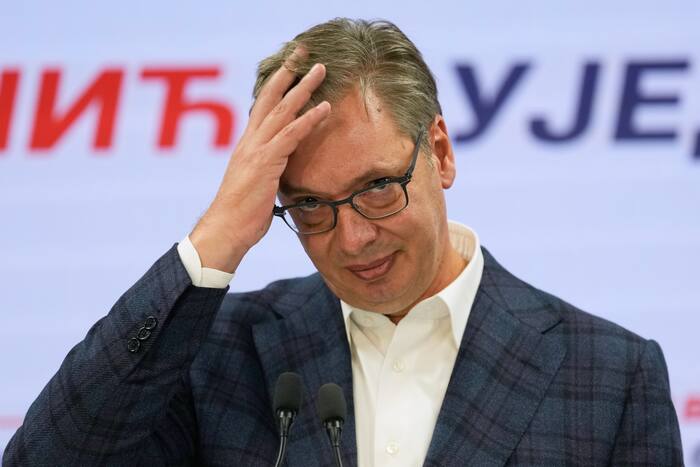
Conventional diplomatic commentary often treats Serbian politics as a binary switch. According to a prominent line of foreign policy analysis—exemplified by coverage suggesting that an electoral defeat for Aleksandar Vučić immediately opens the door for Serbia to reheat frigid ties with the European Union—the primary obstacle between Belgrade and Brussels is a single strongman. Remove the leader, the argument goes, and the structural alignment with the West naturally follows.
This framing relies on a simplified reading of Balkan geopolitics. While political analysts and European officials frequently point to democratic backsliding and executive overreach under Vučić's Serbian Progressive Party (SNS) as major roadblocks, treating a change in leadership as a cure-all ignores the deeper institutional, constitutional, and regional realities that dictate EU enlargement. Even in a scenario where the Serbian opposition secures a decisive parliamentary or presidential victory, the path to Brussels remains blocked by structural hurdles that no new administration can quickly erase. For another view, consider: this related article.
The Structural Consensus Beyond One Leader
To understand why Serbia's relationship with the European Union is stalled, observers must separate executive style from entrenched state policy. Foreign policy commentators who focus exclusively on Vučić's "four pillars" strategy—balancing Brussels, Washington, Moscow, and Beijing—often overlook how deeply that balancing act is embedded in Serbian public opinion and economic infrastructure.
According to public opinion polling conducted by organizations such as the Belgrade Centre for Security Policy (BCBP) and the European Movement in Serbia, support for EU membership among Serbian citizens has hovered near historic lows, often dipping below 45 percent. Simultaneously, polls consistently show that a clear majority of Serbs oppose imposing sanctions on Russia and view China as a critical economic partner. Related coverage regarding this has been published by NPR.
A hypothetical new government in Belgrade would inherit this exact electorate. Any incoming coalition attempting to rapidly align with the EU’s Common Foreign and Security Policy (CFSP)—specifically by adopting sanctions against Moscow—would face immediate domestic backlash, potential coalition fractures, and intense pressure from nationalist opposition parties. Foreign policy observers who assume a post-Vučić government could effortlessly pivot westward underestimate the political cost of defying domestic consensus on Russia and energy security.
The Kosovo Impasse Remains Unchanged
The single largest formal barrier to Serbia’s EU accession is Chapter 35 of the accession negotiations, which covers the normalization of relations with Kosovo. European Commission progress reports have repeatedly stated that without a legally binding, comprehensive normalization agreement between Belgrade and Pristina, neither country can advance toward full membership.
Analysts who argue that Vučić’s departure would immediately warm EU ties fail to account for the reality that the Serbian opposition is largely aligned with—or even more conservative than—the current government regarding Kosovo's status.
- Constitutional Constraints: The 2006 Constitution of Serbia explicitly defines Kosovo and Metohija as an integral part of Serbian territory. Amending this requires a two-thirds parliamentary majority followed by a national referendum, a political threshold no foreseeable Serbian government can cross.
- Opposition Positioning: Major opposition blocs, including both civic-minded coalitions and center-right parties, have consistently rejected formal recognition of Kosovo’s independence and its admission to the United Nations.
- Reciprocal Deadlocks: Progress on the Brussels and Ohrid agreements depends equally on decisions made in Pristina, including the establishment of the Association of Serb-Majority Municipalities. A change of government in Belgrade does nothing to resolve the political friction between EU mediators and Kosovo's leadership.
Imagine a scenario where a reformist, pro-European coalition takes office in Belgrade tomorrow. They could immediately restore media freedom, depoliticize the judiciary, and clean up electoral rolls. Yet the moment EU diplomats place the demand for de facto recognition of Kosovo back on the negotiating table, that new government would hit the exact same diplomatic wall that stalled its predecessor.
Enlargement Fatigue Inside Brussels
Blaming Belgrade alone for the freeze in EU-Serbia relations also ignores the shifting political dynamics within the European Union itself. For years, enlargement experts—including researchers at the European Council on Foreign Relations (ECFR) and the Carnegie Europe think tank—have documented a persistent "enlargement fatigue" among key EU member states.
While Russia’s invasion of Ukraine revived geopolitical arguments for integrating the Western Balkans, institutional skepticism remains high in capitals like Paris, The Hague, and Berlin. Several EU leaders, notably French President Emmanuel Macron, have argued that the EU must reform its own internal decision-making—such as abolishing unanimity voting on foreign policy and budget matters—before admitting new members.
Furthermore, the EU’s revised enlargement methodology, introduced in 2020, allows member states to pause negotiations or reverse progress if a candidate country backslides on rule-of-law reforms. Even with a compliant, reform-oriented government in Belgrade, Serbia would still face years of technical screening across 35 negotiating chapters, followed by mandatory ratification by all 27 national parliaments—a process where any single EU neighbor can exercise a bilateral veto over historical, minority, or border disputes.
The Economic Entanglement with Beijing and Moscow
Another flawed assumption in mainstream commentary is that Serbia’s ties with Russia and China are merely personal vanity projects of the current leadership. In reality, they are underpinned by binding state contracts, critical infrastructure loans, and energy dependencies that cannot be unwound overnight.
- Energy Dependence: Serbia relies heavily on Russian natural gas delivered via the Balkan Stream pipeline, and its primary oil company, NIS (Naftna Industrija Srbije), is majority-owned by Russian state-backed Gazprom Neft. Diversifying supply through interconnectors with Bulgaria and Greece is underway, but complete decoupling requires billions in capital expenditure and years of construction.
- Chinese Infrastructure and Mining: Over the past decade, Chinese state-owned enterprises have acquired major strategic assets in Serbia, including the Smederevo steel mill and the RTB Bor copper mining complex, while financing major highway and railway projects under the Belt and Road Initiative.
- Trade Realities: While the EU remains Serbia’s largest trading partner and source of foreign direct investment, cancelling Chinese infrastructure loans or breaching bilateral agreements would trigger massive financial penalties and stall domestic economic growth.
A new administration in Belgrade would be forced to manage these existing legal and financial commitments pragmatically. Expecting an immediate rupture with Beijing or Moscow confuses campaign rhetoric with the realities of sovereign debt and industrial employment.
What Actually Moves the Needle
Evaluating Serbia’s European trajectory requires moving past personality-driven narratives and focusing on measurable institutional benchmarks. Rather than viewing an election outcome as an automatic ticket to Brussels, observers and policymakers should track concrete structural indicators:
- Judicial and Media Reforms: Genuine progress begins with implementing the recommendations of the OSCE Office for Democratic Institutions and Human Rights (ODIHR) regarding electoral conditions, alongside enforcing existing laws that guarantee the independence of the Regulatory Authority for Electronic Media (REM).
- Gradual Phased Integration: Instead of waiting for full political membership, the most realistic path forward involves integrating Serbia into the EU Single Market, the Single Euro Payments Area (SEPA), and regional green lanes—mechanisms outlined in the European Commission’s Growth Plan for the Western Balkans.
- Energy Diversification Milestones: Tracking the actual volume of non-Russian gas imported through the Niš-Dimitrovgrad interconnector provides a far more accurate measure of geopolitical realignment than diplomatic statements.
Leadership changes in Belgrade can certainly alter the tone of negotiations and improve domestic democratic standards. However, equating the defeat of one politician with the resolution of decades-old territorial disputes, constitutional deadlocks, and European institutional hesitation misreads the mechanics of Balkan politics. Until the underlying structural conflicts over Kosovo, energy security, and EU internal reform are resolved, the road from Belgrade to Brussels will remain an uphill climb regardless of who sits in the presidency.