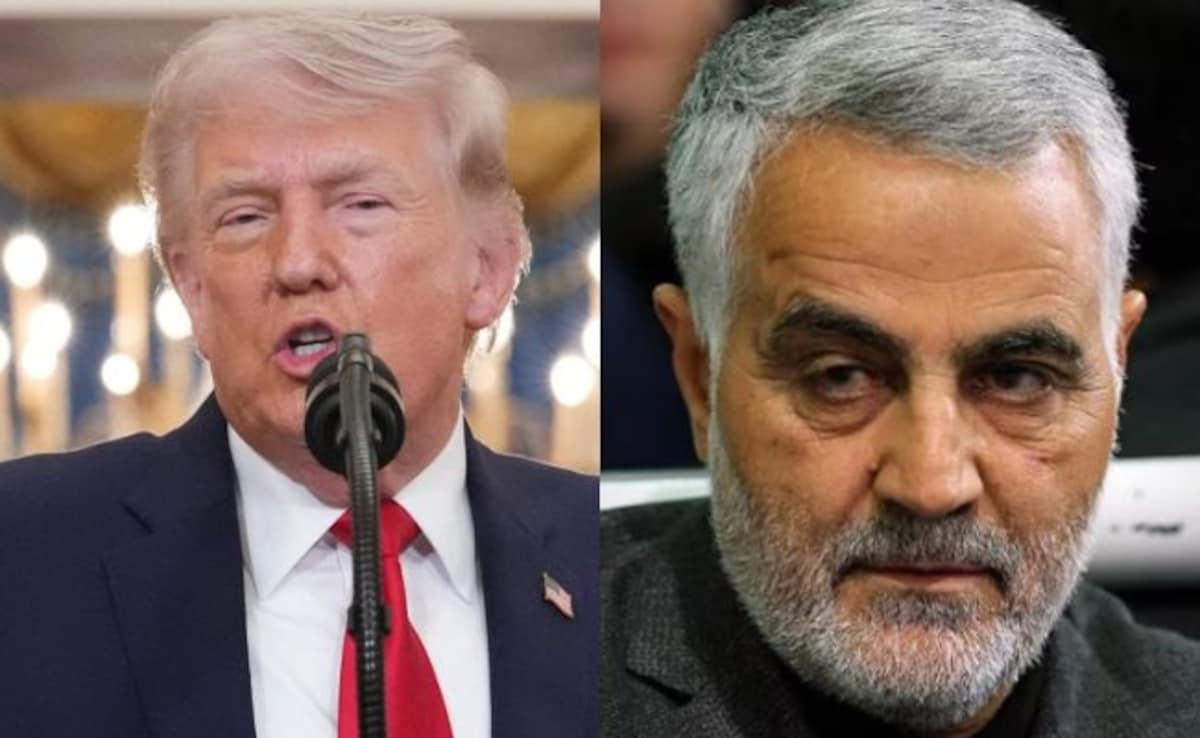
On January 3, 2020, an MQ-9 Reaper drone loitered in the humid air above Baghdad International Airport. Its sensors were locked onto a two-vehicle convoy carrying Qasem Soleimani, the commander of Iran’s Quds Force and the primary architect of Persian influence across the Middle East. When the Hellfire missiles struck, they did more than incinerate a high-ranking general. They dismantled a decades-old unspoken agreement between Washington and Tehran regarding the limits of proxy warfare. Donald Trump’s decision to authorize the strike was described by the former president as a necessary removal of a "horrible, evil genius," but the ripples of that explosion are still reshaping the geopolitical friction points of 2026.
Soleimani was not a traditional soldier. He was a ghost, a diplomat, and a warlord rolled into one. For twenty years, he moved through Iraq, Syria, and Lebanon with a level of immunity that bordered on the supernatural. He believed his status as a sovereign state actor shielded him from direct American kinetic action. He was wrong. The strike signaled a shift from managing Iranian influence to attempting to decapitate its leadership structure, a gamble that forced the Islamic Revolutionary Guard Corps (IRGC) to transition from a cult of personality to a more decentralized, yet equally lethal, bureaucratic machine.
The Myth of the Indispensable Man
The Western obsession with Soleimani often painted him as the sole engine of Iranian expansion. This view misses the structural reality of the Quds Force. While Trump’s rhetoric focuses on the "evil genius" trope, the IRGC is an institution built to outlast any individual. Soleimani’s death created a temporary vacuum in personal relationships—he could speak to Hezbollah’s Hassan Nasrallah and Syrian leaders with the authority of a brother—but the logistical pipelines he built remained intact.
Iran’s "Axis of Resistance" relies on a shared ideological and tactical framework rather than just one man’s Rolodex. We see this in the current coordination between militia groups in Iraq and Yemen. The death of the commander did not lead to the collapse of the proxy network. Instead, it forced these groups to become more autonomous. They are now less dependent on direct orders from Tehran and more capable of initiating localized conflicts that serve broader Iranian interests. This decentralization makes the threat harder to track and even harder to deter through traditional diplomacy.
Intelligence Failures and the Brink of Total War
The lead-up to the Baghdad strike was defined by a series of escalations that nearly spiraled into a full-scale regional conflagration. In late 2019, the killing of an American contractor and the subsequent storming of the U.S. Embassy perimeter in Baghdad created a political climate where "doing nothing" was no longer an option for the White House. However, the intelligence community was sharply divided on the "imminence" of the threats Soleimani was allegedly planning.
The tactical success of the drone strike overshadowed a massive strategic risk. For several days following the assassination, the world watched as Iran launched ballistic missiles at the Al-Asad Airbase in Iraq. It was the most direct attack by a state actor on U.S. forces in decades. The fact that no Americans died in that retaliatory strike was a matter of luck and early warning systems, not a lack of Iranian intent. If a single missile had hit a crowded barracks, the United States and Iran would likely be in the sixth year of a war that would make the Iraq invasion look like a minor skirmish.
The Political Theater of Assassination
Donald Trump’s recent recollections of the event serve a dual purpose. First, they reinforce his image as a decisive leader willing to ignore the "forever war" hesitations of the Pentagon establishment. Second, they highlight the shift in how the U.S. views sovereign immunity for designated "terrorist" leaders. By calling Soleimani an "evil genius," Trump bridges the gap between a military target and a cinematic villain, making the extrajudicial killing more palatable to a domestic audience.
But the "genius" label is also a subtle admission of respect for the efficacy of Iran’s unconventional warfare. Soleimani spent years defeating U.S. interests with a fraction of the budget. He used cheap drones, IEDs, and political subversion to stall the world’s most powerful military. The assassination was an admission that the U.S. could not beat him at his own game of shadows, so it chose to flip the board entirely.
The Legal Gray Zone
The strike occurred on Iraqi soil without the permission of the Iraqi government. This remains a stinging point of contention in Baghdad. It turned the Iraqi parliament into a hornet's nest of anti-American sentiment, leading to repeated votes to expel U.S. troops.
- Sovereignty: The use of a third-party country’s airspace to assassinate a second-party country’s official sets a precedent that adversaries are already citing.
- Targeted Killing: Moving from non-state actors (like Al-Qaeda) to official state military leaders (like the IRGC) changes the rules of engagement globally.
- The Precedent: If the U.S. can define a state official as a terrorist and kill them in a neutral country, what stops other nations from applying the same logic to American officials abroad?
The Long Memory of Tehran
In the world of high-stakes intelligence, there is a concept known as "strategic patience." Iran operates on a timeline measured in decades, not election cycles. While the Trump administration viewed the strike as a closed chapter, Tehran viewed it as the opening of a new era of hostility. The IRGC has spent the years since 2020 refining its ability to strike at "soft targets" and developing long-range maritime capabilities that can threaten global shipping lanes.
The killing of Soleimani did not stop Iran’s nuclear ambitions. It did not stop the flow of missiles to the Houthis. It did not stabilize Iraq. What it did was remove a master tactician while leaving the entire tactical infrastructure behind him angry and seeking a quiet, calculated revenge. The "shadow war" has become less of a shadow and more of a blatant, grinding reality of modern Middle Eastern life.
Lessons for the 2026 Landscape
The current instability in the Levant is a direct descendant of the January 2020 escalation. When the hierarchy of power was disrupted, smaller, more radical elements within the proxy networks gained more influence. Without Soleimani’s "evil genius" to keep the various factions in Syria and Iraq on a tight leash, these groups have occasionally acted in ways that even Tehran finds difficult to control. We are no longer dealing with a single mastermind; we are dealing with a hydra.
Military force is an instrument, not a strategy. The Reaper drone solved a person-shaped problem, but it exacerbated a region-shaped crisis. The hardware of war is easy to deploy, but the software of regional stability remains broken. We are living in the debris of that 2020 explosion, watching as the successor to the "ghost commander" applies the lessons learned from his predecessor's end.
The most dangerous aspect of the Soleimani strike wasn't the act itself, but the belief that killing the man would kill the movement. History shows that martyrs are often more effective than generals. The fires in Baghdad have long been extinguished, but the heat remains, radiating from a conflict that has moved far beyond the reach of a Hellfire missile.