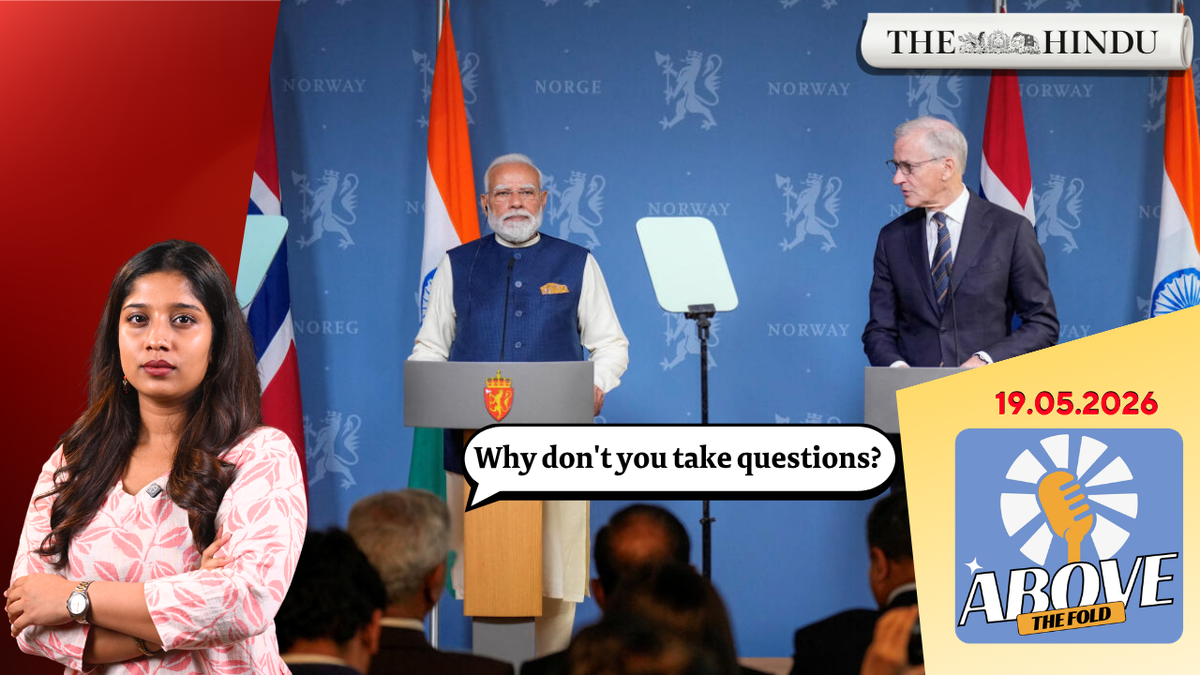
The outrage machine is humming again. Norway’s press corps is offended, the Ministry of External Affairs is playing defense, and the usual suspects are lamenting the "death of democratic dialogue" because Prime Minister Narendra Modi didn't take questions. It is a predictable, tired script. The media views a skipped press conference as a failure of leadership. In reality, it is a masterclass in informational gatekeeping.
Most journalists operate under the hallucination that a Q&A session is the ultimate litmus test for a world leader. They believe they are the "voice of the people." They aren't. They are intermediaries whose business model relies on conflict, soundbites, and the occasional "gotcha" moment that can be clipped for social media engagement. Modi’s refusal to engage in this theater isn't a retreat; it is a tactical bypass of a broken system.
The Myth of the Hard Hitting Question
Look at the mechanics of a modern press conference. You have three seconds to formulate a thought before the next reporter jumps in. It is a environment designed for surface-level optics, not policy depth.
When a leader stands at a podium in Oslo or New Delhi, the questions rarely revolve around the complexities of $CO_2$ sequestration or the intricacies of the Unified Payments Interface (UPI) architecture. Instead, they hunt for a slip of the tongue. They want a headline that triggers a diplomatic incident or a domestic protest.
If you were managing a brand worth trillions of dollars—which is what a nation-state is—would you hand the microphone to a room full of people whose primary incentive is to make you look incompetent?
- Risk: High. One wrong word can tank a trade deal or incite a riot.
- Reward: Non-existent. No voter ever changed their mind because a politician gave a "good" answer to a hostile journalist.
- Efficiency: Zero. It is a waste of the most expensive time on the planet.
Disruption of the Intermediary Class
The legacy media is terrified because they are being rendered obsolete. For decades, they held the keys to the kingdom. If a leader wanted to speak to the masses, they had to go through the press.
That monopoly is dead.
Modi uses direct-to-consumer communication. Between Mann Ki Baat, a massive social media presence, and controlled release videos, he has built a pipeline that bypasses the editorial filters of the BBC, the New York Times, or the Norwegian local press.
When the MEA tells the Norwegian press that "the format was agreed upon beforehand," they are politely saying: "We don't need you."
The press calls this "authoritarian." A business analyst would call it "vertical integration." By controlling the distribution channel, the government ensures the message arrives uncorrupted by the biases of a middleman.
The Norwegian Contextual Error
The Norwegian press operates in a high-trust, small-scale environment. In a country of 5.5 million people, transparency is easy. You can practically bump into the Prime Minister at the grocery store.
India is a subcontinent of 1.4 billion people. The scale of governance is $250\times$ larger. The geopolitical stakes are infinitely more volatile. Applying the standards of a Nordic social democracy to a rising global superpower is not just naive; it’s an intellectual category error.
Norway’s press wants to ask about human rights or regional tensions. India wants to talk about becoming the world's third-largest economy. These agendas are fundamentally misaligned. If there is no common ground for the conversation, the conversation is a performance. And performances are for actors, not for people running a country with a GDP growing at $7%$.
Data Over Discourse
If we look at the metrics that actually matter—foreign direct investment (FDI), infrastructure growth, and digital penetration—the lack of press conferences has had zero negative impact.
In fact, one could argue that the stability provided by a tightly controlled narrative is a feature, not a bug, for investors. Markets hate volatility. Press conferences are engines of volatility. By removing the "wild card" of an unscripted Q&A, the Indian government provides a level of predictability that the global financial elite finds comforting, even if the journalists find it frustrating.
Consider the math of a typical diplomatic gaffe. In 2023, a single misspoken phrase by a mid-level diplomat can lead to a 2% drop in currency value within hours.
$$V_{risk} = (P_{gaffe} \times C_{market_volatility})$$
Where $V_{risk}$ is the potential economic damage. When $P_{gaffe}$ (the probability of a gaffe) is reduced to near-zero by eliminating unscripted interactions, the economic security of the state increases. It’s a cold, hard calculation.
The Brutal Truth About "Accountability"
The cry for "accountability" through press conferences is a scam. True accountability happens at the ballot box and through institutional audits.
Does a 15-second response to a question about "freedom of the press" actually hold a leader accountable? No. It provides a dopamine hit for the reporter and a "win" for their audience.
If you want to hold a government accountable, you look at:
- The Comptroller and Auditor General (CAG) reports.
- The implementation of the Union Budget.
- The actual delivery of public services (Direct Benefit Transfers).
The MEA’s response to the Norwegian media wasn't a "defense." It was a dismissal. They know that the power dynamic has shifted. The global south is no longer interested in performing for the Western press to prove its "democratic credentials."
The Cost of Transparency
Transparency isn't free. It has a massive overhead. Every hour spent prepping for a hostile press junket is an hour not spent on policy. I have seen executive teams in the private sector crumble because they prioritized "public relations" over "product relations."
The Indian government has clearly decided that its "product"—the development of the Indian state—is more important than its "PR" with foreign media outlets who were never going to give them a fair shake anyway.
This is the new reality of global politics. Content is decentralized. Authority is claimed, not granted by a press pass. If the Norwegian press—or any press—wants access, they have to offer something more valuable than a "gotcha" question. Right now, they are offering nothing but noise.
The silence from the podium isn't a sign of weakness. It’s a sign that the old gods of the newsroom have lost their power.
Stop asking why the leader won't speak to the press. Start asking why the press thinks they still matter enough to be spoken to.