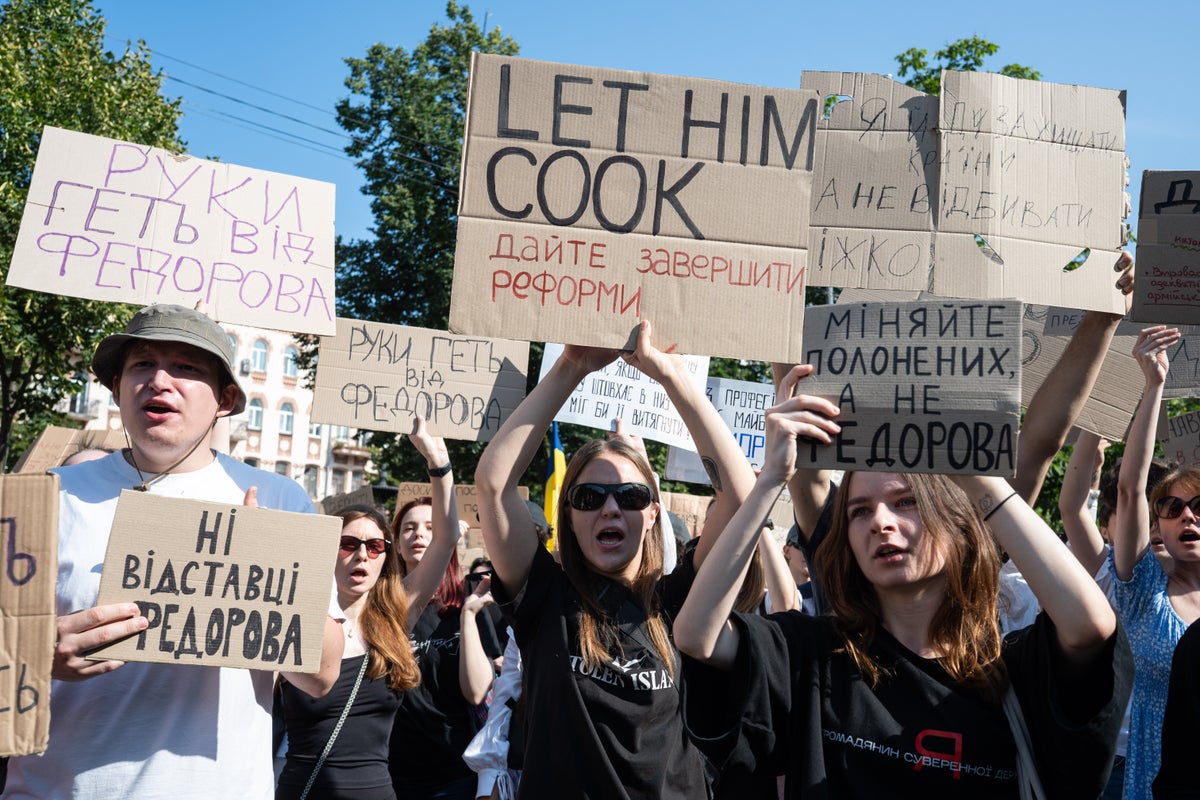
The morning air in Independence Square carries a weight that has nothing to do with the weather. It is the heavy, collective friction of a society that has spent nearly four and a half years holding its breath. In the heart of Kyiv, the crowds assembling are not carrying the flags of a foreign adversary. They are holding signs painted by their own hands, turned toward the windows of their own government.
When a nation is fighting for its literal map coordinates, the government and the street are supposed to move in lockstep. But on this Thursday, a visible tear formed in the fabric of Ukraine’s internal unity. President Volodymyr Zelenskyy’s move to push out Defense Minister Mykhailo Fedorov has done something rare in recent times: it has brought Ukrainians out to protest against a leadership decision mid-war.
To understand why a routine political reshuffle can feel like a seismic betrayal on the ground, you have to look past the official press releases and stand among the people who feel the immediate consequences of bureaucratic whiplash.
Imagine a soldier—let us call him Dmytro—hunkered down in a fortified trench line somewhere in the eastern mud. Dmytro doesn’t know the political maneuvering happening under the golden domes of Kyiv. What he knows is that three months ago, his unit began receiving standard-issue reconnaissance drones faster, with less paperwork, and with software that actually spoke to his artillery team. To Dmytro, that isn’t "digital transformation." It is the reason he is still breathing.
Fedorov was the architect of that specific lifeline. At just 35 years old, he represented the young, tech-forward, radically transparent Ukraine that the younger generation believed they were bleeding for. Before he took the defense mantle six months ago, he was the nation's digital minister, the man who turned state bureaucracy into a sleek smartphone app. When he moved into the Ministry of Defense, he brought a tech CEO's intolerance for old-guard inefficiency.
But the problem with moving fast and breaking things is that in a state of total war, the things that break are often human lives and institutional stability.
Fedorov didn’t sugarcoat the structural rot he inherited. He went public with staggering numbers: nearly 200,000 desertions and roughly two million people evading the draft. It was a dose of brutal, icy reality in a conflict often sustained by carefully curated optimism. He promised sweeping reforms to fix a conscription system buckling under the pressure of a war approaching its fifth year.
Then, the music stopped.
Social media posts from Fedorov listing his short-lived achievements began circulating on a Wednesday night, acting as a preemptive farewell before any formal announcement left the president’s office. By Thursday morning, the capital was murmuring.
For the people gathered in downtown Kyiv, the sudden removal of a modernizer feels less like a strategic pivot and more like the system fighting back against reform. When the state attempts to replace a popular figure with an establishment insider like Naftogaz CEO Serhii Koretskyi for the prime minister’s slot, the public cynicism is instant. The crowd isn't angry because they hate the government; they are terrified that the old ways of doing business—the slow, opaque, Soviet-legacy politics—are creeping back into the bunkers while the best of their youth are dying to keep those very habits at bay.
War requires two types of strength: the physical armor to stop a bullet, and the moral trust that keeps a society from collapsing from within.
When a leadership shakeup threatens that trust, the street fills up. The stakes are completely invisible from a news ticker, but they are vividly clear to every civilian standing in the square. They know that a war cannot be won if the people at the top lose the confidence of the people in the trenches.
The crowd in Kyiv eventually thinned as the afternoon sky darkened, but the silence left behind was uneasy. Zelenskyy’s political authority is facing its deepest test since the full-scale invasion began. In a war with no room for error, friction at the top is a luxury the country simply cannot afford.