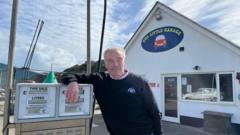
The wind in Alderney doesn’t just blow; it bites. It carries the salt of the Atlantic and a persistent, damp chill that settles into the marrow of your bones. For the roughly two thousand souls who call this three-mile-long island home, the elements are a constant companion. But lately, a different kind of cold has been creeping into the Victorian cottages and modern bungalows of St Anne. It is the chill of a balance sheet that no longer adds up.
When you live on a rock surrounded by churning turquoise waters, everything has a price tag dictated by distance. Every loaf of bread, every liter of milk, and every gallon of fuel must cross the sea. On the mainland, a spike in global oil prices is a headline or a reason to moan at the local petrol station. In Alderney, it is an existential threat. You might also find this related coverage useful: The Mechanics of Targeted Public Violence and the Failure of Deterrence Frameworks.
Consider a man we will call Elias. He is seventy-four, a retired fisherman with hands like weathered teak and a fixed pension that hasn’t kept pace with the world outside the breakwater. For Elias, the heating oil tank behind his house is a ticking clock. As the winter dampness settles in, he faces a choice that no one in a modern society should have to make. He can keep the radiators lukewarm and skip fresh produce, or he can eat well and live in a coat inside his own living room.
He is not alone. As reported in detailed coverage by USA Today, the implications are significant.
The Geography of Inequality
The States of Alderney recently moved to address this widening fracture in the community. A proposal for fuel duty relief has emerged, not as a political luxury, but as a lifeline. The math is brutal. Fuel prices on the island have historically sat significantly higher than those in the UK or even neighboring Guernsey. When the global market fluctuates, Alderney doesn’t just feel the ripple; it gets hit by the surge.
The proposed measure seeks to slash the duty on motor legal fuel and, crucially, heating oil. It is a recognition that in a place with no piped gas and a limited electrical grid, oil isn't a choice. It is survival.
Distance is a tax.
When a tanker makes its way to Braye Harbour, the cost of that journey is baked into every drop of liquid energy pumped into the island’s reservoirs. The "pump price" becomes a reflection of isolation. For the young family trying to run a small landscaping business or the delivery driver navigating the narrow, cobbled streets, the overhead costs are beginning to swallow the margins.
The Invisible Weight of a Litre
If you walk down Victoria Street, you won’t see overt signs of a crisis. There are no bread lines. But the stress shows in the subtle shifts of daily life. It’s the shopkeeper who turns off the display lights an hour early. It’s the parent who calculates exactly how many trips to the school gate they can afford before the red light flickers on the dashboard.
The logic behind the duty relief is rooted in a concept called "fiscal levers." In larger economies, governments can adjust interest rates or launch massive infrastructure projects to stimulate growth. Alderney has fewer tools in its shed. Reducing the tax on fuel is one of the few ways the local government can directly put money back into the pockets of its citizens without waiting for a trickle-down effect that might never arrive.
Critics often argue that tax relief creates a hole in the public purse. They aren't wrong. If the States collect less revenue from fuel, that money has to be found elsewhere, or services must be trimmed. It is a precarious high-wire act. Yet, the counter-argument is more visceral. If the cost of living becomes high enough to drive young families away, the island loses its future. A town of empty houses and closed shops pays no tax at all.
The Thermal Divide
We often talk about the digital divide, but in the Channel Islands, there is a thermal divide.
Heating a granite house built in the 1800s requires a staggering amount of energy. These homes were designed to breathe, which is a poetic way of saying they are drafty. Without affordable heating oil, the dampness of the English Channel moves in and stays. It rots the timber, it peels the wallpaper, and eventually, it rots the health of the inhabitants. Respiratory issues thrive in cold, damp environments.
By proposing this relief, the government is essentially making a public health intervention disguised as a fiscal policy.
The proposal isn't a permanent fix, of course. It’s a bandage on a wound that requires deeper surgery. The world is transitioning away from fossil fuels, and Alderney knows this. There are conversations about tidal power—harnessing the ferocious "Race" of water between the island and France—and talks of solar arrays. But you cannot heat a home today with a tidal turbine that might be built in a decade.
Elias knows this. He watches the news and hears about the "green transition" with a skeptical tilt of his head. He wants a cleaner world for his grandchildren, but he needs his living room to be eighteen degrees Celsius tonight.
The Stakes of the Vote
When the States of Alderney debate this proposal, they aren't just arguing over pence and percentages. They are debating the threshold of dignity.
The proposal suggests a significant reduction, one aimed at bringing the island’s prices closer to a semblance of parity with the mainland. It is a gesture of solidarity from a government to its people. It says: We see that the cost of staying here is becoming too high.
There is a specific kind of resilience required to live on an island. You have to be comfortable with the idea that you are occasionally cut off from the rest of the world when the fog rolls in or the gales howl. You accept the limited shopping and the expensive flights as the price of beauty and peace. But there is a limit to what resilience can weather.
Economic pressure is more erosive than any storm. It wears people down slowly, quietly, until they simply decide they can't do it anymore. The ferry starts looking less like a link and more like an exit ramp.
A Community Under Pressure
What happens to a community when the basic cost of movement and warmth becomes a luxury?
The social fabric begins to fray. The volunteer who drives the elderly to the doctor starts to hesitate because of the petrol cost. The local contractor has to raise his prices, which means the homeowner defers the roof repair, which means the local hardware store sees fewer customers. It is a recursive loop of stagnation.
The fuel duty relief is an attempt to break that loop. It is a bold move for a small jurisdiction, a declaration that the well-being of the resident is worth the risk of a budget deficit.
As the sun sets over the Casquets lighthouse, casting a long, golden shadow across the island, the reality of the situation remains unchanged. The tankers will still have to cross the water. The wind will still bite. But if the proposal passes, the light in Elias's window might stay on a little longer this February. He might be able to sit in his armchair, watch the whitecaps on the horizon, and feel, for the first time in a long time, that the world isn't trying to freeze him out.
The true value of a currency isn't found in a bank; it’s found in the heat of a radiator and the ability of a neighbor to drive ten minutes down the road to check on a friend.
The rock in the English Channel remains, stubborn and beautiful. The people who live there are just asking for the chance to keep the fire burning.


