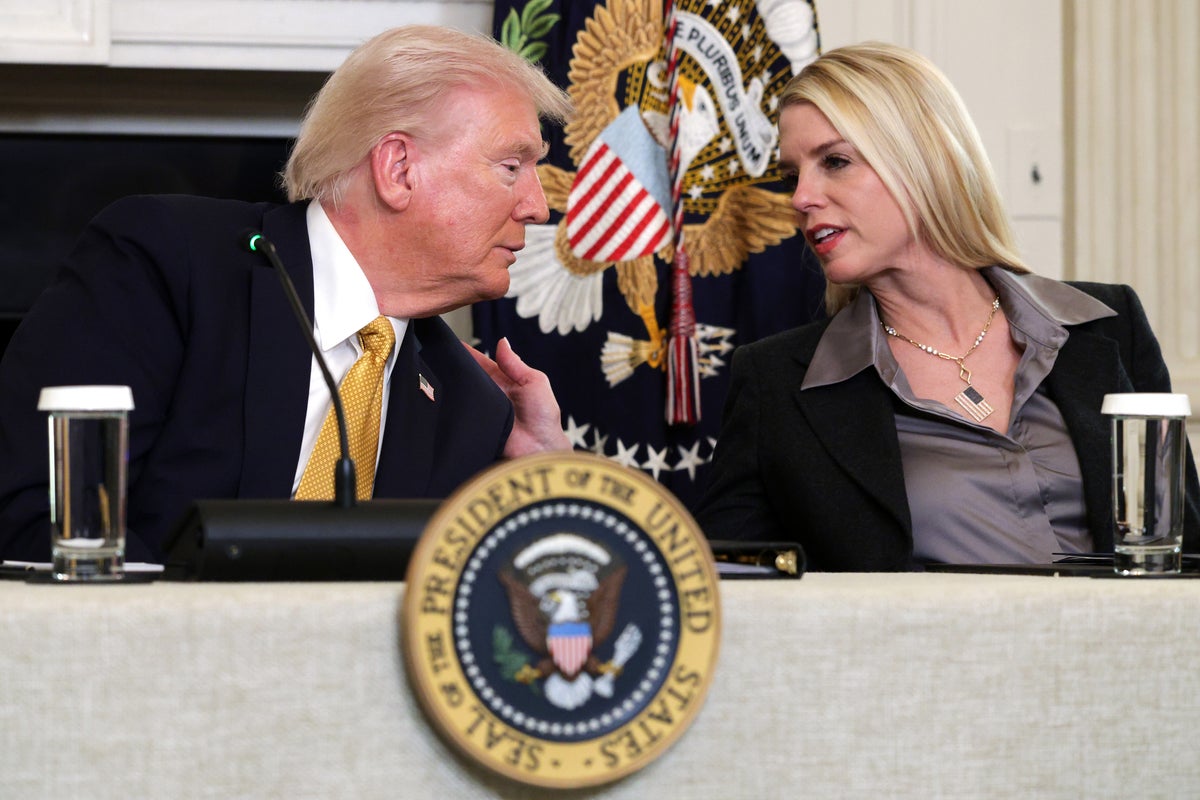
The silence in a high-stakes political orbit isn't empty. It’s heavy. It’s the kind of silence that settles in a room after a sudden, sharp glass breaks—a moment where everyone freezes, waiting to see who will pick up the shards and who will be blamed for the mess. For Pam Bondi, a woman whose career has been defined by a certain polished resilience, that silence lasted just long enough for the world to start guessing.
Power in Washington functions like a centrifugal force. You spend years fighting to get closer to the center, enduring the heat and the pressure because the view from the inner circle is unlike anything else. But the closer you get to the sun, the faster you can be cast out into the cold.
When news broke that Donald Trump had moved on from Bondi, the narrative shifted instantly. The headlines were clinical, detailing "missteps" and "strategic pivots" as if describing a software update gone wrong. But politics isn't a series of data points. It is a blood sport played by human beings with egos, histories, and very real vulnerabilities.
The Long Walk to the Inner Circle
To understand the weight of a fall, you have to measure the height of the climb. Bondi didn't just stumble into the Trump administration’s good graces. She was a fixture of the Florida legal landscape, a prosecutor who knew how to command a courtroom and a camera. She had the kind of telegenic authority that the former president prized—a blend of legal sharpness and media savvy.
She stood by him through the first impeachment. she was a shield and a sword. For a long time, she was the person you sent when the stakes were highest because she didn't just argue a case; she sold it. She understood that in the modern political arena, the court of public opinion often reaches a verdict long before a judge ever bangs a gavel.
Then came the transition. The whispers started. In the halls of Mar-a-Lago and the backrooms of the transition team, the air changed.
When the Shield Cracks
The friction didn't happen all at once. It was a gradual erosion. Imagine a bridge that looks perfectly sturdy from a distance, but underneath, the salt air has been eating at the steel for years. One day, a heavy truck rolls across, and the whole thing gives way.
The reported "missteps" were less about a single catastrophic failure and more about a misalignment of expectations. In the world of high-level appointments, competence is a baseline. Loyalty is the currency. But even loyalty has a shelf life if it isn't paired with a flawless execution of the principal's immediate, often shifting, desires.
Bondi found herself in the crosshairs of a team that was already looking for a different kind of energy. The transition period is a chaotic, brutal winnowing process. It is the political equivalent of musical chairs, and when the music stopped, Bondi found there was no seat left for her.
The sting of being "fired"—or, in the polite parlance of the Beltway, "transitioned out"—is a unique kind of public bruising. For someone who has spent a lifetime being the one who asks the questions and holds the power, being the subject of the speculation is a disorienting reversal.
The Human Toll of the Headline
Behind every "live update" is a person sitting in a quiet office, or perhaps a living room in Florida, watching their life’s work be distilled into a scrolling ticker. We often forget that these figures aren't just characters on a screen. They have families. They have legacies they are trying to protect. They have a sense of self that is tied, perhaps too tightly, to their proximity to power.
Consider the psychological weight of the "break in silence." When a public figure finally speaks after a period of forced or strategic quiet, they are attempting to reclaim their narrative. They are trying to glue those shards of glass back together.
Bondi’s eventual comments were calculated. They had to be. In that world, an emotional outburst is a career killer, but total stoicism can look like a confession. You have to walk a thin line of "honored to have served" while subtly signaling that the exit wasn't your fault.
It is a performance. We all do it to some degree—when we lose a job, when a relationship ends, when we fail at something we swore we would win. We put on the armor. We tell the world we’re fine. But the armor is heavy, and it chafes.
The Invisible Stakes
Why does this matter to anyone who isn't a political junkie? Because the story of Pam Bondi is a mirror. It reflects the terrifying fragility of professional success in an era of extreme polarization.
We live in a time where your entire reputation can be unmade in a weekend. The "missteps" cited in the news cycles are often proxies for deeper, more complex human disagreements. Maybe it was a clash of personalities. Maybe it was a disagreement over a specific legal strategy that never made it to the press. Or maybe, quite simply, the wind changed.
The invisible stakes are the precedents we set for how we treat people when they are no longer useful to the machine. If a woman with Bondi’s credentials and history of loyalty can be discarded with a brief statement and a wave of "updates," what does that say about the nature of modern leadership?
It suggests a world where people are tools, not partners.
The Florida Shadow
Florida has always been the stage for this particular brand of drama. It is a state built on reinvention and high-contrast living. Bondi’s career there was a masterclass in navigating that environment. But Washington is a different beast entirely. Florida is about the sun and the spectacle; D.C. is about the shadows and the survival.
When Bondi returned to her roots, she didn't just go back to a state; she went back to a sanctuary. But the shadow of the dismissal follows. It’s in the way people look at you at a fundraiser. It’s in the phone calls that don't come as quickly as they used to.
She had to decide if she was going to be a victim of the narrative or the author of a new one.
The Reality of the "Pivot"
The news cycle moved on within forty-eight hours. That is the most brutal part of the human element in politics: the world’s indifference to your personal crisis. While you are grappling with the end of a chapter, the audience is already turning the page to see who gets the next appointment, who wins the next primary, who loses the next scandal.
Bondi’s silence wasn't just about strategy. It was a moment of breath. It was the pause before the next act.
We often think of power as something you "have," like a physical object. But power is more like a lease. You pay for it every day with your time, your reputation, and your peace of mind. And the landlord can change the locks without warning.
The facts tell us she was out. The narrative tells us she was human.
She walked out of the bright lights of the administration and back into the humid air of the private sector, carrying the weight of what she had seen and what she had lost. The headlines focused on the "missteps," but the real story was in the eyes of a woman who had seen the inner workings of the most powerful office on earth and realized, perhaps too late, that the circle is only as strong as the person at the center.
The shards of glass are still there. They’ve just been swept under the rug of the next breaking news alert.
She stands now on the periphery, watching the new favorites take their place in the heat. She knows something they don't know yet. She knows exactly how it feels when the music stops and the room goes quiet.
The silence isn't empty. It’s a teacher.