The hospital corridor in Warsaw smells of floor wax and stale coffee. It is a universal scent, one that instantly dry-docks the throat. For couples like Marek and Tomasz—hypothetical names for a very real, very quiet demographic—this corridor has long been a place of calculated anxiety.
Tomasz is in the room at the end of the hall. Marek is outside. If they were married, Marek would walk through the door, pull up a plastic chair, and hold Tomasz's hand. But they are not married. In the eyes of the Polish state, they are legal strangers. Marek cannot automatically view Tomasz’s medical chart. He cannot make an emergency decision if a monitor starts to wail.
For a few weeks, it looked like the hallway was about to get shorter.
A hard-fought compromise had wound its way through the Sejm. It wasn’t a marriage bill. The architects of the legislation had stripped away the heavy, symbolic markers to appease a fragile political coalition. No vows at a civil registry office. No option to share a surname. Instead, it was a practical, stripped-down mechanism: a contract signed before a notary and filed quietly with the state.
It offered the bare essentials of shared life. The right to file taxes together. Exemption from inheritance taxes so a grieving partner wouldn't have to buy back their own home from the government. The right to find out if the person you love is going to survive the night.
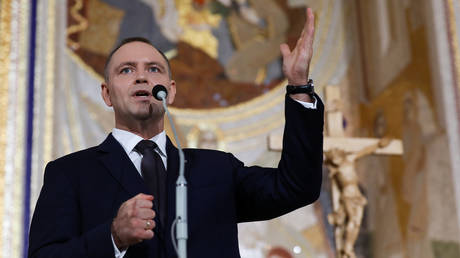
Then came the morning of July 17, 2026. With a single stroke of a pen, President Karol Nawrocki vetoed the bills.
The documents returned to the drawer. The hallway remained exactly as long, and as cold, as it had always been.
The Fortress of Paper
To understand the veto, you have to understand the specific legal armor the Polish presidency wears. President Nawrocki did not frame his rejection as an act of malice. He framed it as a defense.
The core of the argument rests on Article 18 of the Polish Constitution. Adopted in 1997, the text places marriage—explicitly defined as a union between a man and a woman—under the express protection and care of the Republic. In the president's view, the proposed cohabitation contracts were not a practical bridge for unmarried couples. They were a Trojan horse.
"Marriage cannot become one of many equally valid options offered by the state administration," the president declared during his announcement. He argued that granting the legal privileges of marriage without demanding the identical, rigorous obligations creates a parallel track. A cheaper, lighter version of the foundational family unit. In his words, the family is "fundamental to the survival of the nation."
It is a perspective built on institutional preservation. If the state begins to validate alternative domestic partnerships, the traditional structure loses its monopoly on legal security.
But out in the corridors, away from the constitutional debates, that logic translates into an entirely different currency. It translates into friction.
The Daily Friction of Non-Existence
When a state decides that your relationship does not exist on paper, the consequences are rarely cinematic. They are bureaucratic.
Consider what happens next when a partner dies in a country without civil unions. Without an explicit, ironclad will—which itself can be contested by biological relatives who haven't spoken to the deceased in a decade—the surviving partner is legally nobody. The shared apartment, the furniture bought on installment plans, the books on the shelves—all of it shifts instantly to the next of kin.
Then comes the final, bitter irony of the tax code. In Poland, if a stranger leaves you property, the state levies a massive inheritance tax. To keep the roof over your head after your partner dies, you must pay the government for the privilege of retaining what you already built together.
The compromise bill passed by parliament was designed to fix exactly these vulnerabilities. It was a patchwork law born of political exhaustion. Prime Minister Donald Tusk’s ruling coalition is a sprawling tent, ranging from progressives to agrarian conservatives. To get the 230 votes needed to pass the Sejm in May, the bill had to look less like a celebration of love and more like a corporate merger.
The left took a step back. The liberals compromised. They created a "closest person" registry. It was clinical. It was transactional.
Yet, even this muted compromise was deemed too great a threat to the nation's cultural fabric.
The Disconnect
The real tension in modern Poland isn't just between political parties; it is between the government buildings in Warsaw and the reality on the streets.
Public opinion has drifted away from the rigid stance of the presidential palace. Recent polling shows a steady, quiet shift. A majority of Polish citizens now support the legal recognition of same-sex partnerships. Society has largely normalized what the law refuses to code.
Even the judiciary has begun to move. Earlier this year, the Supreme Administrative Court ruled that same-sex marriages contracted in other European Union states must be recognized domestically for basic administrative and residency purposes. Cities like Warsaw and Wrocław actually began transcribing foreign certificates into the local system.
The country is living in a state of legal dissonance. The courts are opening windows, parliament is trying to unlock doors, and the presidency is bolting the gates.
A Quiet Corridor
President Nawrocki did leave a small, ambiguous crack in the door. He noted that he remains open to minor administrative adjustments—specifically regarding hospital visitation and basic healthcare information—provided they don't mimic the structure of marriage or introduce "ideological changes" to family law.
But for those waiting for more than a crumb of administrative charity, the veto feels definitive. It is a reminder that in the theater of symbolic politics, real people are used as stage weights.
The sun sets over Warsaw, casting long shadows through the hospital windows. Marek sits on the plastic chair. He is still waiting for a doctor who is willing to look past the lack of a marriage certificate, a doctor who will simply treat him like a human being who cares for another human being.
The law remains unchanged. The paperwork is filed away. The nation is preserved, but the hallway remains entirely dark.