The floorboards of certain houses in South Florida do not creak under the weight of history. They creak under the weight of brass.
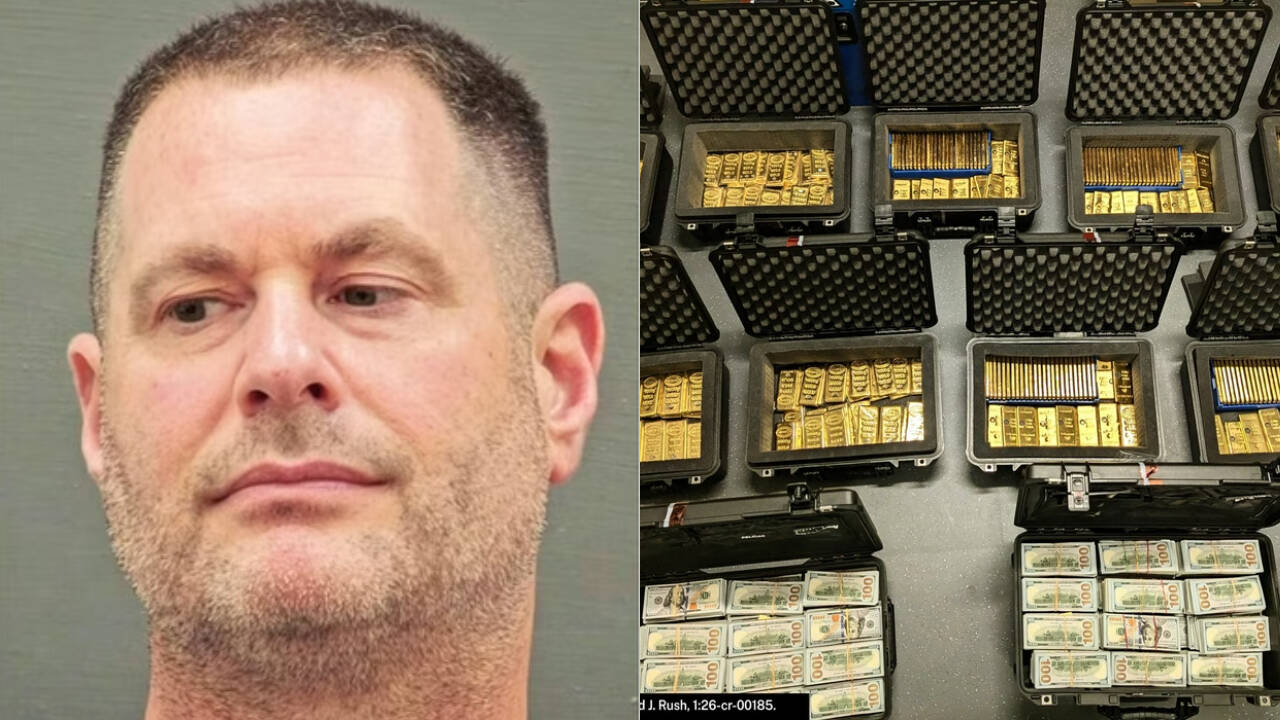
When federal agents finally turned the key in the locks of several sprawling properties across the Sunshine State, they were not looking for drugs, or missing persons, or the crude contraband of the street corner. They were looking for the quiet accumulation of a ghost. They found watches that cost more than a suburban hospital wing. They found gold bullion stacked with the indifferent precision of firewood. They found deeds, titles, and escrow accounts totaling one hundred million dollars—an empire built on the quietest currency in the world: state secrets sold to the highest bidder.
To understand how a man who once swore an oath to protect the architecture of American intelligence ends up trading his legacy for Swiss horology and heavy metal, you have to understand the anatomy of a slow moral corrosion.
It does not begin with a dramatic betrayal in a smoke-filled alleyway. It begins with a Tuesday.
Imagine sitting in a windowless room in Langley, staring at satellite feeds that show the pulse of a world you are paid to contain. You know things that the morning newspapers will not guess for a decade. You carry the friction of absolute authority paired with absolute anonymity. You are the invisible hand of the state. And then, you look at your government-issue pension, your mid-tier sedan, and the creeping realization that your children’s college tuition is a math problem you are failing to solve.
That is the exact moment the door cracks open.
Enter the foreign handler. They do not look like villains from a Saturday morning cartoon. They look like bankers. They offer patience, discretion, and a wire transfer that looks like a rounding error to a foreign treasury but feels like liberation to a man whose soul has grown thin on bureaucratic rations.
The first transfer is terrifying. Your hands shake as you type the routing numbers. The second transfer is easier. By the tenth, the money has stopped feeling like a crime and started feeling like back pay. You begin to rationalize. You tell yourself that the information you are leaking is obsolete, or that everyone is doing it, or that the empire is too vast to notice the missing brick.
Except the empire notices. It always notices. It just waits until the pile is high enough to make the forfeiture worth the ledger entry.
The assets seized in Florida read like the inventory of a pirate captain who retired into wealth management. There were the waterfront mansions where the air conditioning hummed twenty-four hours a day to keep the humidity off Italian leather. There were the chronographs—Patek Philippes and Rolexes—resting on velvet pillows inside walk-in safes, each one ticking away seconds bought with treason. Gold bars, stamped with serial numbers that could be traced back to central banks, stored not in a fortress, but in the mundane, sun-drenched suburbs of a state famous for letting people reinvent themselves.
Florida has always been the American promised land for reinvented men. It is a place where you can buy a stucco palace behind iron gates, plant palm trees to obscure the street view, and pretend that the past is a foreign country you visited once. But the past has a way of catching up, especially when it is denominated in heavy metals and high-end real estate.
Consider the mechanics of the fall. When the Department of Justice announced the forfeiture of that hundred million dollars, the headlines focused on the numbers. One hundred million. It is a figure so large it becomes abstract. It sounds like a tech startup's valuation or a lottery jackpot.
We lose the human scale in numbers like that.
Let us bring it down to the ground. Imagine holding a single one-kilogram bar of gold in your hand. It is surprisingly small—about the size of a smartphone, but so dense that it feels like a physical law of the universe trying to anchor itself to your palm. It weighs just over two pounds. Now multiply that small, crushing weight by hundreds. That is what was sitting in the dark of those Florida closets. That is what human intelligence looks like when you convert it into physical matter.
Every single watch face represents a compromise. Every square foot of marble flooring represents a secret handed over across a sticky-topped table in a European cafe.
The irony of espionage is that it is supposed to be about ideas, nations, and ideological survival. But at the end of the day, it almost always degrades into real estate. The grand architects of global conflict end up worrying about property taxes, waterfront views, and whether their portfolio is diversified against inflation. The spy who saves the world in the movies usually drives off into the sunset with nothing. The spy who sells it buys a boat in Boca Raton and spends his afternoons worrying about the salt air rusting his engine.
There is a profound loneliness in that kind of wealth. You cannot show it off. You cannot invite your neighbors over for a barbecue and explain why you own a timepiece that costs more than their mortgage. You live in a fortress of your own making, surrounded by luxury that you must pretend is modest, waiting for the heavy knock on the iron gates that you always knew was coming.
When the agents arrived, there was no shootout. There was no dramatic chase across the tarmac. There was only the quiet presentation of court documents, the click of handcuffs, and the methodical inventory of items that had names too long for a police ledger.
The gold went into canvas bags. The watches went into padded foam cases. The keys to the waterfront homes were handed over to federal receivers who will auction them off to the highest bidder, recycling the proceeds back into the machinery of the state that was once betrayed.
What remains is not the gold, and not the watches, and not the square footage of Florida coastline. What remains is the ledger of trust.
We live in an era where trust is the only scarce resource left. We trade it away cheaply, in fragments, through glowing screens and whispered conversations, forgetting that systems do not collapse from sudden impacts; they rot from the inside out, one compromised conscience at a time.
The man who traded his oath for a hundred million dollars in gold thought he was securing his future. Instead, he simply built a very expensive, very heavy cage. And now, the gold is in a vault in Washington, the watches are in evidence, and the houses belong to the ledger.
The tide comes up against the Florida seawall, exactly as it always has, indifferent to the gold buried in the floorboards, indifferent to the men who thought they could outsmart the state, washing over the sand with a rhythmic, unbroken persistence that outlasts every empire ever built.