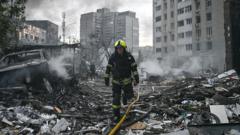
Vladimir Putin doesn't do coincidences. Just hours before NATO leaders gather in Ankara, Turkey, Russian ballistic missiles and drones tore through high-rise apartment buildings in Kyiv. The July 6 barrage killed at least nine people in the capital, injured 46 others—including five young children—and left rescue crews digging through the shattered remains of 21-story and 30-story residential blocks.
This isn't just standard wartime attrition. It's a calculated diplomatic middle finger. If you liked this post, you should check out: this related article.
The timing is incredibly deliberate. It comes right after a 90-minute phone call between Donald Trump and Putin on July 4, and exactly one day before Trump and Ukrainian President Volodymyr Zelenskyy are set to meet on the sidelines of the Ankara summit. By raining fire on civilian infrastructure, Moscow is broadcasting a message to Washington and NATO: no matter what backchannel peace deals you think you're brokering, we dictate the terms on the ground.
The Fire This Time
If you think air defenses have made Kyiv a safe haven, Monday morning was a brutal reality check. Residents woke up to the sound of more than 10 massive explosions as ballistic missiles, cruise missiles, and Shahed drones overwhelmed local defenses. For another angle on this story, see the recent coverage from The Guardian.
The destruction concentrated heavily on civilian spaces where people were asleep.
- In the historic Podilskyi district, a Russian missile scored a direct hit on a nine-story residential building, causing a partial collapse from the fifth floor up.
- In the eastern Darnytskyi district, falling debris smashed into a 25-story building and ignited a massive fire on the upper floors of a 30-story skyscraper.
- Five children, aged seven and eight, are among the hospitalized.
Emergency workers used ladder trucks to pull 22 trapped residents out of the rubble in Darnytskyi alone. Tymur Tkachenko, head of the Kyiv City Military Administration, warned that the death toll will likely rise as heavy machinery clears the concrete slabs. This follows another devastating strike just days earlier that killed 31 people, making early July one of the bloodiest periods for the capital this year.
Shaking the Table in Ankara
Why escalate right now? To understand the strategy, look at the diplomatic calendar. Zelenskyy explicitly warned his citizens on Sunday that intelligence pointed to an imminent, massive strike timed perfectly to American Independence Day and the Ankara summit. He was right.
Putin uses violence as a leverage tool before major international meetings. This summit is particularly high-stakes. Donald Trump is positioning himself as the ultimate mediator to end the war, using his recent phone calls with both Putin and Zelenskyy to set the stage for a forced negotiation. By flattening apartment buildings in Kyiv, Russia wants to show it isn't intimidated by American diplomatic pressure or NATO's collective posture.
Moscow's defense ministry naturally tried to spin the bloodshed. They claimed the strikes targeted military-industrial facilities and fuel infrastructure in retaliation for recent Ukrainian drone strikes on St. Petersburg and oil hubs inside Russia. But the smoke rising from towering residential blocks tells a completely different story.
The Grind in Donetsk and the Long-Range War
While Kyiv takes the headline-grabbing missile hits, the actual frontline remains a meat grinder. Russian forces are using this moment of political uncertainty in the West to push aggressively into the eastern Donetsk region. They want to capture as much territory as possible before any potential freeze in the conflict is negotiated.
At the same time, Ukraine isn't just taking punches. They've aggressively expanded their own long-range strike capability. Ukrainian drones have regularly hit Russian oil refineries, military factories, and ports, even managing to cut electricity in occupied Sevastopol, Crimea, earlier this week. Kyiv knows its only real leverage at the Ankara negotiation table is making the war too expensive and disruptive for the Kremlin to sustain.
For the average Ukrainian, though, geopolitical grandstanding means another night spent in a cold subway station or a concrete bunker. The next few days in Turkey will determine the trajectory of the war, but Monday's attack proves that peace is nowhere near the horizon. Expect Ukraine to push hard in Ankara for advanced air defense systems and fewer restrictions on using Western weapons to strike deep inside Russian launch sites. It's the only way they can stop the skies above Kyiv from falling.