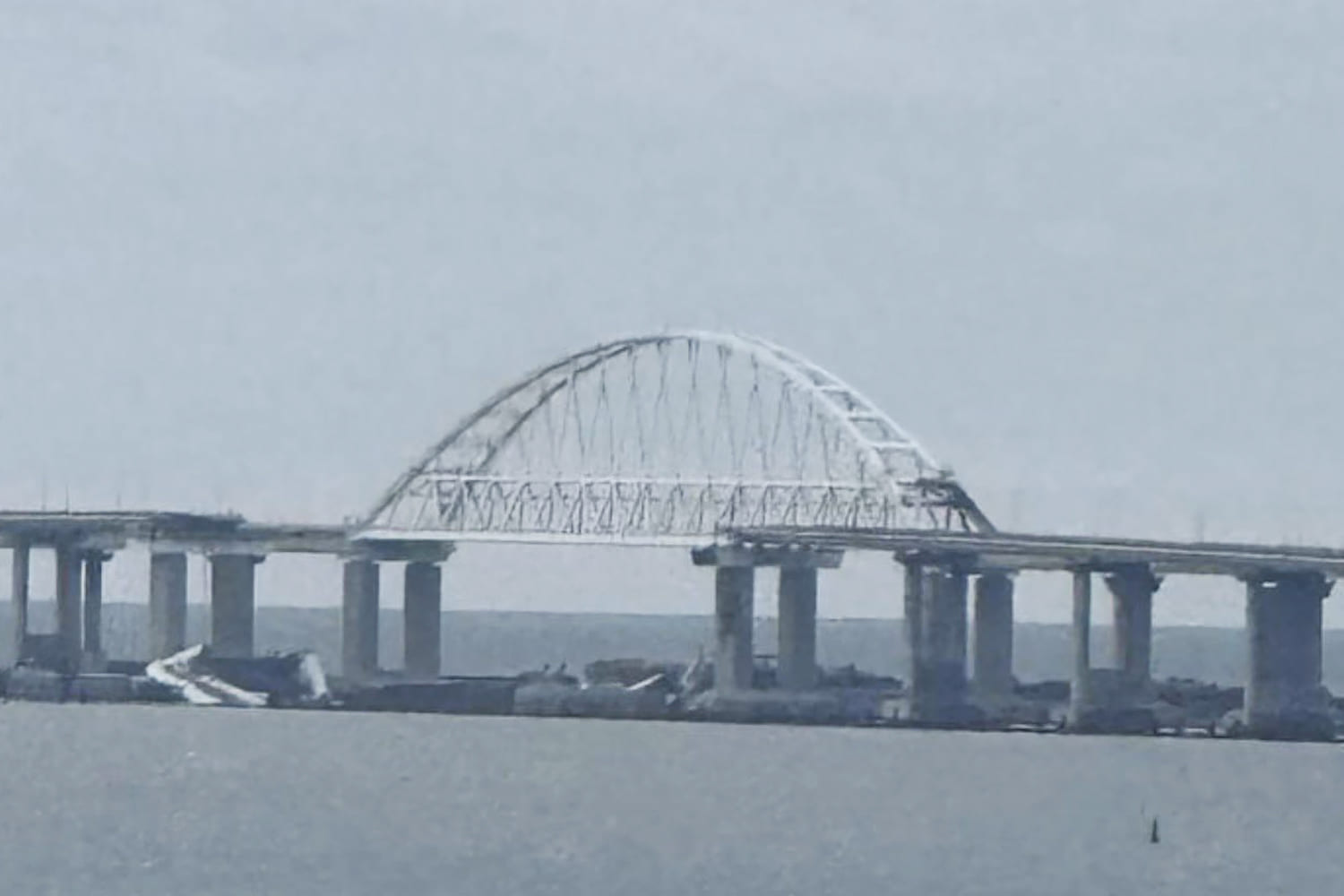
Twelve miles of concrete and steel across the Kerch Strait were supposed to cement Vladimir Putin’s legacy forever. Instead, the Crimean Bridge has become an expensive, recurring nightmare for Moscow's military planners.
When Ukrainian strikes partially destroyed sections of Putin’s prized bridge, the physical damage was only half the story. The real blow was psychological and logistical. You don't spend nearly $4 billion on Europe's longest bridge just to watch it burn on live television while your troops in southern Ukraine run low on fuel and ammunition. Meanwhile, you can explore other developments here: The Mathematics of the 2026 Alaska Senate Flip and Ranked Choice Thresholds.
Let's be clear about what actually happened and why this structure remains the single most contested piece of infrastructure in the Russo-Ukrainian war.
How Ukraine Cracked Russia’s Most Guarded Target
Russian state media spent years bragging that the Kerch Strait Bridge was virtually indestructible. They claimed it was protected from the air, the sea, and even underwater by layered air defenses, combat divers, and radar-reflecting barges. To see the full picture, we recommend the recent article by Reuters.
Then came October 2022. A massive truck bomb detonated on the roadway, collapsing two spans of the westbound road deck and igniting seven fuel tankers on the adjacent railway track. Traffic halted immediately. The Kremlin scrambled to downplay the blast, yet satellite imagery from Maxar Technologies showed the scorching reality of twisted steel and blackened concrete.
Russia patched it up, tightened security, and told the public the threat was neutralized. They were wrong.
In July 2023, Ukraine’s Security Service (SBU) and Navy proved the bridge was still vulnerable—this time from the water. Experimental unmanned surface vessels, known as Sea Baby drones, packed with hundreds of kilograms of explosives, slammed into the bridge's support pillars. Another road section collapsed into the Kerch Strait. Two civilians were killed, and the roadway was shut down yet again.
Later strikes using ATACMS ballistic missiles and coordinated drone swarms continued to test the air defense umbrella surrounding Crimea. Every time Moscow insists the bridge is safe, Kyiv finds a new angle of attack.
Why the Kerch Strait Bridge Matters So Much
To understand why Ukraine keeps targeting this bridge, you have to look at a map of the Black Sea. When Russia annexed Crimea in 2014, it took control of a peninsula that had no direct land connection to the Russian mainland. Everything—food, water, medicine, concrete, and soldiers—had to arrive by ferry or plane.
Putin needed a physical umbilical cord. Construction began in 2016, and Putin personally drove a bright orange Kamaz dump truck across the span during the May 2018 opening ceremony. For the Kremlin, the bridge wasn't just transport infrastructure. It was a concrete monument to imperial expansion.
When Russia launched its full-scale invasion in February 2022, the bridge transformed overnight from a prestige project into a critical military artery.
- Rail logistics: Russian military doctrine relies heavily on trains to move heavy armor, artillery shells, and bulk fuel. The railway span of the Crimean Bridge carried the bulk of supplies feeding Russian forces in Crimea and the southern Kherson and Zaporizhzhia fronts.
- Civilian morale: Millions of Russian tourists drove across that bridge every summer to vacation in occupied Crimea. Watching it burn shattered the illusion that the war was something happening far away to other people.
- Political symbolism: Putin tied his personal reputation to the project. Every strike against the Kerch Bridge is a direct slap at the Kremlin's authority.
The Logistics Headache Nobody Talks About
People often assume that knocking out a couple of road spans stops the Russian army cold. That's a misconception. Modern military logistics are messy, redundant, and stubborn.
Even when the road deck was partially destroyed, Russia kept running trains across the rail bridge, albeit at reduced speeds and lower weight limits. Damaged concrete takes months to cure and test under heavy loads, which forced Moscow to restrict heavy military convoys from using the roadway for extended periods.
So how did Russia adapt? They leaned heavily on two workarounds.
First, they turned back to large landing ships and civilian ferries to shuttle trucks across the Kerch Strait. That worked—until Ukrainian naval drones and Storm Shadow cruise missiles started sinking those ships in port. The destruction of vessels like the Novocherkassk and Caesar Kunikov gutted Russia's amphibious transport capacity in the Black Sea.
Second, Moscow accelerated the construction of a new railway line along the occupied Azov Sea coast, running from Rostov-on-Don through Mariupol and Berdiansk toward Crimea. This "land bridge" gives Russia an alternative supply route that doesn't rely on a single vulnerable chokepoint over open water.
Still, the Azov rail line runs much closer to the Ukrainian front lines than the Kerch Bridge does. Moving supplies there puts Russian trains directly within range of Ukrainian tube artillery, HIMARS rockets, and long-range strike drones. There is no truly safe route left for Russian logistics in the south.
Separating Fact From Wartime Propaganda
Whenever explosions rock the Kerch Strait, information warfare kicks into overdrive. Both sides have strong incentives to shape the narrative, which makes it tough to tell what's actually happening on the ground.
Russian officials routinely claim their air defenses shot down 100% of incoming missiles, blaming any visible smoke on "falling debris" or a "protective smoke screen" deployed by garrison troops. Meanwhile, pro-Ukrainian social media accounts sometimes celebrate total collapse before the smoke even clears, posting old photos or misinterpreting satellite passes.
If you want to track the real impact of any strike on the Crimean Bridge, ignore the breathless breaking-news tweets and watch three specific indicators instead:
- Satellite imagery from commercial providers: Companies like Planet Labs and Maxar capture high-resolution photos within 24 to 48 hours of major strikes. Look at the shadows cast by the bridge deck onto the water—if a shadow breaks or shifts abruptly, a span has collapsed or buckled.
- Traffic queues at Taman and Kerch: Russian transport authorities publish wait times for security checkpoints at both ends of the bridge. When queues stretch past 1,000 vehicles for days, inspection bottlenecks or lane closures are choking throughput.
- Railway freight restrictions: Watch for official notices rerouting heavy cargo onto ferries or the southern land corridor. Concrete damaged by intense fire loses its structural load-bearing capacity, even if the surface looks intact after a quick coat of asphalt.
What Russia Built to Stop the Next Attack
You can't hide a twelve-mile bridge, so Russia has tried to turn the surrounding waters and airspace into an obstacle course.
Drive near the Kerch Strait today—or look at commercial satellite photos—and you'll see layers of improvised defenses that didn't exist in 2022. Russia sank old barges along the southern approaches to the bridge, stringing heavy steel cables and floating booms between them to block unmanned surface drones from reaching the concrete piers.
They deployed Pantsir-S1 air defense systems directly onto barges and artificial islands flanking the structure. Radar reflectors sit floating in the water to confuse incoming anti-ship missiles. Even trained military dolphins were stationed in pens near Sevastopol and Kerch to detect enemy combat divers.
Does any of it make the bridge invulnerable? No. Static defenses buy time and force attackers to spend more munitions, yet they rarely stop a determined, multi-domain strike. Ukraine has consistently paired decoys with long-range missiles and naval drones to overwhelm Russian radar operators.
The Strategic Reality in the Black Sea
The partial destruction of Putin’s prized bridge marks a broader shift in how modern wars are fought. A nation without a conventional surface navy managed to neutralize Russia's Black Sea Fleet, force its warships to retreat from Sevastopol to Novorossiysk, and repeatedly cripple a multibillion-dollar strategic lifeline.
For Ukraine, keeping the Crimean Bridge under constant threat achieves multiple goals at once. It ties down elite Russian air defense batteries—like the S-400 systems—that Moscow desperately needs to protect oil refineries and airfields inside Russia itself. Every air defense battalion parked beside the Kerch Strait is one less battalion guarding troops on the eastern front.
It also reminds the Russian public that occupied Crimea isn't a secure fortress. Property values on the peninsula have slumped, hotel bookings have cratered, and military families have quietly moved back to the mainland.
When you follow future developments around the Kerch Strait, pay less attention to whether the bridge is completely dropped into the sea and more attention to its capacity. A bridge that can't carry heavy armored trains or forces every truck through a twelve-hour bottleneck has already failed its primary military purpose. Track the commercial satellite updates, watch the Black Sea naval drone engagements, and look at where Russia is forced to move its air defenses next—that's where the real story of the southern front is being written.