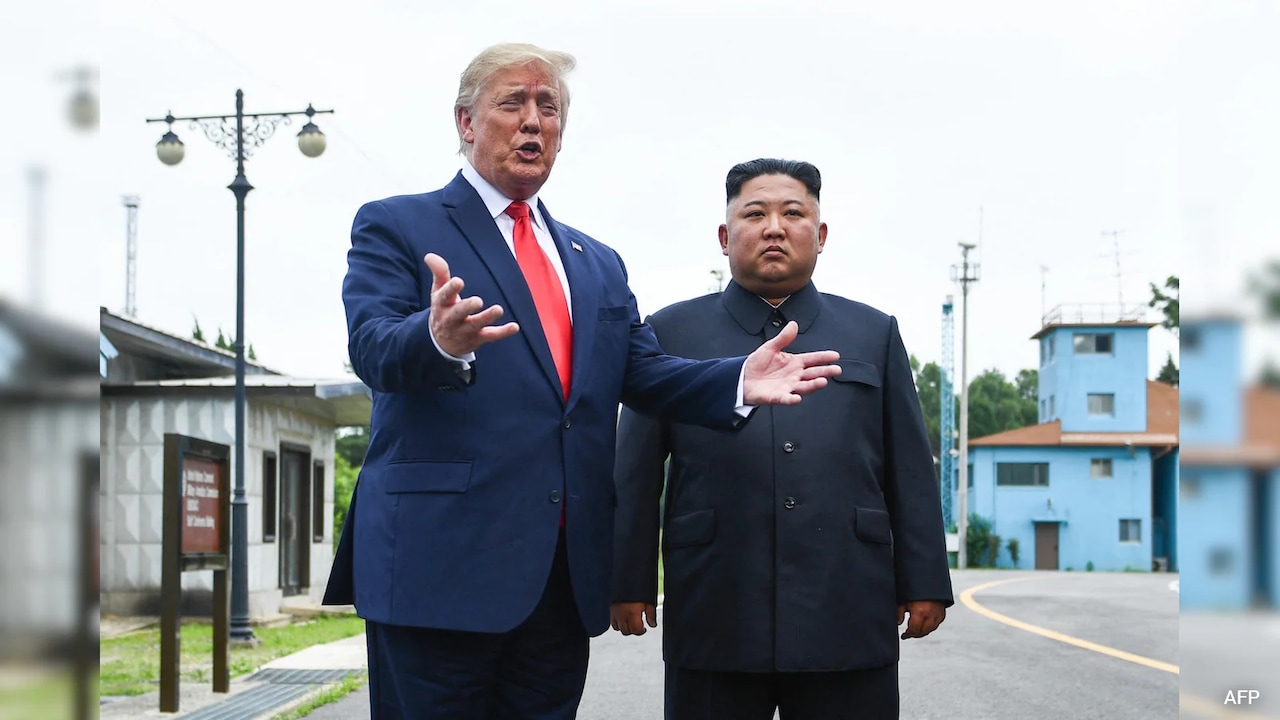
North Korea recently intensified its rhetorical assault against the South Korean administration, branding Seoul as an obedient American servant following former United States President Donald Trump's decisions to downscale combined military exercises. This dynamic reveals a persistent structural vulnerability on the Korean Peninsula. Pyongyang weaponizes alliance friction to drive a wedge between partners, exploiting domestic political shifts in Washington and Seoul to fracture joint defense postures.
When allied forces reduce the scale of theater exercises under political directives, strategic deterrence absorbs an immediate shock. Official state media in the North wasted no time labeling the South Korean leadership as colonial puppets bowing to foreign masters. Behind the inflammatory vocabulary lies a calculated pressure campaign designed to force unilateral concessions and alter the regional balance of power.
The Mechanics of Alliance Friction
Joint military exercises serve as the nervous system of the mutual defense treaty between Washington and Seoul. For decades, these large-scale deployments tested command structures, logistics networks, and rapid reinforcement protocols across the Pacific. Scaling back these maneuvers alters the readiness equation.
Military planners understand that combat readiness decays rapidly without continuous, high-tempo rehearsals. When political imperatives override operational requirements, theater commanders must find substitute methods to maintain deterrence. Computer-simulated command post drills replace field training maneuvers. While simulations save money and lower immediate diplomatic temperatures, they fail to replicate the friction of moving heavy armor, synchronizing artillery fires, and landing amphibious waves under realistic pressure.
Pyongyang monitors these adjustments with clinical precision. North Korean analysts evaluate every canceled brigade-level maneuver or downscaled air wing exercise as a tactical victory. The state apparatus interprets reduced drills not as a gesture of goodwill, but as an admission of allied weakness and hesitation.
Historical Echoes of Subversion
This pattern of psychological warfare stretches back decades. Pyongyang has consistently utilized a two-track strategy. When confronting hardline administrations in the South, North Korea deploys artillery threats and missile tests to manufacture crisis. When dealing with administration changes in Washington or Seoul that favor diplomatic engagement, the regime pivots to demanding structural concessions as a precondition for dialogue.
Labeling Seoul a servant of Washington is an intentional psychological jab aimed at South Korean national pride. South Korea possesses one of the most advanced economies and formidable conventional militaries in Asia. Yet, operational wartime command arrangements have historically tied its military architecture directly to American general staff. This structural reality provides fertile ground for North Korean propaganda.
Domestic audiences in the South view these rhetorical attacks through a polarized lens. Progressive politicians argue that scaling back exercises creates diplomatic space for peace talks and denuclearization breakthroughs. Conservative factions counter that any reduction in military preparedness invites aggression from an adversary that has never abandoned its core objective of reunification under communist rule.
Economic Strain and Internal Motivations
External belligerence often masks internal fragility. The North Korean state economy remains crippled by decades of international sanctions, structural mismanagement, and chronic resource scarcity. Maintaining a million-man standing army alongside an illicit nuclear weapons program consumes a staggering share of national gross domestic product.
Pyongyang relies on external crises to manage domestic dissent. By manufacturing tension with the alliance, the regime justifies severe internal economic controls and diverts public attention away from chronic food shortages and infrastructural decay. When state media broadcasts denunciations of Seoul as an American vassal, it reinforces an official narrative of national martyrdom. The population is taught to view military hardship as a necessary defense against foreign subjugation.
Yet, this strategy carries severe risks. Continuous escalation drains state coffers even faster than allied exercises drain western budgets. Relying entirely on nuclear blackmail limits diplomatic options when Pyongyang occasionally requires foreign humanitarian assistance or economic relief from regional neighbors.
The Strategic Dilemma for Washington and Seoul
Alliance managers face a persistent dilemma. How do you maintain credible deterrence while offering diplomatic off-ramps to a nuclear-armed adversary?
Unilateral concessions rarely yield reciprocity from Pyongyang. Historical precedents demonstrate that freezing or scaling back military drills often prompts further demands rather than immediate disarmament steps. North Korea views compromises as proof that its coercion model works.
Future policy adjustments must balance diplomatic flexibility with undeniable operational strength. If allied militaries abandon foundational readiness to appease an aggressive neighbor, the resulting deterrence vacuum invites miscalculation. The security architecture of Northeast Asia depends entirely on clarity. Ambiguity in the face of persistent hostility only accelerates instability along the thirty-eighth parallel.
The friction between Washington and Seoul over training costs, strategic burden-sharing, and operational control will continue to offer Pyongyang opportunistic openings. Exploiting these seams remains a core pillar of North Korean doctrine. Until the alliance solidifies an unyielding operational baseline that survives political transitions in both capitals, the cycle of rhetorical escalation and tactical retreat will persist unabated.