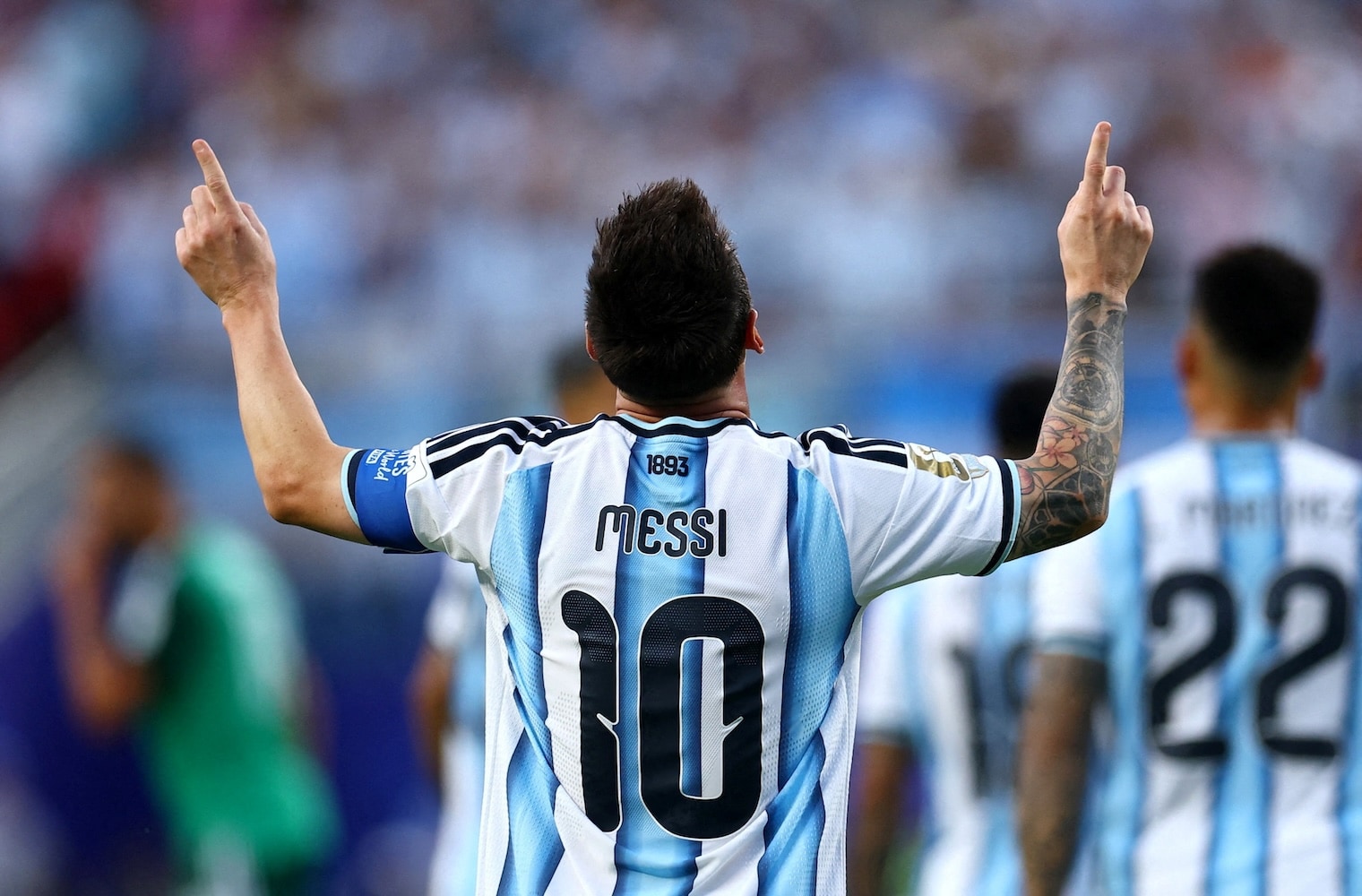
International tournament football isolates goal-scoring efficiency under conditions of extreme scarcity. Unlike a 38-match domestic campaign where regression to the mean favors elite talent, the World Cup operates within a maximum seven-game sample size. Reaching the historical output benchmark of 16 goals achieved by Miroslav Klose requires an intersection of three distinct operational variables: sustained physical durability across multiple four-year cycles, tactical integration within high-volume offensive systems, and conversion efficiency under high-leverage knockout constraints.
To evaluate the mathematical trajectory of reaching 16 World Cup goals, we must dismantle the standard narrative of individual genius and isolate the underlying structural mechanisms. When an elite forward matches this record, it represents an optimization of output that defies the standard aging curves of professional athletes.
The Tri-Factor Framework of Tournament Goal Scaling
The accumulation of historical tournament goals is governed by a strict mathematical function. Total output is not merely a product of talent; it is the net result of three foundational pillars.
1. The Longevity Coefficient (Available Minutes)
The primary bottleneck to World Cup goal accumulation is opportunity. Because the tournament occurs only once every four years, an athlete's career window typically limits them to two or three iterations at peak physical performance. Reaching 16 goals requires expanding this window to four or five tournaments. This demands an extraordinary baseline of injury resilience and the capacity to adapt playing styles as physical metrics decline.
Klose’s record was built on appearing in 24 matches across four tournaments (2002, 2006, 2010, 2014). This equates to a sustained presence in the deep knockout rounds, a variable heavily dependent on team quality. An elite forward in a squad eliminated consistently in the group stage faces a mathematical impossibility; they cannot generate the raw minutes required to challenge historical benchmarks.
2. Tactical Volume and Systemic Sufficiency
An attacker cannot score without shot generation. The offensive system must consistently penetrate the penalty box and generate high-value expected goals (xG) opportunities. In historical contexts, Germany's tactical framework during Klose's tenure prioritized lateral crossing and vertical efficiency, maximizing his specific strengths in aerial duels and first-touch finishing inside the six-yard box.
When analyzing a player like Lionel Messi, the system shifts from a volume-crossing model to a central-creator model. The goal production mechanism relies less on mechanical service and more on progressive carries, spatial manipulation, and low-lofted combinations. The structural demand on the player changes from a specialized finisher to an offensive engine who must simultaneously generate and convert opportunities.
3. High-Leverage Conversion Variance
In short-form tournaments, the variance of finishing is amplified. A cold streak of three matches in a domestic league is a minor statistical blip; the same streak in a World Cup group stage results in elimination. Players who reach the 16-goal threshold exhibit a high conversion rate relative to the quality of chances received.
The Anatomy of the Hat-Trick Shift
Scoring three goals in a single World Cup match alters a player's statistical trajectory by compressing months of expected output into a 90-minute window. This phenomenon usually occurs due to a specific tactical breakdown in the opposition's defensive block.
The first phase of a tournament hat-trick typically stems from an early breakdown in the opponent’s low block. When an underdog or a defensive team concedes early, their strategic imperative changes. They must abandon a compact defensive shape and commit numbers forward to equalize. This structural disintegration creates transition space—the exact environment where elite attackers maximize their efficiency.
The second phase involves the physical fatigue of the defensive line. In international football, preparation time is limited, leading to suboptimal defensive coordination under duress. As the match progresses past the 60-minute mark, spaces between the midfield and defensive lines widen. A trailing team chasing the game becomes highly susceptible to rapid vertical counter-attacks, allowing an elite finisher to exploit isolated 1v1 or 2v1 scenarios.
The third phase is psychological capitulation. Once a two-goal deficit is established in a knockout or critical group match, defensive discipline often yields to desperation. High-pressing triggers become disorganized, leaving the backline exposed without adequate cover from the double-pivot or defensive midfielders. The third goal of a hat-trick is rarely a product of complex positional play; it is almost always the clinical execution of an uncontested chance born from systemic collapse.
Evaluating the Metrics: Klose vs. Messi
To understand the achievement of matching a historical goal record, we must contrast the operational profiles of the two record-holders. Their efficiency metrics reveal two entirely different methodologies for achieving the same objective output.
- Mroslav Klose: A volume-based box predator. Klose’s historical profile is defined by positional discipline. He rarely dropped into the defensive third or assumed playmaking responsibilities. His goal-scoring efficiency was highly optimized within the eighteen-yard box, utilizing elite movement to convert high-probability chances created by elite wide playmakers.
- Lionel Messi: A high-efficiency, multi-phase catalyst. Messi’s goal accumulation occurs alongside elite progressive passing and shot-creation metrics. His path to 16 goals demands higher physical exertion per goal because he is frequently involved in the buildup phase, meaning his shots often originate from deeper, lower-probability zones outside the penalty area.
This divergence demonstrates that the 16-goal benchmark is not a monolithic achievement. It can be reached either through hyper-specialized efficiency within a dominant, crossing-oriented collective or through individual technical superiority that forces goals out of low-probability scenarios.
The Structural Limits of Tournament Projections
Predicting whether future athletes will surpass the 16-goal threshold requires looking at structural changes in international football. The expansion of the World Cup format introduces a counter-balancing set of variables that will alter scoring velocity.
The increase in the number of participating teams means the group stage will include a higher density of lower-ranked nations. This structural change will likely increase the frequency of high-scoring anomalies in the opening round, allowing elite forwards to inflate their goal tallies early in the tournament. A single five-goal performance against an unseeded nation could theoretically account for nearly a third of the entire historical record.
The expansion introduces an extra knockout round, extending the maximum number of matches for a finalist from seven to eight. This increases the total available minutes for elite teams, providing a larger sample size to accumulate goals within a single tournament cycle.
The opposing variable is the compounding effect of modern physical load. Elite players now log upwards of 60 competitive matches per year for their clubs. The physical degradation at the end of a grueling European domestic season introduces a high risk of soft-tissue injuries and fatigue-induced performance drops during the summer international window. While the tournament structure offers more opportunity, the human body's physiological limits create a strict ceiling on sustained output.
The future of tournament goal-scoring records will not be determined by an increase in raw technical talent. The record will belong to the player who belongs to an elite national pool capable of consistently reaching the semi-finals, operates within a high-volume attacking system, and manages their physical load to maintain peak sprint velocity and conversion efficiency into their mid-thirties. The 16-goal benchmark remains a test of systemic durability rather than a simple metric of athletic superiority.