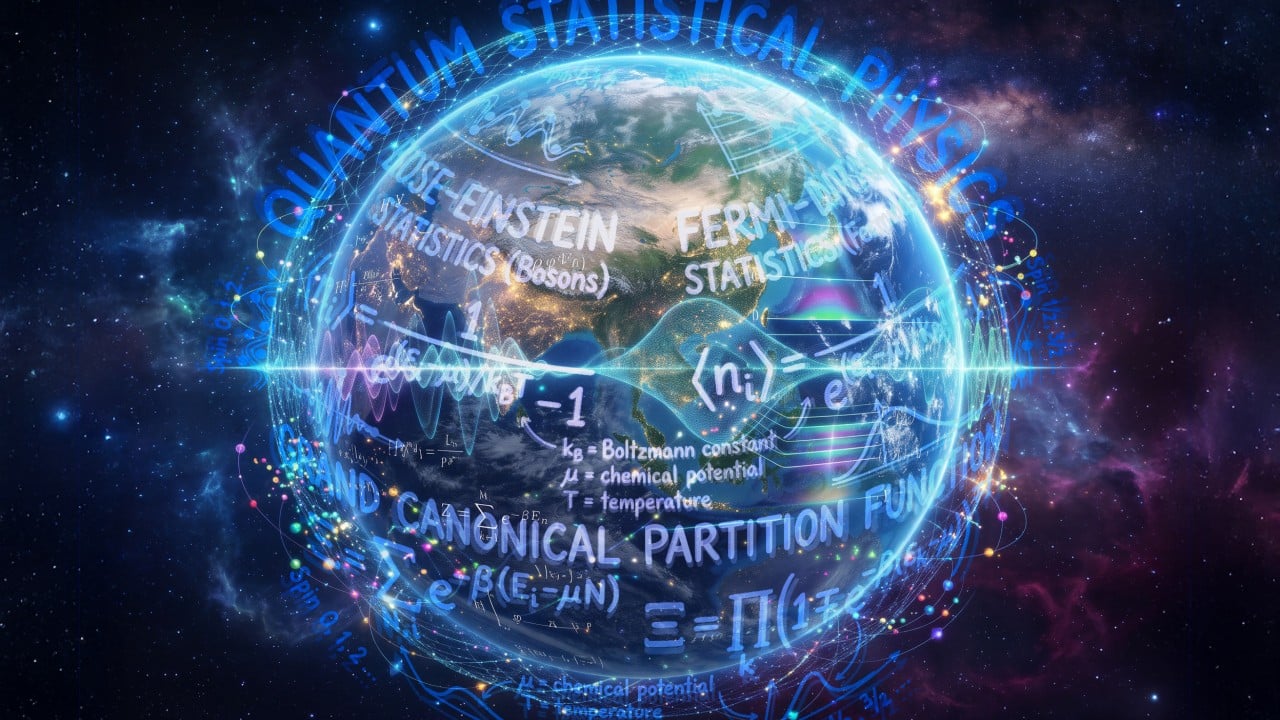
Gravity keeps your feet on the floor. Electromagnetism holds atoms together and powers your phone. Strong and weak nuclear forces run the sun.
Every high school physics textbook stops right there, claiming four fundamental forces govern our entire universe. That textbook is missing the biggest piece of the puzzle. Without quantum statistics, you wouldn't exist, stars would collapse into black holes instantly, and the chair beneath you would vanish into a microscopic speck of nothingness. Learn more on a similar topic: this related article.
Physicists often call it an "effective force" or an exchange interaction rather than a true fifth force because it doesn't rely on force-carrying particles like photons or gluons. Honestly, that's just semantics. When a rule of nature exerts outward pressure strong enough to stop a dying star from collapsing under its own gravity, calling it a force is completely fair.
Quantum statistics dictates how identical particles behave when you crowd them together. And it turns out that subatomic particles fall into two strict social clubs—one that refuses to share personal space, and another that loves piling onto the exact same spot. Additional reporting by CNET delves into related perspectives on the subject.
The Two Social Clubs of the Subatomic World
In our everyday world, if you have two identical billiard balls, you can still track which is which. Paint a tiny dot on one, or just watch their paths carefully. At the quantum scale, identical particles aren't just similar. They're fundamentally indistinguishable. You can't tag an electron. If two electrons collide and bounce away, even the universe itself can't tell which one went left and which one went right.
Because nature can't tell identical particles apart, the math describing them—specifically their wavefunctions—has to obey strict symmetry rules when two particles swap places. That math splits every known particle in the universe into two distinct families based on an intrinsic property called spin.
Fermions Are the Ultimate Introverts
Particles with half-integer spin (like 1/2, 3/2, and so on) are called fermions. Electrons, protons, and neutrons all belong to this club.
Fermions obey Fermi-Dirac statistics, which enforces a brutal rule known as the Pauli exclusion principle. Austrian physicist Wolfgang Pauli formulated this in 1925, and it states that no two identical fermions can occupy the exact same quantum state at the exact same time.
Think of an atom like an apartment building where every floor is an energy level, and every room has a specific set of quantum numbers. Electrons are stubborn tenants. Once an electron moves into a room, no other electron with the same spin can enter. New electrons have to take the stairs and fill higher, more energetic floors.
Bosons Love a Crowd
Particles with integer spin (0, 1, 2) play by the exact opposite rules. These are bosons, named after Indian physicist Satyendra Nath Bose, who worked out their behavior alongside Albert Einstein in the 1920s. Photons of light, gluons, and the Higgs boson are all members.
Bosons follow Bose-Einstein statistics. Instead of avoiding each other, they actually prefer to crowd into the exact same quantum state. The more bosons you already have in a given state, the higher the probability that another boson will join them. They're social conformists at the subatomic level, and that herding instinct creates some of the strangest phenomena in modern physics.
Why You Haven't Fallen Through Your Chair
Right now, you're sitting or standing on something solid. You probably assume your body doesn't fall through the floor because the negatively charged electrons in your clothes repel the negatively charged electrons in the chair.
Electrostatic repulsion plays a role, sure. Yet if electromagnetic repulsion were the only thing keeping atoms apart, matter would be wildly unstable and far denser than it actually is.
The real reason solid objects feel solid is electron degeneracy pressure—a direct physical push created by quantum statistics. When you sit down, you're trying to compress the atoms in your chair closer together. Doing that forces the electrons in those atoms to overlap in space. Because electrons are fermions, the Pauli exclusion principle slams the door shut. To avoid sharing the same quantum state, those electrons are forced into higher energy states, creating a massive outward resistance.
In 1967, physicists Freeman Dyson and Andrew Lenard proved mathematically that without the Pauli exclusion principle, ordinary bulk matter wouldn't just shrink. Two pieces of wood or metal brought together would collapse inward in a fraction of a second, releasing more energy than an atomic bomb. Every chemical bond, every periodic table element, and the structural integrity of your own bones depend entirely on fermions refusing to share space.
How Quantum Statistics Holds Up Dead Stars
Look up at the night sky and you're watching a trillion-year tug-of-war between gravity and quantum statistics.
While a star like our sun is alive, nuclear fusion in its core generates massive heat and outward thermal pressure that balances gravity's inward pull. Eventually, though, the fuel runs out. Fusion stops. Gravity wins the first round and crushes the star's core inward.
For stars up to about eight times the mass of our sun, that collapse stops when the core shrinks to roughly the size of Earth. At this point, the star becomes a white dwarf, and its density reaches roughly a million times that of water. A single teaspoon of white dwarf material weighs several tons.
What stops gravity from crushing it further? Not heat—the star is cooling down. It's pure electron degeneracy pressure. The electrons are packed as tightly as quantum statistics allows, pushing back against gravity with a force that doesn't depend on temperature at all.
If the dying star's core is heavier than about 1.4 times the mass of our sun—a threshold calculated by Subrahmanyan Chandrasekhar in 1930—gravity overwhelms even the electrons. The electrons get crushed directly into protons, merging to form neutrons. The core collapses further until it's only about 12 miles wide, creating a neutron star.
Now neutrons, which are also fermions, take over the fight. Neutron degeneracy pressure halts the collapse, holding up a city-sized object with more mass than our entire sun. Quantum statistics literally sets the cosmic boundary between a dead star and a black hole.
The Tech You Use Every Day Runs on Particle Rules
You don't need a telescope to see quantum statistics at work. You're staring at its output right now.
Semiconductors and Computer Chips
Every microchip inside your phone or laptop relies on Fermi-Dirac statistics. Inside a solid crystal like silicon, electrons fill up available energy levels from the bottom up, like water filling a glass. The highest filled energy level at absolute zero is called the Fermi level.
Engineers control whether a material acts as an insulator, a conductor, or a semiconductor by manipulating where that Fermi level sits and how easily electrons can jump across an energy gap when warmed up or hit with voltage. Without the strict statistical distribution of fermions across energy bands, transistors wouldn't switch, diodes wouldn't block current, and digital computing wouldn't exist.
Lasers and Superconductors
On the flip side, bosons power some of our most advanced hardware. A laser works because photons are bosons. When you excite atoms inside a laser cavity, one photon passing by stimulates an excited atom to emit a second photon with the exact same wavelength, phase, and direction. Because bosons love sharing the same quantum state, this triggers a cascade. Billions of identical photons march out in lockstep, creating a tight, coherent beam of light capable of cutting steel or reading fiber-optic cables across oceans.
Superconductivity is an even wilder trick. Electrons are fermions, so they normally refuse to flow through a wire without bumping into atoms and generating heat (electrical resistance). However, when you cool certain metals down near absolute zero, vibrations in the crystal lattice gently nudge electrons into pairs called Cooper pairs.
Here's the magic. Two half-integer spins combined equal an integer spin. By pairing up, two antisocial fermions disguise themselves as a single boson. Once they act like bosons, all the Cooper pairs drop into the exact same quantum state simultaneously, flowing through the wire as a single frictionless fluid with zero energy loss.
Weird States of Matter You Can Actually See
Push quantum statistics to temperature extremes and matter stops behaving like solid, liquid, or gas altogether.
In 1995, Eric Cornell and Carl Wieman at the University of Colorado Boulder, alongside Wolfgang Ketterle at MIT, cooled a cloud of rubidium and sodium atoms to just a few billionths of a degree above absolute zero. Because those specific atoms had an even total number of protons, neutrons, and electrons, each entire atom acted as a composite boson.
At that ultra-cold temperature, the individual atoms lost their separate identities and merged into a single giant quantum wave called a Bose-Einstein condensate (BEC). Instead of millions of separate atoms bouncing around, they behaved like one single "super-atom" visible under a microscope.
Scientists have since used Bose-Einstein condensates to slow light down to the speed of a bicycle, simulate black hole event horizons on lab tables, and build ultra-sensitive atom interferometers that detect tiny shifts in Earth's gravity for underground mapping and navigation without GPS.
Meanwhile, researchers working with ultra-cold fermions have created degenerate Fermi gases, helping us understand how matter behaves inside neutron star cores—environments we could never otherwise recreate on Earth.
What Most People Get Wrong About Quantum Forces
A common mistake when reading pop-science articles about quantum statistics is picturing electrons physically pushing each other away like tiny magnets or rubber balls colliding.
They aren't. There's no physical field shooting out from one fermion to shove another fermion aside. The "force" comes purely from probability and symmetry. When you calculate the odds of finding two identical fermions in the same place with the same spin, the math evaluates to exact zero. Nature forbids that configuration, so the particles are forced into states with higher momentum and kinetic energy.
Another misconception is thinking particles are locked into being fermions or bosons forever. In two-dimensional systems—ultra-thin sheets of electrons chilled to extreme temperatures inside strong magnetic fields—particles can actually break the usual rules. Physicists call these quasiparticles anyons. When two anyons swap places, their quantum wavefunction shifts by an angle that isn't just 0 (bosons) or 180 degrees (fermions), but any fraction in between. Microsoft, Google, and university labs are actively racing to harness non-Abelian anyons to build fault-tolerant topological quantum computers that resist environmental noise.
How to Spot Quantum Statistics in Action
If you want to build real intuition for how physics actually shapes daily life, stop treating quantum mechanics as weird math reserved for particle accelerators. Start looking for the fingerprints of fermions and bosons in the world around you:
- Check the periodic table: Notice how rows hold 2, 8, 18, and 32 elements. Every single chemical property—why oxygen bonds with hydrogen, why gold doesn't rust, why neon won't react with anything—is just the Pauli exclusion principle stacking electrons into shells.
- Look at MRI machines: Hospital MRI scanners rely on superconducting magnets cooled by liquid helium. Those magnets only carry massive electrical currents without melting because electrons pair up into bosonic Cooper pairs.
- Watch a laser pointer or barcode scanner: You're watching Bose-Einstein statistics force trillions of photons into identical quantum lockstep.
- Read up on the spin-statistics theorem: If you want the math behind why spin dictates social behavior, look into Wolfgang Pauli's 1940 proof connecting special relativity with quantum mechanics.
Physics textbooks love neat lists of four fundamental forces, yet those four forces would only produce a featureless soup without a rulebook telling particles how to organize. Quantum statistics is that rulebook—quietly giving matter its volume, stars their lifespan, and modern electronics their spark.