Glass rattles before sound arrives.
If you have ever stood near a heavy door when a shockwave passes three miles away, you know the peculiar dishonesty of that delay: first comes the shiver in the frame, a dry metallic clatter you feel in your teeth, and only a heartbeat later does the low, chest-caving thump hit your ribs. That lag is where politics lives when leaders talk about nuclear thresholds, centrifuges, and strikes that have already landed or might still come. If you enjoyed this piece, you should check out: this related article.
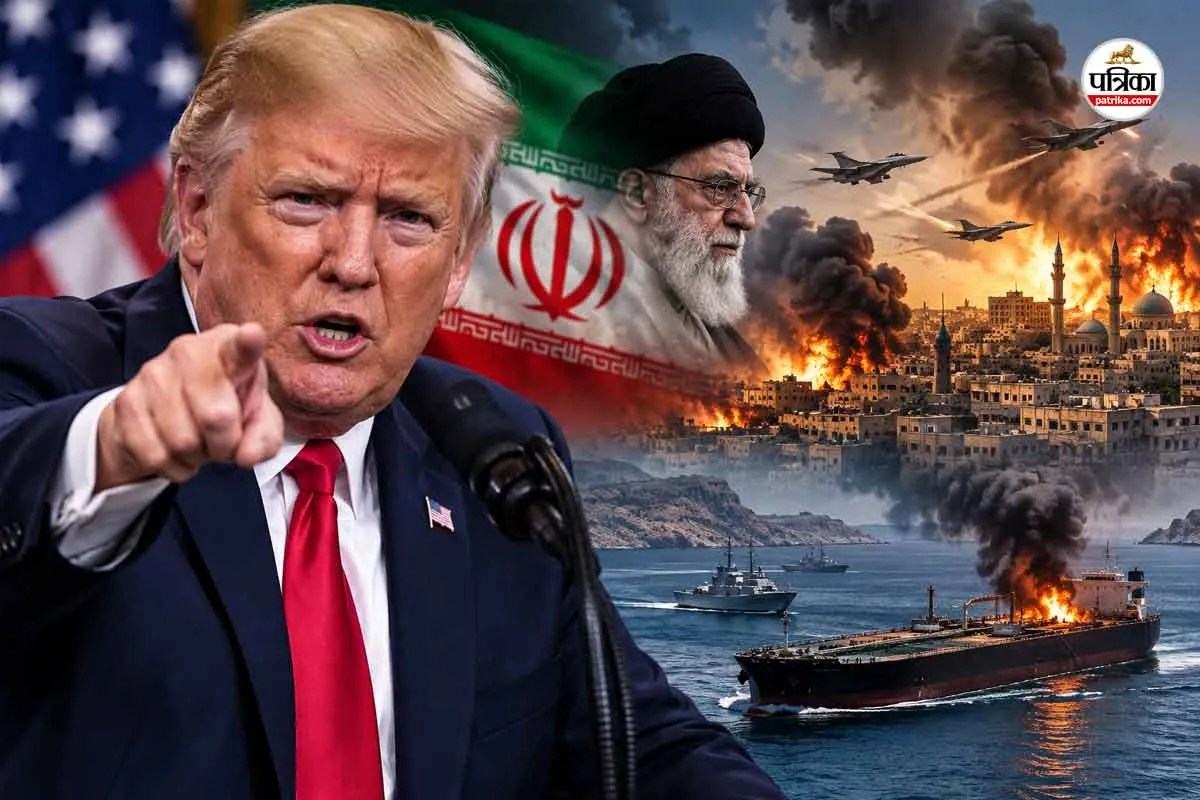
When Donald Trump declares that Iran will never have a nuclear weapon—and adds, in blunt, unvarnished street cadence, that forces have "knocked the hell out of them" and "we may go a little further"—the sentence lands like a cinderblock dropped onto a tin roof. No diplomatic wrapping. No hedging qualifiers tucked into a third paragraph. Just a hard ceiling announced from a podium, followed by the threat that the ceiling might still be pushed lower.
I have spent years watching how these moments echo far from war rooms and press briefings. In 2016, sitting in a cramped second-floor flat in Beirut while power flickered on and off every twenty minutes, I listened to neighbors argue over whether a distant escalation in the Gulf would push bread prices out of reach by Friday. Nobody in that room had a seat at the bargaining table. Everybody felt the draft under the door. For another look on this development, check out the recent update from TIME.
Words like "never" carry a seductive weight. They sound final. They sound clean. Yet nuclear history is notoriously stubborn about finality, because uranium does not read press releases, and fear has a way of multiplying in the dark.
To understand what is actually at stake when a president pairs a hard nuclear prohibition with the possibility of going "a little further," we have to strip away the theater of tough talk and look at the human ledger underneath it. Who bears the cost of a strike that stops short of regime collapse? What happens inside a closed system when its outer walls are hammered? And why does a promise of permanent prevention often become the opening act of a much messier chapter?
What "Knocked the Hell Out of Them" Really Means on the Ground
Street language is effective because it skips euphemisms. "Degrade," "set back," "interdict"—these are words written by committees to make violence sound like accounting. Saying you knocked the hell out of an adversary tells you something different: someone intends the blow to hurt, to leave visible wreckage, and to project unmistakable dominance.
Military force against a hardened, dispersed nuclear program rarely looks like a single movie explosion that turns everything to ash in one frame. Think of it instead like taking a sledgehammer to a subterranean plumbing network. (Note: This plumbing comparison is a metaphor to illustrate how dispersed infrastructure behaves under attack.) You can smash exposed valves, collapse shafts, sever power lines, and crack concrete casings. A heavy strike can set back enrichment timelines, destroy specialized equipment that takes years to machine, and rattle the confidence of planners who thought depth and secrecy would keep them safe.
Yet hammered pipes can sometimes be patched in secret, rerouted through narrower channels, or rebuilt with lessons learned from what broke. Worse, strikes that bruise without extinguishing a program can harden the resolve of hardliners who argue that only a nuclear deterrent guarantees survival. That is the central paradox of coercive force in nonproliferation: the very blow meant to close the door permanently can convince the people behind it that bolts and deadlocks are no longer enough.
Consider a hypothetical scenario to make this friction concrete. Imagine a mid-level engineer—let's call him Darius, purely as a composite stand-in for the thousands of technicians working inside state-backed facilities—driving home at dusk after a shift where alarms flashed and ventilation hummed unevenly. He is not an ideologue giving fiery speeches on state television; he is a man worried about his daughter's asthma medication and whether his paycheck will buy rice next month. When external strikes hit facilities tied to his sector, his daily reality shifts overnight. Checkpoints multiply. Security interrogations grow sharper. Rumors spread through family group chats about power outages, damaged substations, and air defenses stretched thin.
For ordinary people in Tehran, Isfahan, or Shiraz, a grand strategic declaration from Washington rarely arrives as an abstraction. It arrives as anxiety at the pharmacy counter, currency swings that wipe out savings in an afternoon, and the quiet dread of sirens or blackouts. A leader can claim decisive success in a soundbite while a family thousands of miles away is rationing fuel and wondering if the water pressure will hold until morning.
And there is another invisible stake: regional spillover. The Middle East is a tightly wired circuit. When sparks fly near the Persian Gulf or the Levant, shipping lanes tighten, insurance premiums jump, and neighboring states—already strained by refugees, inflation, and proxy rivalries—brace for fallout they never asked to invite.
Why "Never" Is the Hardest Word in Statecraft
There is a temptation, whenever tensions spike, to treat nuclear proliferation like a light switch. Either the switch is off, or it is on. Either Iran has a weapon, or it does not.
Reality is far messier. Between a peaceful civilian energy program and a tested nuclear warhead lies a long, gray corridor of capability: enriching uranium to higher purities, mastering conversion and metalization, building delivery systems, and assembling the technical know-how to dash toward a device if leadership ever gives the final order. A country can cross thresholds of knowledge and industrial capacity long before it tests a bomb—or even before it formally decides to build one.
When a president says Iran will "never" have a nuclear weapon, that pledge functions on two levels at once. First, it is a statement of national policy and resolve: the United States views a nuclear-armed Iran as unacceptable and is willing to use military force, economic pressure, or both to prevent it. Second, it is a political promise that creates its own trap. If intelligence later suggests covert reconstitution, or if regional escalation spirals beyond what voters stomach, "never" leaves very little room for quiet accommodation without looking like retreat.
I have to admit something here that makes tidy punditry uncomfortable: I do not have a crystal ball, and neither does anyone shouting certainty on cable news. Anyone who claims with 100 percent confidence that a series of strikes has permanently erased years of technical knowledge—or conversely, that military pressure never alters an adversary's calculus—is selling certainty where genuine ambiguity lives. History is crowded with confident predictions that aged poorly within eighteen months.
Look back at how states have approached the bomb over the past eighty years. Sometimes deterrence and diplomacy held; sometimes sanctions squeezed; sometimes preventive strikes delayed programs; sometimes regimes chased weapons precisely because they feared being toppled without them. The pattern is not a single straight line. It is a tug-of-war between fear, ambition, cost, and miscalculation.
That is why "we may go a little further" carries such sharp edge. Ambiguity about the next step is intentional. If an adversary knows the exact limit of your willingness to strike, they can plan around the boundary. Keep them guessing whether the next move is a follow-up strike, cyber pressure, tighter enforcement, or a pivot back to hard bargaining, and you force them to defend everything at once.
Yet strategic ambiguity has a twin: domestic and allied uncertainty. Allies in the region want protection without becoming the primary target of retaliation. Markets want predictability, even when politicians thrive on surprise. And citizens watching from afar are left trying to read tea leaves out of twenty-second clips.
The Human Cost of Brinkmanship
Let's be honest about what brinkmanship feels like for people caught in its crossfire. It rarely peaks in one dramatic hour and then vanishes. More often, it settles into a low-grade hum that wears people down week after week.
Think about another hypothetical figure—let's call her Leila, an import-export clerk in a Gulf port city whose livelihood depends on steady maritime trade and calm skies. When headlines scream about strikes and possible further action, her inbox fills up with delayed shipments, rerouted vessels, and nervous clients asking whether contracts will hold. Nothing may hit her city directly, yet her stability erodes by inches. Every rumor of a missile launch or naval standoff sends a ripple through household budgets and sleep schedules.
This is the part of foreign policy coverage that gets flattened when stories are reduced to quotes and counter-quotes. Leaders trade blows in rhetoric; diplomats trade warnings through intermediaries; commentators score points on toughness. Meanwhile, real people adjust their routines around risks they cannot control.
There is also the danger of misreading signals. In high-tension environments, every radar blip, troop movement, or unscripted remark can be interpreted through worst-case lenses. A warning meant to deter can be read as proof that full-scale war is imminent. A pause meant to test restraint can be read as weakness. When both sides assume the worst about the other's intentions, accidents become far more plausible than anyone admits out loud.
Why does this cycle repeat so reliably? Because both sides are answering internal pressures as much as external ones. Domestic politics rewards strength and punishes perceived softness. Rivals project toughness to keep allies loyal and deter challengers. Once momentum builds, stepping back without losing face becomes extraordinarily difficult.
Still, recognizing the trap is not the same as surrendering to it. Toughness does not have to mean blindness to consequences, and caution does not have to mean passivity. The hardest strategic work happens in the space between blind escalation and wishful thinking—asking hard questions about what each move achieves, what it risks, and what comes the day after.
What Comes After the Blow
A strike or a threat of further action is a tactic, not a complete strategy. Even the heaviest punch only answers the question of what happens in that moment; it does not automatically answer what happens six months later when the dust settles and daily life resumes.
If the goal is genuinely preventing a nuclear weapon while avoiding a wider, ruinous war, every step has to be judged against that standard. Will going "a little further" permanently shut down pathways to a bomb, or will it drive remaining work deeper underground and sever the last threads of verification and oversight? Will pressure force concessions, or will it unite a fractured population around a besieged leadership?
Nobody gets to dodge those questions forever. Eventually, every crisis runs into physical limits, economic realities, and human exhaustion. Leaders may speak in absolutes—never, knocked the hell out, a little further—because absolutes project control in a world that stubbornly refuses to sit still.
Watch the glass by the window. When the rattle stops, the quiet that follows isn't always peace. Sometimes it's just the pause before everyone checks to see what didn't break—and what's still holding its breath.