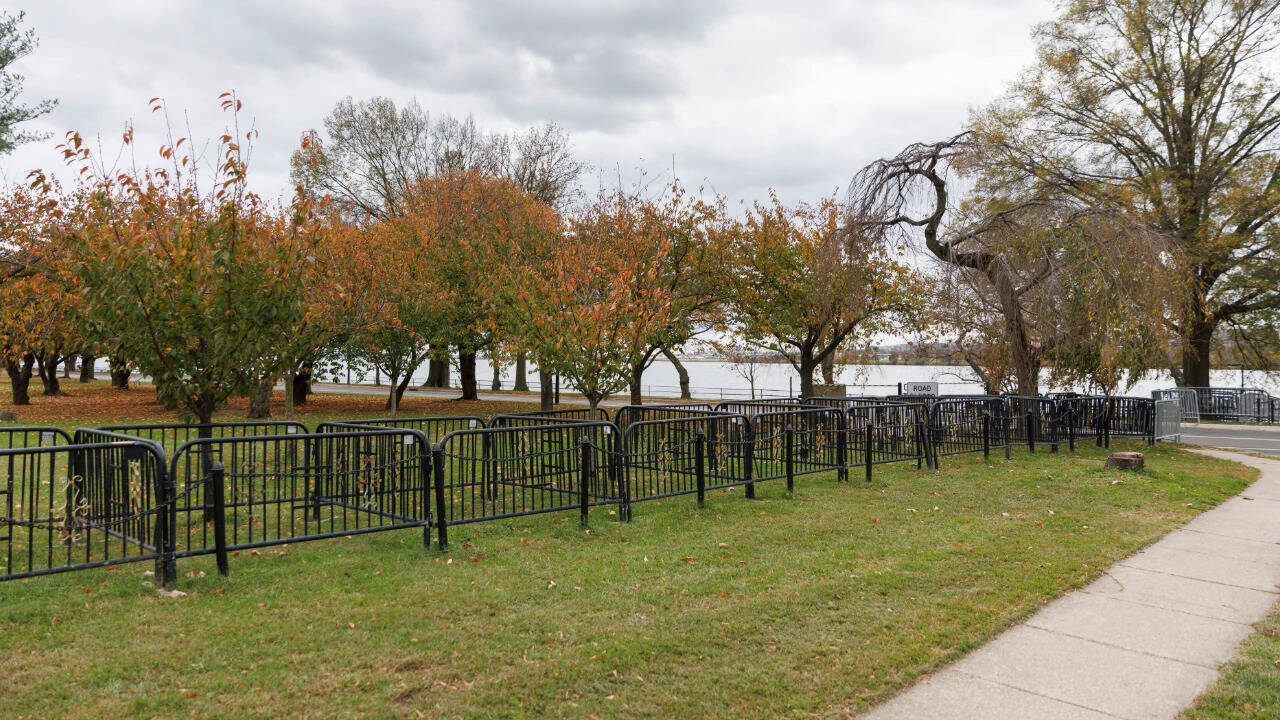
Dew sits heavy on the seventh green at East Potomac Golf Links just before six in the morning. The Washington Monument rises out of the river mist like a pale finger pointing at the sky, and the hum of commuter traffic across the Potomac River has not yet turned into a roar.
Wait. Listen closely. Discover more on a similar subject: this related article.
Beneath the muted thwack of a forged iron meeting a scuffed range ball, there is the sound of history breathing. For more than a century, this narrow spit of land wedged between the Washington Channel and the Potomac River has belonged to everyone and no one at all. It is municipal turf. It is democratic grass. And for the past several months, it sat squarely in the crosshairs of a federal tug-of-war that nearly erased it from the map.
When a federal judge stepped in this week to halt the Trump administration’s plan to shutter the historic Washington, D.C. golf course for sweeping redevelopment, the headlines treated it like another routine legal skirmish in a city addicted to court orders. They gave you the dates, the docket numbers, and the dry statutory citations. They missed the heartbeat entirely. Because what happened on that peninsula is not really about zoning laws or executive overreach or even golf. It is about what happens when public memory collides with private ambition—and who gets left standing in the parking lot when the gates swing shut. More analysis by The Guardian highlights related perspectives on the subject.
The Man with the Mismatched Clubs
To understand why a federal injunction over 18 holes of public parkland matters, picture a hypothetical regular at the East Potomac driving range. Let’s call him Arthur.
Arthur is seventy-two, retired from the postal service, and walks with a slight hitch in his left hip that only disappears during the backswing. He does not own a country club membership. He cannot afford a three-hundred-dollar greens fee in the Virginia suburbs, nor does he have any interest in manicured bunkers guarded by security gates. Three mornings a week, Arthur pulls a canvas bag stuffed with mismatched clubs out of the trunk of a 2011 Honda Accord, pays a modest fee at the counter, and walks onto grass that was explicitly designed so a guy like him would never be turned away.
Arthur is an invention for the sake of clarity, yet he stands on that tee box every single morning in a hundred different bodies. He is the teenager from Anacostia learning grip pressure from a volunteer coach. He is the tired Capitol Hill staffer burning off frustration at twilight. He is the retiree who found community after his spouse passed away, tethered to the living world by a standing 7:15 AM tee time.
When you close a place like East Potomac—even temporarily, even under the banner of "modernization" or "redevelopment"—you do not simply pause a business operation. You sever a civic artery. Once a public space is fenced off and handed over to grand architectural visions, ordinary people rarely get it back in a form they can afford to touch.
I have watched this script play out in cities across the country. I remember standing outside a beloved municipal track in the Midwest years ago, peering through chain-link fencing wrapped in green privacy mesh while executives promised the neighborhood a "world-class athletic destination." Five years later, the weeds had been replaced by glass pavilions, private valet stands, and membership tiers that priced out ninety percent of the zip code. The promise of improvement is the oldest Trojan horse in urban politics.
Concrete, Segregated Past, and Public Promise
East Potomac was never meant to be a playground for the ultra-wealthy. Its origins are rooted in one of the most radical ideas in American civic life: that beauty, leisure, and open space belong to the working public by right, not by wealth.
Built on dredged river silt in the early twentieth century, the course opened its first nine holes in 1920, designed by Walter Travis, one of the greatest golf architects of his era. Think of East Potomac not as a luxury resort, but as a public library where the books are made of turf, sand, and river wind. Just as a library lets a kid from a modest apartment read the exact same edition of Moby-Dick as a billionaire on Fifth Avenue, a municipal golf course puts everyday citizens on the exact same architectural canvas as the elite.
Yet that promise was not born pure. Like so much of Washington, D.C., the fairway carries scars. For decades, Black golfers in the nation's capital were barred from playing on the white courses, relegated to inferior facilities until persistent, courageous civil rights organizing forced the federal government to desegregate East Potomac in the 1940s and 1950s. Men like S.B. Fuller and local activists fought for the right to walk those exact fairways. Their victory transformed East Potomac into a vital hub for Black golfers and working-class families in Washington—a living monument to hard-won access.
To bulldoze or fundamentally alter that landscape without rigorous legal scrutiny is not merely an administrative choice. It is an erasure of layered American history.
What Actually Happened in the Courtroom
So how did we arrive at a federal judge slamming the brakes on the White House’s plans?
The conflict traces back to the administration's push to reimagine federal properties and recreational assets around the capital. Under proposals advanced by Trump officials, the existing operations and structure of East Potomac Golf Links faced closure to make way for an aggressive redevelopment overhaul—one critics argued would dismantle the historic character of the course, displace existing community programs, and bypass mandatory environmental and historical review processes.
Consider what happens next when a federal agency tries to move fast on protected parkland:
- The Statutory Wall: Federal land in the District of Columbia is not a blank check. Under the National Historic Preservation Act and the National Environmental Policy Act, major alterations to historic sites listed on the National Register of Historic Places—which includes East Potomac Park—require transparent public comment, environmental impact assessments, and formal historic preservation reviews.
- The Challenge: Preservationists, local golfers, and civic advocates argued that the administration was attempting to shortcut these guardrails, pushing toward closure before the public or historic oversight bodies had a meaningful say.
- The Ruling: The federal judge agreed that the challengers raised serious, substantial legal questions about whether the government had bypassed required statutory procedures. By issuing the injunction, the court froze the closure plan in its tracks, ruling that you cannot lock the gates and tear up historic public ground first and ask for legal permission later.
Law is often caricatured as cold machinery, all Latin phrases and dusty binders. But in moments like this, an injunction acts like an emergency brake pulled on a speeding train just before a washed-out bridge. It forces everyone to stop, step out into the daylight, and look at what is actually about to be destroyed.
The Architecture of Exclusion
Why does a golf course trigger such fierce emotional gravity? After all, skeptics love to point out that golf takes up vast acreage, consumes water, and carries a reputation as an elitist pastime. It is a fair critique—and one I used to share before I spent real time watching who actually uses municipal courses.
If you want to see the difference between private privilege and public democracy, stand on the first tee at a municipal course on a Saturday morning. You will see union electricians paired up with federal judges, college students sharing carts with grandmothers, immigrants learning the rhythm of the game alongside third-generation Washingtonians. There is no velvet rope. There is no dress code policed by a nervous twenty-year-old in a blazer.
When private-style redevelopment enters the picture, the language always sounds seductive. Officials talk about "elevating the experience," "upgrading infrastructure," and "maximizing asset value." Those phrases are the corporate dialect of exclusion. Upgrading an asset almost always means upgrading the price tag. Maximizing value almost always means filtering out the people who cannot pay premium rates.
We have seen this across American cities for twenty years. Public parks get handed over to private conservancies or luxury developers under the premise that the government cannot afford maintenance. Slowly, subtly, the public space changes posture. Security guards replace park rangers. Paid event spaces swallow open lawns. Free youth clinics get squeezed into undesirable hours to make room for corporate outings. Nobody hangs a sign that says Keep Out. They just raise the threshold until regular folks quietly stop coming.
The Weight of Unfinished Business
Of course, a preliminary court order is a pause, not a permanent truce. Anyone who has followed federal litigation knows that injunctions buy time, not immunity.
The government still holds immense leverage over how National Park Service land is managed, leased, and maintained. East Potomac genuinely does need care. Anyone who has played there after a heavy rainstorm knows the drainage issues are real, the clubhouse has seen better decades, and the course infrastructure requires thoughtful investment. Pretending the facility is flawless does no favors to the people who love it.
The tension—the genuine, uncomfortable puzzle at the heart of this story—is how you repair a historic public treasure without destroying its soul in the process. If you do nothing, time and river water slowly erode the course. If you hand it over to unchecked redevelopment, ambition erodes its accessibility.
Finding the narrow path between decay and gentrification requires patience, transparency, and a willingness to listen to the people who actually walk those fairways at dawn. That is precisely what federal preservation laws were written to enforce. They are intentionally slow because concrete is permanent. Once you pour it, once you reroute a historic hole or demolish a century-old layout, no court order can un-pour it.
Morning on the Peninsula
For now, the gates remain open.
Tomorrow morning, before the city wakes up and the political arguments resume on cable news and in appellate briefs, the sprinklers will hiss to life along the Potomac River. The mist will lift off the water channel. Somewhere near the practice green, an older man with a worn leather glove will pull a seven-iron from an aging canvas bag, take two slow practice swings to loosen a stiff hip, and watch a white ball climb cleanly against the marble silhouette of the Washington Monument.
Nobody owns the view. Nobody owns the grass. For one more morning, at least, the ground holds firm beneath his feet.