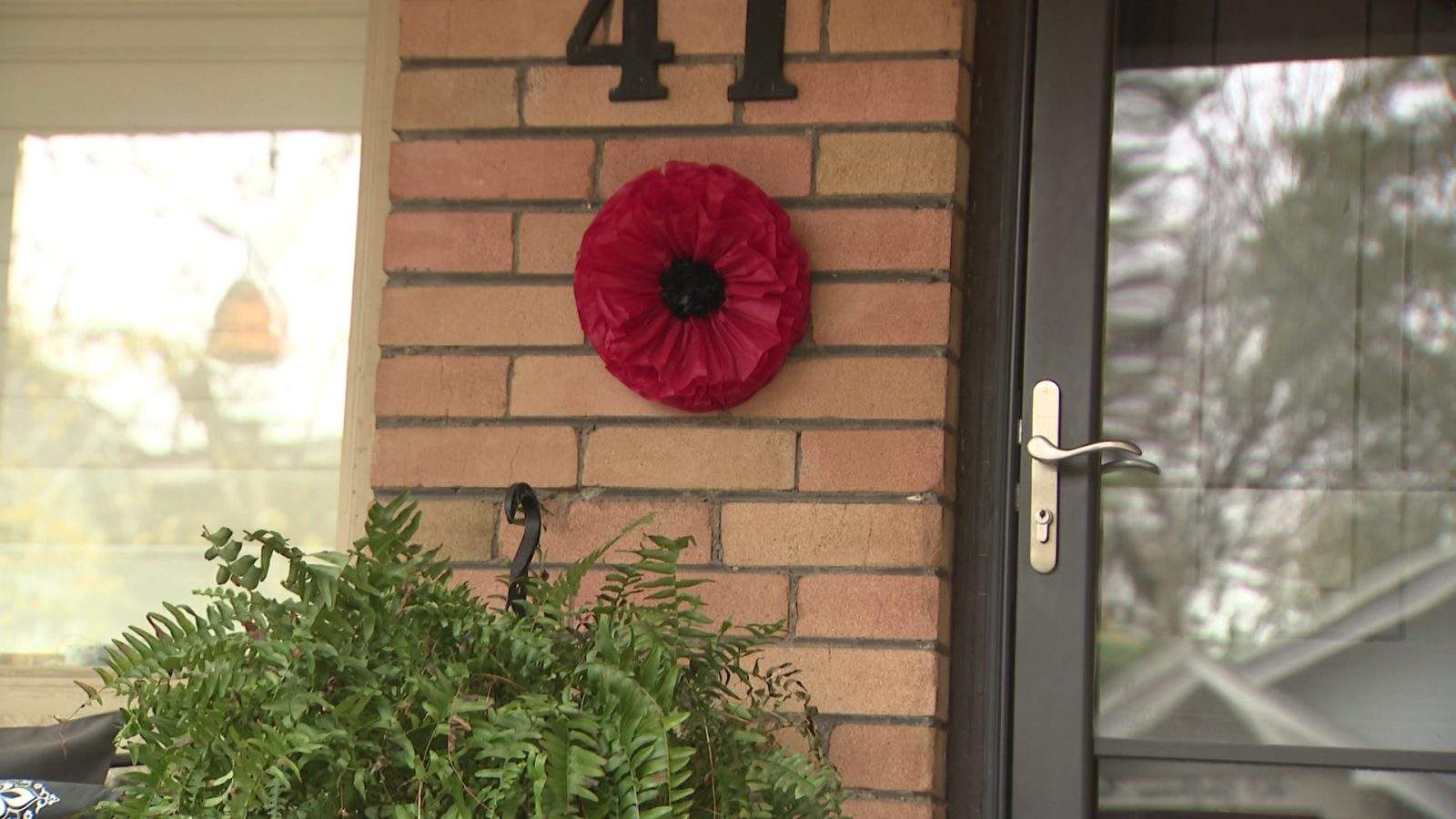
They sit on front porches in November, catching the slant of autumn light before the frost takes hold. Oversized. Weather-resistant. Cut from sturdy corrugated plastic and painted a shade of crimson that refuses to fade against gray siding.
Door poppies.
If you have driven down a quiet residential street in Canada or parts of the Commonwealth during the first two weeks of November, you have likely seen them hanging beside brass house numbers or tucked neatly into porch planters. They are larger than the traditional felt lapel pins—nearly the size of a dinner plate—designed not for a wool coat, but for a home. To the casual passerby, they look like a simple seasonal decoration, a polite nod to Remembrance Day.
Look closer.
Behind almost every single one of those oversized red blooms is a quiet, desperate math problem playing out inside aging brick buildings across thousands of small towns. It is the math of dwindling membership rolls, rising utility bills, and the vanishing generation of men and women who once kept the lights on. And often, the person standing behind the workbench, cutting those poppies out by hand with a utility knife and a prayer, is someone like Claire.
Let us step into a hypothetical garage on a Tuesday evening in late October to understand what is really happening. Picture a woman in her late sixties—we will call her Claire, though she has a hundred real-world counterparts from Nova Scotia to British Columbia. Her father landed at Juno Beach in 1944, came home with shrapnel in his left shoulder and a silence he carried for fifty years, and spent every Friday night until his death at the local Royal Canadian Legion branch.
Claire remembers the smell of that hall from her childhood. Floor wax. Cheap coffee. Damp wool coats drying near the radiator. She remembers the fierce, unshakeable pride of the men who built it—men who pooled their own money after the war because they needed a place where nobody had to explain why they couldn't sleep through a thunderstorm.
Now, the roof on that very same hall is leaking. The commercial furnace is thirty years old and groaning like a dying animal. And the men who built it are almost all gone.
The Invisible Collapse of the Cornerstone Hall
To understand why a veteran’s daughter spends her autumn evenings covered in red paint dust, you first have to understand what a local Legion actually does—and how close many of them are to turning off the lights forever.
There is a persistent, dangerous myth that the Royal Canadian Legion is flush with government cash, sustained effortlessly by tax dollars and massive national endowments. That is false. Completely false.
Local Legion branches are autonomous, non-profit community hubs. They pay their own property taxes. They pay their own heating bills, insurance premiums, and roof repairs. While the annual Poppy Campaign raises tens of millions of dollars nationally, strict rules govern every single cent dropped into those familiar plastic counter boxes. Poppy Trust Funds are legally ring-fenced: they can go directly to veterans, their families, medical equipment, housing, and bursaries, not to fixing a cracked foundation or paying the electric bill at Branch 42.
For decades, branches survived on hall rentals, dart leagues, meat draws, and membership dues. That model worked when a town of five thousand people had four hundred active members.
Then time did what time always does.
Between 2010 and 2020, hundreds of branches across North America closed their doors or merged to survive. The Second World War generation—the bedrock of these institutions—passed into history. Korean War veterans followed. Even the younger veterans of Afghanistan and peacekeeping missions often found themselves disconnected from the traditional hall culture, busy raising young families or navigating modern work schedules.
Suddenly, a forty-year-old building that used to host three hundred people on a Saturday night had forty aging members trying to cover a four-thousand-dollar monthly overhead.
I walked through a struggling branch hall a few winters ago, and the cold inside was physical. The thermostat had been turned down to fifty-eight degrees to save on natural gas. On the wall hung framed black-and-white photographs of young men in crisp uniforms, smiling from 1943, while buckets sat beneath a stained ceiling tile in the corner to catch melted snow. The bar was empty. The volunteer treasurer—a retired schoolteacher with arthritis in both hands—spread a ledger across the laminate table and pointed to a single column in red ink.
"If the boiler goes this winter," she told me quietly, "we don't have a next winter."
When a local Legion closes, a town doesn't just lose a bar or a bingo night. It loses the place that hosts the Boy Scouts for free. It loses the emergency warming shelter during ice storms. It loses the service officers who sit across the table from a twenty-eight-year-old corporal with traumatic brain injury, helping him navigate three hundred pages of Veterans Affairs paperwork without charging a dime.
Why a Bigger Poppy Changed the Equation
This is where the door poppy enters the story—not as a craft project, but as a lifeline.
Think about the traditional lapel poppy. You drop a toonie into a box at the grocery store, pin the red felt to your jacket, and walk out into the wind. By afternoon, the pin has slipped out, and the poppy is lying on a wet sidewalk somewhere near the parking lot. It is a fleeting, private gesture.
Door poppies flip that dynamic entirely.
Made from corrugated plastic—the same weatherproof material used for real estate signs—or occasionally painted wood and metal, a door poppy measures anywhere from twelve to eighteen inches across. It has a black center, a bright green leaf, and a pre-drilled hole at the top for a nail or suction cup. They typically sell for twenty to thirty dollars each.
Because they are sold directly as a branch fundraiser rather than through the national Poppy Trust boxes, the proceeds can often be directed straight toward branch operations and community support programs, depending on how the local branch structures the drive.
More importantly, a door poppy turns remembrance from something you wear into something your neighborhood sees.
Consider what happens next on a suburban street when one house puts up a giant red poppy on November 1st.
By November 3rd, the neighbor across the street notices it while walking his dog. He asks where it came from. By November 5th, four houses on the block have them. It creates a visual contagion of solidarity. Unlike a lapel pin, which disappears inside a car or an office building, a door poppy stands guard all day and all night, visible under porch lights during the rain, impossible to ignore when you pull into your driveway.
For the daughters and sons of veterans—people who grew up watching their parents polish brass buttons before the November 11th parade—making and selling these signs has become a deeply personal act of preservation.
Inside the Workshop of Remembrance
If you have never tried to cut fifty circles out of heavy-duty corrugated plastic by hand, it is hard to appreciate the sheer physical stubbornness required to run a grassroots door-poppy campaign.
Let us return to Claire in her garage. It is 9:30 PM. Her hands ache.
Corrugated plastic doesn't slice cleanly like paper; the internal flutes catch the blade, forcing you to score, press, and snap every curve twice. One slip of the wrist leaves a jagged edge or a sliced thumb. First come the templates—cardboard cutouts traced over and over until the edges fray. Then come the red petals. Then the black centers, cut separately and fastened with weatherproof rivets or industrial adhesive so a November gale won't rip them apart. Finally, the green leaves, angled just so, because veterans will notice immediately if the leaf isn't positioned at eleven o'clock.
Why do it? Why spend eighty hours in a chilly garage breathing in plastic dust when you could simply write a two-hundred-dollar check and go to bed?
Because a check buys a week of electricity, while a door poppy buys a conversation.
When Claire sets up a folding table outside the local hardware store on a Saturday morning, people don't just hand over twenty dollars and walk away. They stop. They lean against the display rack.
An elderly woman in a blue parka traces the edge of a poppy with a gloved finger and mentions that her late husband served on a corvette in the North Atlantic. A young father holding a toddler's hand asks why the leaf is pointing up instead of down, giving Claire thirty seconds to explain the symbolism of life returning to the fields of Flanders. A teenager buying drywall screws for his dad pauses, pulls a crumpled twenty from his pocket, and says, "My granddad used to go to the hall on Fourth Street. Is it still open?"
"Yes," Claire tells him, taping a receipt to the back of the poppy. "Because of this, it is."
That exchange is the real currency. A bank transfer is silent. A door poppy forces a town to look at its own history in broad daylight.
The Anatomy of a Grassroots Lifeline
To see how quickly a simple craft effort can alter the trajectory of a struggling hall, look at the numbers behind real-world door poppy drives across Canada over the past few years.
In small communities from rural Ontario to Vancouver Island, individual volunteers—frequently women in their fifties, sixties, and seventies whose fathers or grandfathers served—have taken it upon themselves to manufacture hundreds of these signs each autumn.
Take the math of a modest, single-person operation:
- Materials per poppy: Roughly $3 to $5 in bulk corrugated plastic sheets, vinyl lettering or outdoor paint, and fasteners, often donated outright by local sign shops or lumberyards once they hear who it is for.
- Sale price: $20 to $25 per poppy.
- Volume: A dedicated volunteer working evenings through September and October can produce 150 to 300 poppies.
Do the arithmetic. Three hundred poppies sold at twenty-five dollars each generates $7,500 in gross revenue. With donated materials, nearly every dollar goes straight into the local Legion’s lifeline.
Seven thousand dollars doesn't build a new stadium. It doesn't make national headlines. What it does is pay for an entire winter's worth of commercial heating oil. It repairs the wheelchair ramp at the front entrance so an eighty-nine-year-old Korean War veteran doesn't have to navigate icy steps. It keeps the kitchen open for the monthly community breakfast where isolated seniors eat eggs and toast for six dollars and talk to another human being for the first time all week.
And the ripple effects go further than the balance sheet.
When local newspapers or community Facebook groups pick up the story of a veteran's daughter hand-cutting poppies in her basement to save her dad's old hall, something shifts in the town's collective psychology. People realize the Legion isn't an invincible monument. They realize it is fragile. They realize that if they don't show up, nobody else is coming to rescue it.
The Complicated Truth About Tradition and Survival
It would be dishonest to pretend that every door poppy campaign is smooth sailing, or that everyone agrees on how remembrance should look in the twenty-first century.
The rules surrounding the poppy trademark in Canada are famously strict—and for good reason. The Royal Canadian Legion holds the legal trademark on the poppy symbol in order to prevent commercial exploitation. Without those guardrails, unscrupulous vendors would slap poppies on cheap t-shirts and coffee mugs every November, pocketing profits while veterans got nothing.
Because of those protections, volunteers cannot simply start mass-producing poppy merchandise on their own without official branch authorization. Every legitimate door poppy campaign has to go through proper local channels, ensuring that the design respects national guidelines and that every penny is accounted for by a branch executive committee.
Sometimes, that bureaucracy creates friction. I have spoken with eager volunteers who felt bogged down by approval forms, and branch presidents who worried nervously about whether outdoor signs would weather properly or draw complaints from national headquarters. There is also the quiet tension inside many halls between old-school traditionalists—who believe fundraising should look the way it did in 1975—and a younger generation of family members who know that if the Legion doesn't adapt its visibility, it will vanish within a decade.
It is messy. Volunteer-run organizations always are. You have tired people, strong personalities, tight budgets, and immense emotional stakes colliding in rooms that badly need a fresh coat of paint.
Yet when you walk down a street on November 10th and see fifty bright red blooms bolted to front porches, those committee arguments evaporate. What remains is unmistakable.
What Hangs on the Door After the Parade Ends
There is a particular silence that falls over a small town on the afternoon of November 11th.
The bugler has packed away the horn. The wreaths are leaning against the cold granite of the cenotaph, their ribbons fluttering slightly in the November breeze. The crowds have drifted home to warm kitchens and afternoon football games. In the local Legion hall, the last of the stew is being ladled out, the chairs are being stacked, and someone is sweeping wet footprints off the linoleum floor.
For the daughters and sons of the Second World War generation, that afternoon carries a specific kind of grief. Every year, the rows of surviving veterans at the front of the ceremony grow shorter. Soon, there will be nobody left who remembers the roar of a Lancaster bomber overhead, or the taste of rationed tea, or the exact weight of a wool greatcoat soaked with Channel seawater.
When the last eyewitness is gone, memory becomes entirely dependent on the architecture we leave behind—the halls, the archives, the stories passed down at kitchen tables, and the quiet promises kept by the people who refused to let the doors lock.
Go back to that hypothetical garage in late October, one final time.
The worktable is clear now. The last drop of crimson paint has dried on the final batch of signs. Claire turns off the overhead fluorescent light, locks the side door, and walks up her front steps into the crisp dark. Before she goes inside, she pauses beside her own front door and adjusts the oversized red poppy hanging beside the porch light, straightening the green leaf so it points cleanly toward eleven o'clock.
Across the street, another red circle catches the glow of the streetlight. Two houses down, another. Down the block, a fourth.
They are just sheets of cut plastic, painted red and black, bolted to wood and brick. They cannot bring back the young men who never came home from Normandy, and they cannot turn back the clock for the aging halls struggling to survive another winter.
They simply hang there in the cold, refusing to come down, holding the line at the front door.