Silence.
That is what hits you first when a country stops working. Not the shouting in the plazas, not the rhythmic thud of drums bouncing off limestone facades, and not the sirens wailing down Madrid’s Gran Vía, though all of those arrive soon enough. The first shock is the unnatural, heavy quiet of a Tuesday morning when the shutters of the corner bakery stay pulled down, the commuter trains sit dead on their tracks, and the low, constant hum of an economy simply vanishes. Read more on a similar issue: this related article.
Millions of people do not walk away from a day’s wages on a whim. In a country where household budgets are already stretched thin enough to snap, losing a single shift means skipping a utility payment, putting off a dental visit, or telling a child that the school trip is off the table. When millions of Spaniards choose to absorb that financial bruise anyway, they are not participating in a political exercise. They are pulling an emergency brake.
To understand why Spain’s general strike brought the country to a standstill—and why, paradoxically, the political right is surging in the polls at the exact same moment—you have to look past the parliament building in Madrid. You have to look at the kitchen tables where the math stopped working years ago. Further reporting by Al Jazeera delves into similar perspectives on this issue.
The Arithmetic of Exhaustion
Consider a hypothetical composite of the modern Spanish worker, let us call her Elena. She is thirty-four, lives on the outskirts of Valencia, and holds a university degree in logistics. On paper, Elena is part of Spain’s post-pandemic success story. Unemployment has ticked down, tourism numbers are breaking records, and macroeconomic charts presented in Brussels show Spain outpacing much of the Eurozone in raw GDP growth.
Elena cannot eat GDP growth.
Her contract is technically permanent, a victory heralded by recent labor reforms, yet her take-home pay barely clears fourteen hundred euros a month. Eight hundred of those euros disappear on the first of every month into the bank account of a landlord who has raised the rent twice in three years. Another three hundred vanishes at the supermarket, where olive oil—the liquid gold of the Spanish diet—has spent years priced like fine scotch, and basic staples cost a third more than they did before the inflation wave hit. What remains must cover electricity, transit, phone bills, and the vague, terrifying concept of "the future."
Elena is not destitute. She is trapped. She works forty-plus hours a week only to tread water in a current growing faster every season.
When you multiply Elena’s kitchen table by four million households, you stop having a collection of personal struggles and start having a powder keg. The general strike was not sparked by a single piece of legislation or one outrageous soundbite from a minister. It was the cumulative detonation of years of silent erosion—the feeling that the social contract, the unwritten promise that hard work buys stability, had been quietly shredded while nobody was looking.
Inside the March
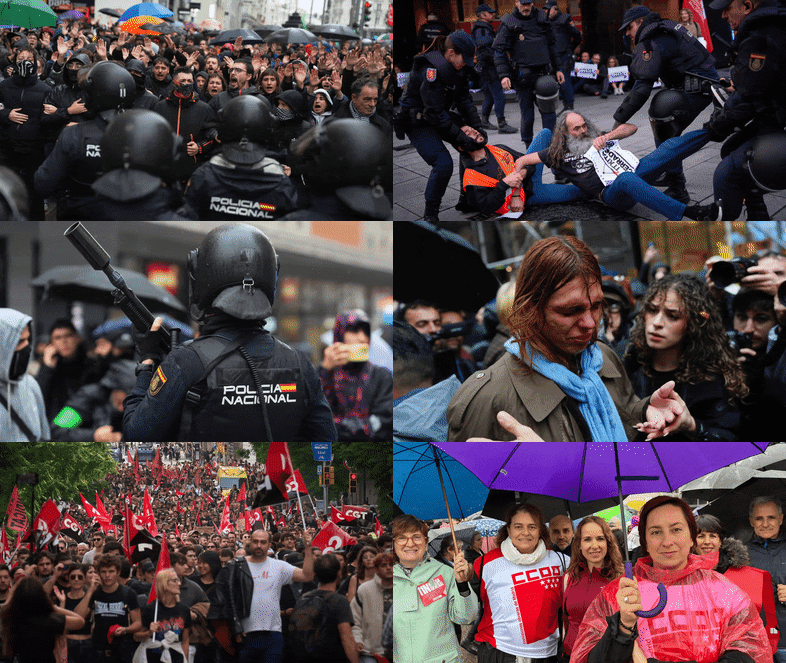
If you have ever stood inside a general strike in southern Europe, you know it does not feel like a polite civic gathering. The air smells of burnt coffee, cheap tobacco, and ozone from the flares lit by union stewards at the front of the column. The asphalt vibrates beneath tens of thousands of boots moving in slow, deliberate unison.
Walk through the crowd in Barcelona, Seville, or Bilbao, and the sheer variety of the anger becomes obvious. Beside dockworkers in high-visibility vests march hospital nurses whose eyes still carry the hollow fatigue of endless double shifts. Behind them come teachers holding hand-painted cardboard signs, delivery riders leaning on battered bicycles, and pensioners whose white hair catches the afternoon sun as they chant the same slogans they shouted forty years ago, wondering how they ended up fighting the same battles twice.
I remember watching a similar mobilization years ago in Madrid, standing near Atocha station as a wall of people spilled out from the boulevard. What struck me then, and what defines the current walkout across Spain, was not rage. Rage is hot and erratic; it burns out quickly. What filled those streets was something colder and far more dangerous to any sitting government: cold, methodical exhaustion. People were not marching because they expected miracles from the politicians watching from behind heavy curtains. They were marching because staying silent felt like consenting to their own erasure.
Union leaders stepped up to microphones across dozens of cities to demand immediate wage indexation, stronger caps on housing costs, and genuine protections against the soaring cost of living. Their message was blunt: corporate profits in banking, energy, and hospitality have surged while real purchasing power for working families has stagnated or fallen. In the eyes of the strikers, the recovery has been privatized, while the bill has been handed directly to the people cleaning the hotel rooms and stocking the shelves.
The Paradox in the Polling Booths
Here is where the story takes a sharp, uncomfortable turn—one that leaves conventional political analysts scratching their heads.
Historically, when labor unions mobilize millions of workers against corporate greed and high living costs, the political left reaps the harvest. Strikes are the traditional heartbeat of progressive movements. Yet look at the polling data across Spain right now, and a completely different picture emerges. While the streets belong to the unions, the momentum in the ballot box belongs to the political right.
How does a mass expression of working-class fury end up strengthening conservative and nationalist parties?
Think of a household roof that has been leaking for five years. The current homeowner spends all day explaining the complex meteorological patterns causing the rain, promising that a comprehensive study on shingle durability is underway, and pointing out that the neighbor’s roof is leaking even worse. Meanwhile, someone walks up to the front door with a hammer, a tarp, and a simple, brutal promise: I will stop the water coming into your living room tonight.
You do not ask the person with the hammer about their long-term architectural philosophy. You just want your floor to dry.
For millions of Spanish voters, the governing coalition has become synonymous with institutional paralysis, endless ideological skirmishes, and a perceived disconnect from daily material reality. While ministers debate intricate social policies or trade barbs over regional autonomy agreements needed to keep their fragile parliamentary majority alive, ordinary citizens feel their core anxieties—rent, groceries, energy bills, and neighborhood security—are treated as secondary footnotes.
The political right has stepped directly into that vacuum with surgical precision.
How the Right Captured the Discontent
It is a mistake to assume the surge of Spain’s right-wing parties—both the traditional center-right People’s Party (PP) and the hard-right Vox—is driven solely by wealthy business owners or cultural traditionalists. That old electoral map is dead. The new battleground is the working-class suburb, the industrial belt, and the mid-sized provincial town where young people cannot afford to move out of their parents' bedrooms until their thirties.
Right-wing strategists understood something crucial long before their opponents did: economic pain rarely stays purely economic. When people feel squeezed financially, they become hyper-aware of where every tax euro goes. They begin to resent bureaucratic bloat, high payroll taxes, and policies that feel imposed from above without consent.
When conservative leaders talk about slashing taxes, cutting red tape for small business owners, and prioritizing national economic sovereignty, they are speaking directly to the shopkeeper whose margins were wiped out by electricity bills and social security contributions. When they take a hard line on immigration and public order, they are tapping into the anxieties of neighborhoods where public services already feel strained to the breaking point.
Consider another hypothetical scenario—not to endorse a viewpoint, but to see the mechanics of persuasion at work. Imagine a fifty-two-year-old self-employed plumber in Zaragoza. He wakes up at six, works until seven, and watches nearly half his gross income disappear into taxes and mandatory fees before he pays a single supplier. During the general strike, he closes his van doors—not out of solidarity with the big national unions, whom he views as subsidized extensions of the state, but out of sheer disgust with a system that punishes effort. When he looks at the political menu, the left offers him subsidies he doesn't qualify for and regulations he hates. The right offers him one intoxicating word: relief.
Whether that relief ever materializes once power changes hands is almost beside the point. In politics, direction matters more than destination. The right has successfully positioned itself as the vessel for anti-establishment frustration, turning a strike aimed at corporate and economic inequality into an indictment of the sitting government’s competence.
The Invisible Stakes Behind the Slogans
Strip away the party flags and the union banners, and what is actually happening in Spain is a quiet crisis of legitimacy. This is not unique to Madrid; it is the defining tremor shaking democracies from Paris to Berlin to Rome.
For decades, European politics operated like a pendulum swinging gently between center-left social protection and center-right market efficiency. Both sides accepted the same basic guardrails. Both assumed that each generation would live slightly better than the one before it.
That assumption has broken.
Young Spaniards today are the first generation in modern democratic history facing the very real prospect of ending up poorer than their parents, despite being the most educated cohort the country has ever produced. Homeownership, once the bedrock of Spanish middle-class identity and retirement security, has become a luxury good reserved for those with generational wealth or foreign salaries. Renting is no longer a temporary stepping stone; it is a permanent extraction mechanism.
When an entire generation realizes the ladder has been pulled up, their politics stop being polite. They become transactional, impatient, and willing to burn down old loyalties to see if something new works. Some take to the streets behind union banners, demanding the state step in and force wealth downward. Others turn sharply to the right, demanding the state get out of the way, cut taxes, and restore order. Both groups are reacting to the exact same wound.
Why Conventional Answers Fail
If you talk to economists in Madrid, they will patiently explain why there are no easy levers left to pull. Spain carries a heavy public debt load—hovering around a hundred percent of GDP—leaving the government with razor-thin fiscal room to hand out massive new subsidies without triggering alarms in Brussels or spooking bond markets. Raise the minimum wage too aggressively without corresponding productivity gains, and small businesses simply stop hiring or shift work into the shadow economy. Cap rents too tightly, and landlords pull apartments off the long-term market altogether, converting them into tourist rentals or leaving them empty, which shrinks supply and drives prices even higher.
Every move carries a counter-move. Every cure threatens to worsen the disease.
Yet explaining macroeconomic constraints to a family choosing between heating and groceries is like reading an engineering manual to someone trapped in a flooded basement. People do not vote for footnotes. They vote for dignity. They vote for the feeling that someone in power actually hears the alarm bells ringing in their own homes.
What makes this moment in Spain so volatile is that both the street protests and the polling surge are feeding off the same fuel: distrust. Strikers distrust employers and politicians to protect their living standards without being forced. Voters distrust the government to manage the economy without burying them in taxes and inflation. Institutions that took decades to build after the transition to democracy are losing their shock absorbers.
The Morning After
Eventually, the banners get rolled up. The sanitation trucks roll down the avenues at three in the morning, sweeping away flattened cardboard signs, trampled flyers, and empty water bottles. By Wednesday afternoon, the shutters on the corner bakery slide back up with a metallic rattle, the commuter trains resume their schedule, and Spain goes back to work.
On the surface, everything looks normal again.
Beneath the surface, nothing has been resolved. The structural fault lines—an economy overly reliant on low-wage service jobs, a housing market choked by scarcity and speculation, a demographic time bomb of an aging population—remain completely intact. The strike proved that millions of citizens still possess the collective muscle to halt the country in its tracks. The polls prove that millions more are ready to hand the keys of government to the political right at the first available opportunity.
Neither the walkout nor an election alone will magically lower the price of a liter of olive oil or build half a million affordable apartments overnight. Until someone finds a way to make the daily arithmetic of Spanish life add up again, that heavy, unnatural quiet on a Tuesday morning will never be far away. And the next time the shutters stay down, they may stay down a lot longer.