Silence.
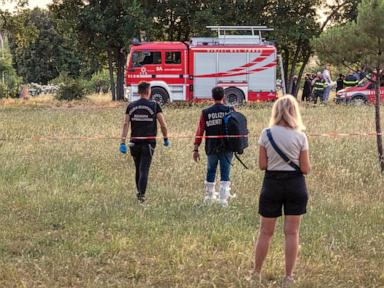
In Rome, silence is rarely an accident, especially in early June when the city’s stone streets bake under the afternoon sun and the air hums with the low, rhythmic thrum of vespas, church bells, and distant voices arguing over espresso. Yet inside the sprawling, sun-dappled expanse of Villa Doria Pamphili—Rome’s largest public park, a place normally reserved for Sunday strollers, joggers tracing the ancient aqueducts, and children chasing pigeons near the fountains—a different kind of quiet settled over the tall grass on a Saturday afternoon in 2025. For another perspective, consider: this related article.
It was the heavy, suffocating stillness that precedes a siren.
When passersby stumbled upon the bodies of a young woman and an infant girl hidden among the greenery of that historic park, the city did not merely witness a crime; it collided with a nightmare that defied the glossy, romanticized postcard image of the Eternal City. Within weeks, an international manhunt stretched across the Mediterranean to the Greek island of Skiathos, ending with the arrest of an American man who had lived under aliases, spun elaborate fictions of wealth and cinema, and left two lives shattered in the Roman dust. By late 2026, an Italian court handed down the heaviest sentence available under its legal code: ergastolo, life imprisonment. Further insight on this matter has been shared by BBC News.
To read the standard police blotter or the clipped, clinical wires from the courthouse in Piazzale Clodio is to learn the dates, the charges, and the verdict. An American national. Double aggravated homicide. Concealment of a corpse. Life behind bars.
Those facts are true, and they are cold. They tell you what happened, yet they explain almost nothing about how a young mother and her baby ended up alone in the dark of a public park, or why the warning signs of coercive control and domestic violence so often look, from the outside, like charm.
The Architecture of a Mirage
To understand how a tragedy like this unfolds, consider a hypothetical scenario—a composite drawn from thousands of documented cases of domestic abuse and coercive isolation across borders. Picture a young woman, thousands of miles from home, navigating a foreign city where the bureaucracy is labyrinthine, the language moves too fast when you are tired, and your entire social safety net fits inside a single suitcase.
In that vulnerable space, confidence acts like a magnet.
When someone arrives claiming to be a filmmaker, a man of means and connections—someone who knows the right people, speaks with effortless authority, and promises a future built on art and security—skepticism feels like ingratitude. You want to believe the story because the alternative is admitting you are completely alone. That is how isolation works in real life. It rarely begins with a locked door or a raised fist; it begins with a narrative so compelling that you slowly stop checking the receipts.
In the real case that unfolded in Rome, investigators peeled back the layers of the defendant’s life only to find a hall of mirrors. Known to authorities under multiple identities—including Francis Kaufmann and the cinematic alias Rexal Ford—he moved through the margins of European cities projecting an image of creative ambition and transient luxury. While the court records meticulously cataloged the forensic timeline of June 2025, the deeper reality revealed during the investigation was a textbook study in rootlessness and fabrication.
Why does a fabricated identity matter so much in a murder trial? Because control requires an airtight room. If a partner has no real ties to a community, no verifiable employer, no fixed address, and no family network nearby, the victim has no anchor to hold onto when the weather turns violent. Every argument happens in a vacuum. Every threat echoes without witnesses.
I have sat in courtrooms where domestic violence cases are dissected months or years after the fact, and the most haunting detail is never the physical evidence bagged in plastic. It is the realization of how invisible the danger was to the people standing ten feet away. Neighbors hear footsteps on the stairs and assume someone is just carrying groceries; baristas see a quiet mother pushing a stroller and assume she is simply exhausted from sleepless nights. We are conditioned to respect privacy, to look away from other people’s domestic lives, right up until the moment yellow police tape stretches across the trees.
What the Forensic Record Reveals
In the Italian judicial system, securing a sentence of ergastolo—life imprisonment—requires more than proving a defendant caused a death. Italy abolished the death penalty decades ago, making life imprisonment the absolute ceiling of judicial accountability, reserved for crimes marked by specific aggravating circumstances.
During the proceedings in Rome, prosecutors had to reconstruct the final hours of the victims—a young woman later identified through international cooperation and genetic testing as Anastasia Trofimova, and her infant daughter, Andromeda, barely eleven months old. The forensic findings painted a grim, undeniable sequence of events that stripped away any claim of accident or sudden, unpremeditated panic.
Think of an investigation like trying to reassemble a shattered glass vase in a dark room using only a flashlight. Every shard—a security camera frame outside a train station, a ferry ticket booked toward Greece, a mobile phone signal pinging off a tower near the Aurelian Walls, a witness who remembered a man carrying a small child through the park at dusk—had to be matched edge-to-edge until the vessel held water.
The autopsy results and investigative timeline established three critical realities that anchored the prosecution's case:
- The Vulnerability of the Victims: One victim was an infant incapable of defense or flight; the other was a young mother isolated far from her country of origin, lacking the institutional and familial support systems that might have intervened earlier.
- The Method and Concealment: The physical evidence demonstrated deliberate, lethal force followed by efforts to hide the bodies within the dense vegetation of Villa Pamphili, delaying discovery while the perpetrator fled the country.
- The Flight Across Borders: Rather than seeking medical help or alerting authorities, the accused crossed international borders to Skiathos, attempting to vanish into the seasonal tourist crowds of the Aegean before European arrest warrants closed the net.
When the verdict came down in Rome, the courtroom reaction was subdued, heavy with the exhaustion that follows prolonged exposure to human cruelty. There is no triumph in a life sentence when one of the victims never lived to see her first birthday.
The Invisible Distance Between Help and Silence
Here is the uncomfortable truth that most crime reporting glosses over: we love a monster story because monsters let the rest of us off the hook.
If we frame the killer in Villa Pamphili simply as an anomaly—a wandering fraudster who snapped in a foreign capital—we can close the browser tab, shake our heads at the tragedy, and go back to our morning coffee. We do not have to ask why a young mother with a baby was living in precarious conditions in the heart of a major European capital without a single social worker, consular official, or community advocate knowing her name.
Cross-border relationships and transient expat or migrant lives carry an invisible tax. When you live outside your home country, every normal safety mechanism degrades. You do not know which local hotline actually answers at two in the morning. You worry that calling the police might jeopardize your visa status, your housing, or your custody of your child. If your partner holds the money, speaks the local language better than you do, or convinces you that the authorities will take your baby away if you report a domestic dispute, silence stops feeling like a choice. It feels like survival.
Consider what happens next when a crisis hits in that environment.
In criminology and domestic violence research, the period when a victim attempts to leave—or when a perpetrator’s elaborate financial and personal lies begin to collapse under scrutiny—is universally recognized as the lethal window. For years, the abuser maintains equilibrium through promises, intimidation, and isolation. The moment reality threatens to expose the fraud, the need for total control escalates into catastrophic violence.
It is terrifying to admit how poorly our systems are built to catch people falling through those cracks. Even in cities with robust policing and progressive legal frameworks, bureaucratic borders remain thick walls. Information rarely flows smoothly between consulates, local municipal registries, pediatric clinics, and law enforcement unless someone is already actively looking for a missing person. By the time anyone began searching for Anastasia and little Andromeda, the summer grass in Villa Pamphili had already grown over them.
Why Justice in Rome Still Matters
Skeptics often ask what a life sentence really accomplishes. A verdict in Piazzale Clodio cannot rewind the clock to May 2025. It cannot put a warm blanket around an eleven-month-old child or give a young woman back the decades she was supposed to spend watching her daughter grow up.
Yet accountability in a courtroom serves a purpose far beyond punishment: it forces the public record to tell the truth.
Had the perpetrator succeeded in disappearing into the Greek islands, or had the case dissolved into jurisdictional limbo between the United States, Italy, and the victims' home country, those two lives might have been reduced to an unsolved file in a basement archive—another nameless Jane Doe and infant found in a European park. For months after the bodies were discovered, before DNA matching and international police cooperation confirmed their identities, the headlines in Rome referred to them only as the unknown woman and the unknown baby of Villa Pamphili.
Giving them back their names—and anchoring those names to an unambiguous legal judgment—is the baseline of human dignity.
The Italian court’s decision to impose ergastolo sends a clear, uncompromising signal across jurisdictions: nationality offers no shield, aliases offer no sanctuary, and the vulnerability of a mother and child far from home will be met with the fullest weight of the law. When extradition treaties, forensic science, and persistent investigative work converge across borders, the illusion of escape evaporates.
Still, legal justice is always an autopsy; it arrives only after the heart has stopped.
If you walk through Villa Doria Pamphili today, the light still filters through the umbrella pines in long, golden shafts, catching the dust motes above the gravel paths just as it has for three centuries. Joggers still pass by with headphones pressed to their ears. Parents still push strollers along the shaded avenues, stopping to point out turtles sunning themselves on the stones of the pond. Everything looks peaceful, timeless, and completely secure—until you remember how easily a human life can vanish behind a wall of green, twenty paces from the path.