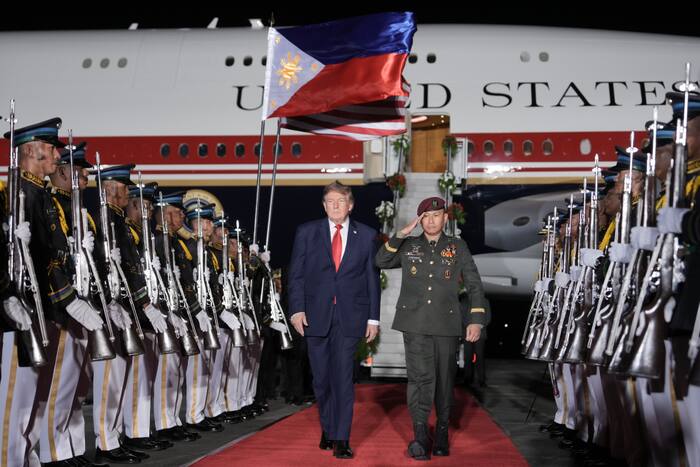
The salt air in Manila does not ask for permission. It clings to the linen collar of a diplomat’s shirt before the tarmac stairs have even finished rolling up to the fuselage of Air Force One, heavy with the smell of diesel, monsoon humidity, and seven thousand islands holding their breath.
When Donald Trump stepped down onto Philippine soil to open an Asian diplomatic swing built around trade agreements and security consultations, the official press releases described the itinerary in the flat, bloodless vocabulary of statecraft. Bilateral economic deals. Defense modernization. Regional stability. You have read those phrases a hundred times, and your eyes have probably slid right past them like rain off a windshield.
Wait.
Look closer at what is actually happening when an American president touches down in the archipelago at the edge of the South China Sea, because the real story is not sitting inside a leather-bound treaty folder in Malacañang Palace. It is sitting in a plastic chair on a wooden pier in Zambales, three hours northwest of the capital, where a hypothetical fisherman—let us call him Mateo—is mending a nylon gillnet with calloused fingers and wondering whether tomorrow morning will bring a haul of yellowfin tuna or a grey-hulled coast guard cutter blocking his path to the shoal.
To understand why a presidential arrival in Manila matters to someone who has never traded a currency futures contract or read a Pentagon white paper, you have to strip away the motorcades and look at the invisible architecture holding up daily life across the Indo-Pacific.
The Architecture of a Strait
Every morning before you drink your coffee, roughly a third of the world’s maritime commerce passes through a stretch of water bordered by the Philippines, Vietnam, Malaysia, and China. Smartphones, microprocessors, liquefied natural gas, sneakers, medical equipment—all of it moves in steel boxes stacked twelve high on container ships gliding through waters where territorial lines are drawn in ink on land and contested in steel at sea.
Think of the Philippine archipelago as the hinge on a heavy door. If the hinge holds, the door swings smoothly, and goods move from factories in East Asia to ports in California without anyone noticing the friction. If the hinge rusts, bends, or breaks, the entire house feels the shudder.
For decades, the United States and the Philippines have been bound by the 1951 Mutual Defense Treaty, a cold-war promise written when propeller planes still crossed the Pacific. On paper, the agreement is simple: an armed attack on either nation in the Pacific area would be met with a joint response. In practice, diplomacy is never as clean as ink. Alliances require constant maintenance, the way a wooden boat in tropical water requires daily caulking against the tide.
When Trump’s delegation arrived in Manila, the administration’s core objective was to pair security assurances with transactional economic muscle. According to White House economic briefings and State Department readouts surrounding the trip, the agenda centers on reciprocal trade access, critical mineral supply chains, semiconductor packaging investments, and joint maritime security coordination with Manila and regional partners.
Notice the pairing. Security and commerce are no longer treated as separate rooms in the diplomatic house. They are the same room.
A Tale of Two Ledgers
To see how this plays out on the ground, consider a second hypothetical figure: Elena, a thirty-four-year-old supply chain manager working at an electronics assembly plant in Laguna, just south of Manila.
Ten years ago, Elena’s factory relied almost entirely on single-source components shipped down from coastal mainland China. It was cheap, predictable, and fast. Then came pandemic lockdowns, tariff escalations, and sudden shipping bottlenecks that left assembly lines idle for weeks while engineers stared at empty loading bays.
Today, Elena spends her mornings negotiating contracts with American and Japanese semiconductor firms looking to diversify their testing and assembly operations into the Philippines. Under Washington’s broader push to "friend-shore" critical technology supply chains—an effort documented in U.S. Department of Commerce trade analyses and bilateral investment frameworks—the Philippines has emerged as a vital node. The country already counts electronics as its largest export sector, accounting for more than half of its total merchandise exports, according to Philippine Statistics Authority data.
Yet Elena’s company faces a quiet dilemma that no single summit can erase overnight. Energy costs in the Philippines remain among the highest in Southeast Asia. Port infrastructure outside Manila still groans under seasonal typhoons and aging logistics grids. When American officials arrive promising new economic deals, factory managers like Elena do not hear abstract geopolitical victory laps; they hear questions about kilowatt-hours, customs clearance times, and whether the promised capital will actually pour concrete before the next election cycle reshapes the political map in Washington or Manila.
I have watched enough trade delegations come and go across Southeast Asia to know the specific, hollow ache that follows a photo-op summit when the follow-through stalls. You sit in a hotel ballroom in Makati, listen to ministers toast a "new era of bilateral prosperity," and then six months later you talk to a customs broker at the Port of Manila who tells you that not a single form has changed on his desk.
That gap between the podium and the pier is where trust lives or dies.
The Arithmetic of Deterrence
Why, then, does the presence of an American president in Manila still carry undeniable weight?
Because in international politics, presence is a currency all its own.
Over the past several years, maritime confrontations near Second Thomas Shoal and Scarborough Shoal have shifted from rare diplomatic footnotes to regular features on evening news broadcasts across Manila. Philippine resupply vessels have faced water cannons, laser illuminations, and hull collisions from Chinese Coast Guard ships asserting sweeping historical claims rejected by a 2016 international arbitral tribunal ruling in The Hague.
For the Philippine government, navigating between Washington and Beijing is like walking a tightrope stretched between two skyscrapers during a typhoon. China remains one of the Philippines' largest trading partners and a major source of consumer goods and infrastructure financing. The United States, meanwhile, remains Manila’s sole treaty ally and the primary guarantor of military deterrence in the Western Pacific.
Push too hard in one direction, and trade freezes. Lean too far in the other, and sovereignty erodes reef by reef.
When Trump sits down with Philippine leadership to discuss defense cooperation alongside economic agreements, both sides are negotiating the exact terms of that balance. American defense planners view access to Philippine military bases under the Enhanced Defense Cooperation Agreement—known as EDCA—as essential for regional deterrence, particularly given the northern Philippine island of Luzon sits roughly two hundred miles across the Luzon Strait from Taiwan.
For Manila, however, hosting American rotational forces is never a cost-free decision. Local mayors in northern provinces worry about becoming targets in a conflict they did not start. Residents near designated sites remember both the economic boom and the social friction of the old American bases at Subic Bay and Clark before the Philippine Senate voted to close them in 1991.
History in the Philippines has a long memory. It remembers the colonial era after 1898, the shared blood of Bataan and Corregidor during World War II, the decades of martial law under Ferdinand Marcos Sr., and the complicated recalibrations of the post-Cold War decades. Nobody in Manila approaches an American handshake with naive amnesia. They look at the hand, they look at the terms, and they calculate the odds.
What the Tariff Table Doesn't Show
There is an inherent tension inside the American economic pitch during this Asian tour, and pretending otherwise would be dishonest.
On one hand, Washington wants Southeast Asian allies like the Philippines to deepen economic integration with American firms, buy American energy and defense hardware, and anchor supply chains away from Beijing. On the other hand, the Trump administration’s trade doctrine relies heavily on tariff leverage, bilateral trade deficit scrutiny, and aggressive industrial protectionism aimed at bringing manufacturing back to the American Midwest.
If you are a Philippine garment exporter or an agricultural producer shipping coconut oil and pineapples to Los Angeles, those two impulses collide directly on your balance sheet.
Consider what happens next when a trade representative sits across from a Philippine finance minister. The American side pushes for market access for U.S. agricultural exports, intellectual property protections, and digital trade rules. The Philippine side asks for tariff relief on textiles and processed foods, clearer pathways for infrastructure investment, and guarantees that Southeast Asian nations will not become collateral damage in a broader trade war between the world’s two largest economies.
Trade economists at institutions like the Asian Development Bank have repeatedly noted that Southeast Asian economies thrive best in open, predictable multilateral trading environments. Bilateral deals can unlock targeted capital—especially in clean energy, telecommunications, and critical minerals like nickel and copper, both of which the Philippines possesses in significant reserves—but they rarely replace the broad tide of regional commerce.
Still, transactional diplomacy has a strange clarity to it. Unlike grand ideological speeches that promise perpetual friendship while delivering vague working groups, a deal-driven approach forces both sides to put their cards face up on the table. You want security cooperation? Here is the price in defense hardware and base access. You want investment in nickel processing? Here are the regulatory reforms and tax incentives required to make private capital move.
The Human Pulse Beneath the Motorcade
Step outside the air-conditioned conference rooms of Pasay City, where police barricades hold back afternoon traffic along Roxas Boulevard, and the grand strategy of the Indo-Pacific shrinks down to human scale.
A jeepney driver idles his brightly painted diesel engine behind a line of stalled cars, watching a motorcade of black SUVs streak past toward the bay. Every peso he earns today depends on the price of imported fuel, which depends on shipping lanes staying open, which depends on whether the men in those dark-windowed cars can keep a cold competition from turning into a hot war.
A nursing graduate in Quezon City checks her phone for visa processing updates, part of a Filipino diaspora of more than ten million overseas workers whose remittances keep entire provincial towns afloat and bind Philippine households directly to the economic health of North America, Europe, and the Middle East.
A young coast guard sailor in Palawan cleans his uniform before deploying on a patrol boat whose hull bears the gray scrapes of last month’s encounter near Sabina Shoal, knowing that deterrence is not an abstract noun in a textbook—it is the distance between two hulls in choppy water at three in the morning.
Diplomacy often fails in the public imagination because we talk about nations as if they were chess pieces carved out of wood. We say "Washington warned" or "Manila pivoted" or "Beijing countered," forgetting that nations are just millions of ordinary people trying to pay school fees, keep the lights on during brownouts, and bring home fish before the afternoon squall rolls in.
The Weight of the Return
As Trump’s Asian tour moves onward from Manila toward subsequent stops across the region, the headlines will inevitably chase the sharpest soundbites, the handshakes on red carpets, and the dollar figures attached to freshly signed memoranda of understanding. Some of those numbers will turn into real factories, real grid upgrades, and real patrol vessels. Others will quietly dissolve into feasibility studies that gather dust in ministry drawers.
That is the unglamorous truth of international statecraft. No single trip resolves seventy-five years of alliance history, nor does a single round of trade talks redraw the economic gravity of East Asia.
Yet late in the afternoon along Manila Bay, when the sun drops behind the Bataan Peninsula and turns the water into hammered copper, the stakes of the visit feel anything but abstract. Out beyond the breakwater, cargo ships wait at anchor like dark silhouettes against the orange sky, their holds filled with the quiet machinery of modern life. Along the seawall, families gather on the warm concrete to catch the evening breeze, listening to the slap of the tide against the stones—a steady, ancient rhythm that continues only so long as the waters beyond the horizon remain calm.