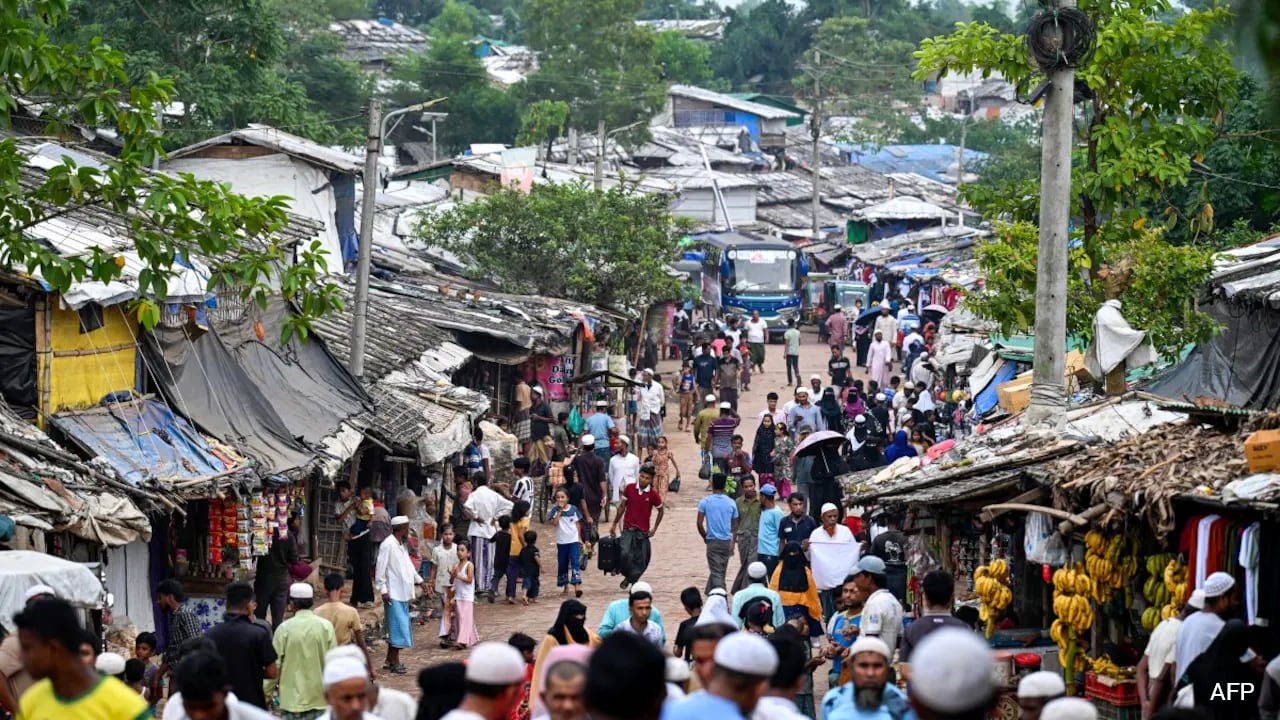
Red mud dries into a crust the color of rust. When the monsoon rains finally break over the hills of Cox’s Bazar, that crust turns back into a slick, sucking mire that swallows sandals whole and smells perpetually of wet bamboo, woodsmoke, and too many human beings pressed against a border they cannot cross.
Picture a man—let us call him Tariq, a hypothetical composite drawn from the thousands of former shopkeepers, teachers, and fishermen now living along the Kutupalong ridge—sitting beneath a tarpaulin roof held down by sandbags. On a cracked smartphone screen powered by a salvaged solar battery, Tariq reads a headline transmitted from a marble courtroom half a world away in The Hague. Fourteen countries have issued a joint statement acknowledging the International Court of Justice ruling regarding the Rohingya genocide. For a more detailed analysis into this area, we recommend: this related article.
Acknowledge.
Tariq stares at the word. He turns it over in his mind the way a starving man turns over a smooth river stone, testing whether it can be cracked open for marrow. Does an acknowledgment stop the leaks in the tarpaulin? Does it restore the deed to a brick house in Maungdaw that was burned to ash in August 2017? Does it buy back the citizenship stripped away by a stroke of a bureaucrat’s pen in 1982? To get more details on this development, comprehensive analysis can be read on Associated Press.
Wait.
Before we dismiss diplomatic vocabulary as empty theater, we have to look closer at how international law actually moves—not with the thunder of cavalry, but with the slow, crushing weight of a glacier grinding down a valley.
The Architecture of Erasure
To understand why fourteen signatures on a diplomatic communique carry hidden voltage, you first have to understand the machinery they are pushing against. For decades, the erasure of the Rohingya people in Myanmar was treated by the outside world as an unfortunate internal friction, a localized flare-up in a distant borderland. That framing was deliberate.
When Myanmar passed its 1982 Citizenship Law, it did not merely deny a minority group the right to vote; it engineered a legal vacuum. By omitting the Rohingya from the list of 135 officially recognized national ethnic races, the state transformed an entire population into ghosts on paper. Without papers, you cannot travel between townships without paying a bribe. Without papers, you cannot register a marriage, enroll in a university, or own land. You exist physically, breathing and sweating under the sun of Rakhine State, while the law insists you are an illegal trespasser in the very village where your grandparents are buried.
By the time the military clearance operations erupted in late 2017—driving more than 700,000 people across the Naf River into Bangladesh in a matter of weeks—the groundwork of dehumanization had already been laid for thirty-five years. Villages were razed with mathematical precision. Satellite imagery showed hundreds of settlements wiped off the map while neighboring non-Rohingya villages stood untouched mere yards away.
For years afterward, the victims faced a second, quieter violence: the slow fade of global attention. Crises are crowded out by newer crises. News cycles move on. In the camps of Bangladesh, where over a million Rohingya now live in the largest refugee settlement on earth, ration cards shrank, bamboo shelters rotted, and young men who had never seen a classroom beyond primary school began risking their lives on rickety wooden boats across the Andaman Sea, trading one trap for another.
Why a Courtroom in The Hague Matters
Enter The Gambia.
In November 2019, a tiny West African nation—separated from Myanmar by seven thousand miles of ocean and continent—filed a landmark case at the International Court of Justice, the highest judicial body of the United Nations. Backed by the 57-member Organisation of Islamic Cooperation, The Gambia accused Myanmar of violating the 1948 Genocide Convention.
Think of the Genocide Convention as a fire alarm wired into the foundation of the post-World War II international order. Under its articles, genocide is not merely a domestic crime; it is an offense against all humanity, and every signatory state carries a legal duty not just to punish it after the graves are dug, but to prevent it while the smoke is still rising.
In January 2020, the judges in The Hague issued a unanimous order for provisional measures. They did not yet rule on the final merits of whether genocide had occurred—such trials take years of painstaking forensic testimony—but they ordered Myanmar to take immediate steps to prevent genocidal acts, rein in its military, preserve evidence, and submit regular compliance reports to the court.
To a layperson, provisional measures sound like a polite request wrapped in Latinate legalese. In reality, they operate like a forensic freeze on a crime scene. Once the International Court of Justice places a state under provisional measures, every subsequent action—every burned field, every blocked aid convoy, every missing witness—is no longer just a news report. It becomes admissible evidence of contempt before the world’s highest bench.
And yet, a court has no police force. It has no battalions to deploy to Rakhine State. Its verdicts rely entirely on whether the nations of the world treat those rulings as binding architecture or optional wallpaper.
Inside the Fourteen Signatures
This is where those fourteen countries enter the frame.
When fourteen nations—spanning Europe, North America, and key diplomatic coalitions—formally step forward to endorse and acknowledge the legal trajectory of the ICJ proceedings, join interventions in the case, or align their foreign policy explicitly around the court's findings, they are doing something far more consequential than issuing a press release.
Let us use an analogy from structural engineering. A single steel rod driven into soft earth can be bent by hand. Drive fourteen rods into the same ground and weld a steel frame across their tops, and suddenly you have a foundation capable of bearing thousands of tons of weight.
In diplomacy, formal acknowledgment by a coalition of states accomplishes three concrete shifts that ripple outward from The Hague straight to the muddy footpaths of Cox’s Bazar:
- It shatters the defense of domestic sovereignty. For years, Myanmar’s generals argued that what happened in Rakhine State was an internal counterinsurgency operation immune to foreign interference. Every nation that formally recognizes the ICJ jurisdiction over the Rohingya case strips away that shield. Under the Genocide Convention, mass atrocity is never an internal affair.
- It locks in evidentiary permanence. Diplomatic statements anchored to ICJ rulings integrate UN investigative findings—such as those collected by the Independent Investigative Mechanism for Myanmar—directly into the official foreign policy records of major states. Even if regimes change, even if political winds shift in capitals from Washington to Brussels to Ottawa, those legal commitments remain on the books.
- It creates a financial and legal tripwire. Once states formally recognize a genocide determination or the binding nature of ICJ provisional measures, their own domestic ministries face legal constraints. Arms embargoes tighten. Targeted sanctions against military-owned conglomerates gain airtight legal footing. Refugee resettlement and humanitarian funding pipelines become far harder for domestic politicians to quietly dismantle.
Consider what happens next when a military junta relies on foreign currency, aviation fuel, and international banking corridors to sustain its war machine. Every diplomatic endorsement of the court's authority narrows the hallways through which that money can travel.
The Weight of Waiting
Still, I will not pretend that international law moves at the speed of human hunger.
Having spent years tracking how atrocity accountability unfolds—from the slow, agonizing tribunals of the Balkans to the dusty courtrooms of Phnom Penh—I know the gut-wrenching gap between a judge’s gavel and a survivor’s dinner table. It is deeply unsettling to admit that justice in international courts is measured in decades while a child in Camp 14 grows from infancy to adulthood behind barbed wire.
There is an unbearable asymmetry here. In The Hague, lawyers in black robes debate jurisdictional nuances over sparkling water, parsing commas in treaties drafted before their parents were born. Meanwhile, back in Rakhine State, renewed civil war between Myanmar’s military and armed ethnic groups has once again caught remaining Rohingya civilians in the crossfire—conscripting young men by force, burning towns like Buthidaung, and sending fresh waves of terrified families fleeing toward a border already stretched past its breaking point.
If you are Tariq, sitting under that leaking tarpaulin, you have every right to feel cynical. You have seen envoys come and go with clipboards and solemn expressions. You have watched pledges of solidarity evaporate when global attention pivots elsewhere.
Why should fourteen nations acknowledging a court ruling feel any different from the promises that came before?
Because history shows that perpetrators of mass atrocity count on one thing above all else: collective amnesia. They gamble that if they stall long enough, burn enough records, and scatter enough witnesses across foreign borders, the world will eventually grow tired of the paperwork and accept the new demographic reality as permanent.
Look at how accountability actually works over time. In 1995, when Bosnian Serb forces overran Srebrenica, it seemed unthinkable that the architects of the slaughter would ever stand in a dock. Years passed. The survivors lived in limbo. Yet because the legal record was relentlessly fortified by international courts and backed by diplomatic coalitions that refused to let the ruling gather dust, the commanders who once boasted of their impunity ended their lives in prison cells.
The legal record is a memory that cannot be bribed or intimidated.
Beyond the Headline
When readers scroll past a terse headline about fourteen countries acknowledging a ruling on the Rohingya genocide, it is easy to file it away as routine diplomatic background noise. We have grown numb to the language of international affairs—the measured verbs, the cautious phrasing, the apparent distance from real flesh and blood.
That numbness is dangerous. It blinds us to the quiet tug-of-war happening beneath the surface of global politics.
On one side stands a doctrine of raw power: the belief that a state armed with helicopter gunships and bulldozers can erase an unwanted minority, rewrite its history books, and wait out the outrage of its neighbors. On the other side stands a fragile, imperfect, stubbornly persistent web of treaties and courtrooms—a system built from the ashes of the twentieth century to assert that human beings cannot simply be deleted without consequence.
Every time another government puts its signature behind the International Court of Justice, it pulls that web tighter. It signals to the generals in Naypyidaw that there is no statute of limitations on genocide. It signals to other authoritarian regimes watching from the sidelines that mass expulsion is not a viable political shortcut. And it tells Bangladesh—a developing nation that has shouldered the staggering humanitarian burden of hosting over a million refugees for nearly a decade—that it is not standing alone at the edge of the abyss.
Of course, signatures alone do not rebuild burned villages. They do not restore lost years of schooling to a generation of Rohingya teenagers, nor do they pull sinking boats back from the waves of the Bay of Bengal. True resolution will require sustained diplomatic pressure for safe, voluntary, and dignified repatriation, alongside real citizenship rights in Myanmar—conditions that remain painfully out of reach today.
Yet without the bedrock of legal recognition, none of those steps are even conceivable. You cannot negotiate the return of a people whose existence you refuse to legally acknowledge. You cannot demand restitution for a crime the world refuses to name.
Night falls fast over the hills of Cox’s Bazar. As darkness settles across the sprawling maze of bamboo and plastic sheeting, thousands of small solar lanterns flicker on along the ridges, glowing like fallen stars against the black outline of the jungle. Inside one of those shelters, Tariq switches off his phone, folds his hands in his lap, and listens to the rain begin to drum against the tarpaulin above his head—knowing that somewhere far beyond the clouds, fourteen nations have just written his people's name back into the ledger of the living.