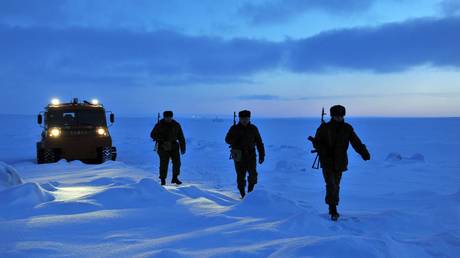
Cold does not care about flags.
If you stand on the edge of the Barents Sea in January, the wind slices through four layers of thermal wool like a dull butter knife, numbing the tip of your nose in forty seconds and turning your breath into jagged crystals that cling to your eyelashes. Out there, beneath a sky bruised purple by six months of polar night, the ocean looks dead. Thick. Immovable. For centuries, that impenetrable wall of sea ice was the greatest peacekeeper on Earth, an unspoken treaty written in frost that kept rival empires separated by thousands of miles of lethal white silence. Expanding on this theme, you can find more in: Why US Sanctions on the Comanchero Gang Change Global Crime Enforcement.
That treaty is thawing.
The ice is retreating at roughly thirteen percent per decade, opening shipping lanes that have been locked since the last Ice Age and exposing an estimated ninety billion barrels of undiscovered oil, thirty percent of the world’s untapped natural gas, and trillions of dollars in rare earth minerals. Suddenly, the empty white space at the top of our maps isn't an obstacle anymore. It is a highway. It is a vault. And every major military power on the planet is currently scrambling to see who holds the keys. Analysts at The Washington Post have provided expertise on this situation.
To understand who actually holds the military advantage in the Arctic, you cannot just count tanks on a spreadsheet or look at a map drawn with the Equator in the center. You have to tilt the globe until you are staring straight down at the North Pole. When you do that, the geography of the modern world shifts violently, and the uncomfortable truth becomes impossible to ignore.
Russia got there first, built the biggest house, and never left.
The Heavyweight in the Dark
Consider a hypothetical Russian naval captain named Alexei, standing on the bridge of a nuclear-powered icebreaker just north of the Kola Peninsula. Outside his reinforced glass window, the ship’s bow rises up onto a six-foot shelf of multi-year sea ice and crushes it downward with a sound like tearing sheet metal. Alexei does not view the Arctic as an exotic expedition or a harsh training ground. To him, it is the backyard.
Russia accounts for roughly fifty-three percent of the entire Arctic coastline. More than two million Russians live above the Arctic Circle—more than all other Arctic nations combined. While Western planners spent the last twenty years fighting desert insurgencies in Iraq and Afghanistan, Moscow quietly reopened fifty Soviet-era military bases, built new deep-water ports, and constructed a string of airfields equipped with advanced S-400 air defense systems along its northern frontier.
And then there are the icebreakers.
In polar warfare, an icebreaker is not a support vessel; it is the entire foundation of mobility. Without one, a billion-dollar guided-missile destroyer is just an expensive steel coffin waiting to be crushed by shifting pack ice. Russia operates a fleet of more than forty icebreakers, including massive nuclear-powered behemoths like the Arktika, capable of smashing through ice nearly ten feet thick while staying at sea for months without refueling.
How many heavy polar icebreakers does the United States Coast Guard currently operate?
Two. And one of them, the Polar Star, was commissioned in 1976, the same year Apple sold its first computer. The U.S. has the Polar Security Cutter program underway to build new heavy icebreakers, yet delays and ballooning costs have pushed delivery timelines back repeatedly.
On paper, this looks like a blowout. Russia holds the coastline, the heavy-lift infrastructure, the nuclear icebreakers, and the bastion defense strategy—a fortified ring around the Kola Peninsula designed to protect its Northern Fleet, which houses the bulk of Russia’s sea-based nuclear deterrent. If a shooting war broke out in the high north tomorrow morning, Russia possesses the home-field advantage in ways that would make any NATO commander lose sleep.
Wait. That is only half the story.
The Invisible Chessboard Beneath the Ice
Count the ships on the surface, and Moscow wins. Look beneath the waves and up into the freezing stratosphere, and the balance of power tilts dramatically.
Think of the Arctic Ocean not as a flat sheet of ice, but as a three-dimensional house with a locked front door, a basement full of tripwires, and a roof covered in cameras. Russia owns the heaviest boots on the porch. The United States and its NATO allies own the basement and the roof.
Let us imagine a second character—a young sonar operator named Maya, sitting in the dimly lit control room of a Virginia-class nuclear attack submarine two hundred meters beneath the Beaufort Sea. Above her hull sits a ceiling of solid ice. She cannot surface easily. She cannot see the sun. Her entire universe consists of cascading green waterfalls of acoustic data and the faint, rhythmic hum of her boat's reactor.
Submarines are the true apex predators of the Arctic. Because the jagged underside of sea ice scatters sonar waves like a hall of mirrors, the high north is the ultimate hiding place for nuclear-armed ballistic missile submarines. For decades, the U.S. Navy has perfected the art of operating under the polar cap, conducting biennial exercises like Operation Ice Exercise (ICEX) where submarines punch straight through the frozen surface to test weapons and navigation systems in sub-zero conditions.
While Russia’s surface fleet is formidable, its undersea fleet faces a massive geographic chokepoint known as the GIUK Gap—the stretch of icy water between Greenland, Iceland, and the United Kingdom. To reach the open Atlantic and threaten North American shipping lanes, Russian submarines leaving Murmansk must thread this needle. Beneath those waters lies a modernized descendant of the Cold War SOSUS network: a web of seabed sensors, autonomous underwater drones, and allied maritime patrol aircraft like the P-8 Poseidon, all listening for the distinct acoustic signature of a Russian propeller.
And then there is the sky.
With Finland and Sweden joining NATO, the geopolitical map of the Arctic underwent an overnight earthquake. Seven of the eight Arctic Council nations are now members of the same military alliance. Suddenly, the Kola Peninsula—Russia’s crown jewel of northern defense—is flanked by a unified wall of Scandinavian airpower.
Norway, Sweden, and Finland have quietly integrated their air forces into a single Nordic command structure, fielding hundreds of modern fighter jets, including a massive, growing fleet of American-made F-35 Lightning II stealth aircraft. When you combine that with the U.S. Air Force’s concentration of fifth-generation fighters at Eielson Air Force Base in Alaska, NATO holds an overwhelming edge in stealth, precision strike capability, and real-time satellite surveillance.
Russia has the icebreakers to clear the path. NATO has the invisible aircraft to own the air above it, and the quietest submarines to hunt whatever moves below.
The Enemy That Wears No Uniform
I still remember the first time I watched a seasoned Arctic survival instructor demonstrate how fast the cold kills complacency. He took off a single outer mitten in minus-thirty-degree weather to adjust a radio dial. It took him maybe ninety seconds. By the time he slid his hand back into the wool, his fingertips were chalk-white and stiff as driftwood. He spent the next twenty minutes tucked into a sleeping bag, gritting his teeth against the agonizing rush of returning blood, muttering curses at himself for forgetting the first rule of the north: the environment is always trying to kill you first, and your human enemy comes second.
When people ask who holds the military advantage in the Arctic, they usually imagine a classic clash of armies. They picture battalions charging across snowfields or warships trading missile salvos amid drifting icebergs.
That is a Hollywood fantasy. In the real Arctic, logistics is the only strategy that matters, and the cold degrades everything it touches.
Batteries die in minutes. Hydraulic fluid thickens into sluggish sludge. Standard steel becomes brittle enough to shatter like glass under sudden stress. A simple mechanical failure that would take twenty minutes to fix in Virginia becomes a three-day life-or-death crisis near Svalbard. Even GPS signals—the nervous system of modern warfare—become unreliable near the pole due to atmospheric interference and low satellite angles.
Here is where the war in Ukraine quietly rewrote the Arctic playbook.
Before 2022, Western defense analysts viewed Russia’s Arctic brigades—such as the 200th Separate Motor Rifle Brigade, trained specifically for polar combat—as elite, unstoppable winter warriors. Then Moscow pulled those exact units south and threw them into the meat grinder of eastern Ukraine. Thousands of Russia’s most experienced Arctic troops, along with massive stockpiles of specialized cold-weather tracked vehicles and air defense systems, were destroyed in the mud of the Donbas.
You can weld a new hull in a shipyard in St. Petersburg, even under Western sanctions. You cannot easily replace ten years of institutional knowledge on how to keep a diesel engine running at forty below zero without freezing your crew to death.
Meanwhile, the United States and its allies have been forced to confront their own glaring vulnerabilities. For decades, American military doctrine assumed we could project power anywhere on Earth effortlessly. The Arctic shattered that arrogance. The U.S. lacks deep-water ports in the American Arctic—Nome, Alaska is undergoing a massive expansion to finally change that—and cold-weather gear for infantry units had been neglected for a generation. Soldiers deployed to northern Norway during recent NATO exercises had to relearn basic survival skills from their Norwegian counterparts, discovering that modern synthetic fabrics sometimes trap sweat, which freezes against the skin and induces hypothermia faster than cotton ever could.
The Dragon Looking North
Just when the chessboard seemed neatly divided between Moscow and Washington, a third player pulled up a chair—even though its borders lie nearly a thousand miles south of the Arctic Circle.
China calls itself a "Near-Arctic State."
To a geographer, that phrase is absurd. To a military strategist, it is brilliant. Beijing understands that the melting Northern Sea Route cuts the shipping distance between Shanghai and Rotterdam by roughly forty percent compared to the Suez Canal. Less distance means cheaper fuel, faster supply chains, and zero vulnerability to American naval blockades in the Strait of Malacca.
China does not have Arctic bases, so it uses wallets and research vessels instead. Beijing has poured billions into Russian liquefied natural gas projects on the Yamal Peninsula, effectively bankrolling Moscow’s Arctic infrastructure while securing energy supplies for itself. Simultaneously, China’s growing fleet of icebreakers—including the Xue Long 2—conducts "scientific research" missions across the polar ocean, mapping the seabed in high resolution.
Why does mapping the Arctic seabed matter? Because knowing the exact depth, temperature, and salinity of the water is the exact data you need to hide submarines—or hunt someone else’s. China is playing the long game, using commercial and scientific footholds today to build the navigational architecture for military presence tomorrow.
The Fragile Math of Deterrence
So, who holds the advantage?
If you measure military power by physical presence, icebreaking muscle, and coastal fortification, Russia holds the cards on the surface. Their northern frontier is a fortress built for a fight on their own doorstep.
If you measure military power by technological superiority, undersea dominance, stealth airpower, and alliance depth, the United States and its seven NATO partners hold a crushing structural advantage—provided they can survive the brutal logistics of getting there and staying warm.
Yet reducing this standoff to a scorecard misses the terrifying reality of what is actually happening at the top of the world.
In the Arctic, the margin for error is razor-thin. A misread radar blip during a geomagnetic storm, a submarine collision beneath the pack ice, or a territorial dispute over an emerging shipping lane doesn't play out in a vacuum. The Arctic is where the nuclear arsenals of Washington and Moscow sit closest together—a flight time of mere minutes for intercontinental missiles arcing over the pole.
During the height of the Cold War, the Arctic was an icy buffer zone, a silent witness to human rivalry that remained largely untouched because neither side could conquer the freeze. Now, our own carbon emissions are unlocking the doors to that frozen vault, inviting armies, drill rigs, and warships into one of the last truly wild places left on Earth.
Think back to that shoreline on the Barents Sea in the dead of winter. Out past the surf, a massive slab of blue sea ice groans under the pressure of a warming current, fractures with a crack that echoes like artillery fire across the empty tundra, and drifts slowly south toward open water. Neither the sailors in Murmansk nor the submariners beneath the Beaufort Sea can stop that sound. They are all just passengers on a melting roof, arguing over who owns the shingles while the beams beneath their feet begin to give way.