Seven in the morning in Seoul feels colder than the thermometer claims. The air carries a sharp, metallic edge, the kind that makes your breath hang in white plumes beneath the sodium streetlights while the rest of the city holds its breath.
Imagine a boy named Min-jun standing outside the iron gates of a high school in Gangnam. He is nineteen, hypothetical in name though painfully real in circumstance, and he has spent the last twelve years preparing for the next eight hours. His mother stands beside him, pressing a thermos of warm barley tea into his hands, her eyes red-rimmed from weeks of praying at local temples. Around them, younger students beat traditional drums and hold up hand-painted banners screaming encouragement, their voices cracking in the frost.
Min-jun isn't listening to the drums. He is looking down at his chest.
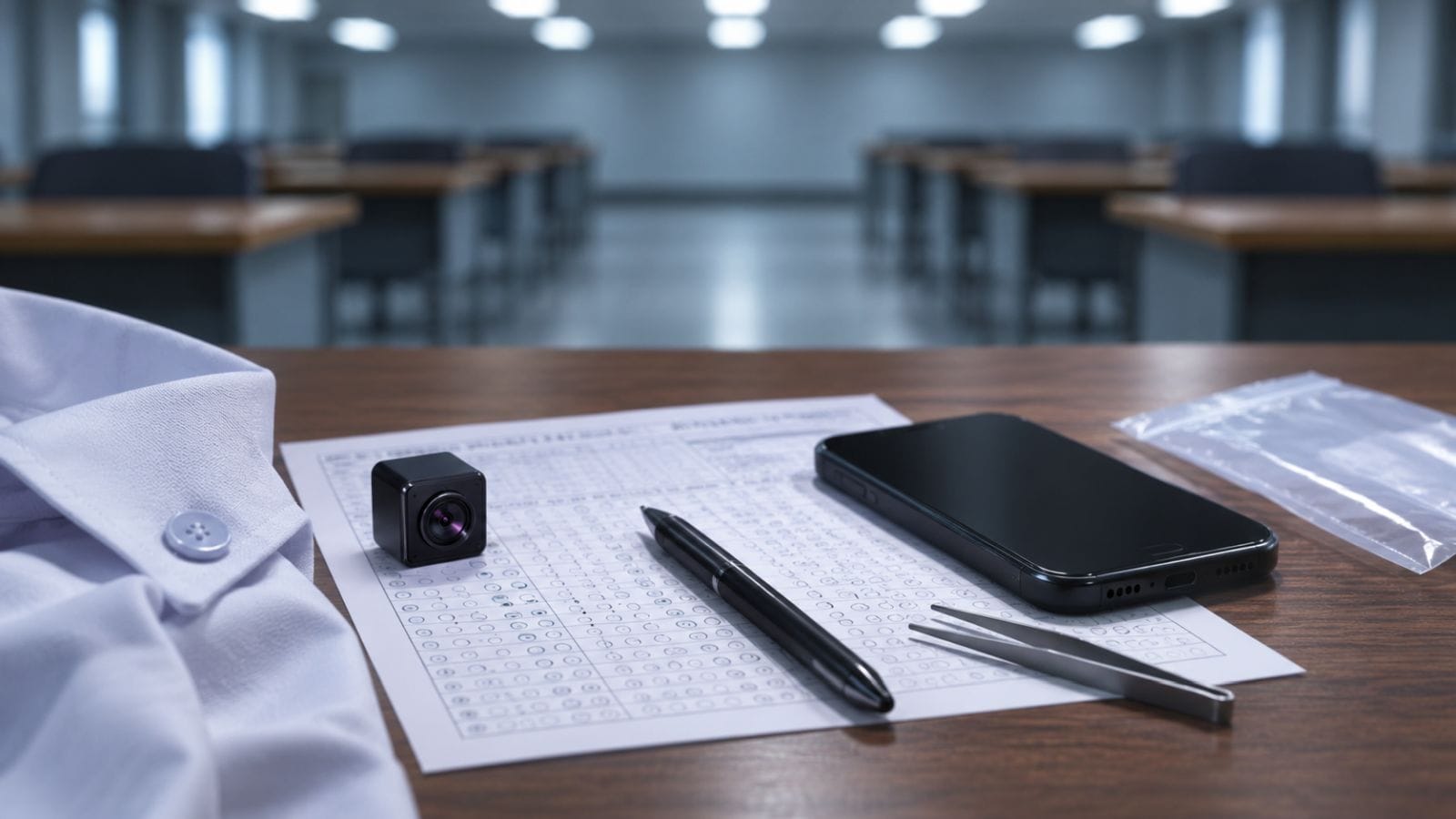
Specifically, he is staring at the third button on his flannel shirt. It is slightly thicker than the others, made of a dark, glossy resin that catches the morning glare. In any other country on any other Thursday in November, a button is just a piece of plastic holding fabric together. Here, on the day of the Suneung—South Korea’s College Scholastic Ability Test—that small disk of resin is a potential liability capable of ending his academic life before he even uncaps a pen.
Silence.
That is what the entire nation buys for Min-jun today. At precisely 8:40 a.m., when the first section begins, South Korea undergoes a synchronized, state-mandated freeze. The stock market opens an hour late to keep commuters off the roads. Construction sites go dead. Banks delay their shutters. Even the sky goes quiet; between 1:10 p.m. and 1:35 p.m., during the English listening comprehension test, the Ministry of Land, Infrastructure and Transport grounds every single airplane across the peninsula, forcing incoming international flights to circle in holding patterns over the sea so that the roar of a jet engine doesn't cost a teenager a single multiple-choice question.
Police cruisers sit idling at major intersections with sirens primed, ready to ferry panicked, oversleeping test-takers through parted traffic at breakneck speeds. When a nation of fifty-one million people rearranges its airspace and financial markets for a standardized test, you begin to understand the crushing weight sitting on Min-jun’s shoulders.
The Architecture of Suspicion
To understand why a shirt button inspires genuine dread in Seoul, you have to understand what the Suneung actually buys. In South Korea, where you go to university doesn't just dictate your starting salary; it dictates your social caste, your marriage prospects, and the quiet pride or lingering shame your parents carry into retirement. The golden ticket is admission into "SKY"—Seoul National University, Korea University, and Yonsei University. Fewer than two percent of test-takers make it in.
When the reward is that absolute, the temptation to cheat becomes an existential threat to the state.
Over the past two decades, South Korea’s Ministry of Education has fought an escalating cold war against technological espionage. In 2004, a massive scandal rocked the country when hundreds of students in Gwangju were caught using modified mobile phones and text messaging networks to receive answers from hired ringers sitting outside the exam halls. The fallout was seismic. Public trust shattered, and the government responded by turning exam centers into high-security bunkers.
I remember the feeling of sitting in an examination hall under hyper-strict proctoring—the way the air seems to thicken until breathing too loudly feels like an infraction. Your peripheral vision narrows until all you see is the scuff marks on the linoleum floor and the shadow of the proctor’s shoes pacing the aisle. Every click of a mechanical pencil sounds like a gunshot. In that environment, paranoia isn't a flaw; it is the baseline operating system.
Because modern spyware can now hide inside objects no larger than a grain of rice, the rules governing what a student can bring into the Suneung room read like the manifest for a maximum-security prison. Digital watches are strictly banned. Smartwatches are treated like contraband. Even analog watches with digital displays are confiscated on sight. Students cannot use their own pens or pencils; instead, the state issues identical black computer-grade pens and mechanical pencils to every single examinee to ensure no one has hollowed out a barrel to hide a micro-receiver.
Which brings us back to Min-jun’s shirt.
In recent years, tiny pinhole cameras disguised as ordinary clothing buttons have become readily available online, capable of transmitting high-definition video of a test booklet to an accomplice miles away. Proctors at the Suneung are trained to sweep every student with handheld metal detectors before and during the exam. If a metal detector chirps over a heavy brass button, or if a proctor notices an unusual sheen on a plastic fastener, the test stops. The student is pulled from their desk, inspected in the hallway, and subjected to intense scrutiny.
Even if the button is completely innocent—just an ornate piece of cheap fashion—the interruption alone can shatter a student's concentration beyond repair. Imagine spending four thousand hours memorizing calculus formulas and classical Korean poetry, only to have your rhythm destroyed because a proctor suspected your cardigan of espionage.
When Rules Become Traps
The tragedy of the Suneung isn't the malicious cheater; it is the innocent student destroyed by a technicality.
Every year, local newspapers publish heartbreaking accounts of teenagers whose exams were voided—not for looking at a neighbor’s paper, not for hiding crib notes in their socks, but for entirely accidental violations of the anti-cheating dragnet. Consider what happens when the rules leave zero room for human error.
A few years ago, a student had an entire year of grueling preparation wiped out because their mother packed a warm lunchbox, forgetting that a forgotten mobile phone was sitting at the bottom of the bag. During the afternoon session, the phone vibrated. It wasn't even turned on properly—just an alarm going off inside a backpack stacked at the front of the room. Under Ministry of Education regulations, possession of any electronic device inside the testing room, regardless of intent or whether it was used, results in immediate disqualification. The student was escorted out in tears, their score reduced to zero.
Think about that for a moment.
In the American legal system, intent—mens rea—is the bedrock of justice. Without the intent to commit a crime, punishment is vastly reduced or dismissed altogether. Inside a Suneung testing hall, intent does not exist. The system operates on absolute liability, much like a nuclear reactor where a single dropped wrench triggers an automatic shutdown.
Students are warned relentlessly about the "fourth period trap." During the fourth section of the exam, which covers Korean history and elective social or science subjects, students are handed booklets containing multiple subjects. They are strictly forbidden from opening or looking at the pages for a subject they did not register to take, and they cannot keep the booklet for a previous elective on their desk while working on the next one. Every single year, dozens of exhausted, sleep-deprived teenagers accidentally flip to the wrong page or leave a completed test sheet visible on the corner of their desk. Proctors mark them down for an infraction. Their entire day—all eight hours of it—is instantly invalidated.
It is an exhausting, brittle way to measure human potential. You are not just fighting the difficulty of the questions; you are fighting your own nervous system while navigating a minefield of procedural landmines.
The Invisible Economy of Hagwons
To understand why parents accept this draconian surveillance without rioting in the streets, you have to look at the financial bloodletting that precedes test day. The Suneung is merely the final act of a drama that plays out nightly in South Korea’s hagwons—private, for-profit cram schools that form the true backbone of the nation's education system.
Walk through the Daechi-dong neighborhood of Seoul at ten o'clock on a Tuesday night, and you will witness a traffic jam that rivals rush hour in Manhattan. Thousands of black sedans idle three-deep along the curb, waiting to pick up middle and high schoolers pouring out of brightly lit office buildings. These kids have been in school since eight in the morning. They eat convenience store triangle kimbap in the backseats of cars while shuttling from math academies to English essay workshops.
South Korean households spend a higher percentage of their income on private education than almost any other developed nation—tens of billions of dollars annually. Families routinely go into debt, delay retirement, or skip vacations to pay for star hagwon instructors who command rock-star salaries and teach in auditoriums packed with hundreds of teenagers.
I once spoke with a father in Busan who worked two jobs—driving a delivery truck by day and managing a convenience store at night—solely to pay his daughter's academy fees. When I asked him if he worried about the toll it was taking on her mental health, he looked at me with a mixture of sorrow and bewilderment. "If she doesn't get into a good university," he said quietly, "she will spend her whole life working twice as hard as I do for half the respect. How can I let that happen?"
That is the invisible engine driving the metal detectors and the button inspections. When families mortgage their futures for a single eight-hour exam, the state has no choice but to guarantee absolute, uncompromising fairness. If even a whisper of widespread cheating leaks out, the social contract collapses. Parents will tolerate a system that strips their children of digital watches, inspects their clothing, and voids their scores over a vibrating phone in a backpack—because the alternative is believing the game is rigged.
The Human Cost of a Single Day
Yet fairness is not the same thing as mercy.
By the time Min-jun sits down at his wooden desk, his hands are trembling slightly from caffeine and adrenaline. He has followed every guideline issued by his high school counselors. He wore a plain cotton sweatshirt with no buttons, no zippers, and no metal eyelets. He left his phone with his mother outside the gate. He brought clear plastic bags for his lunch and transparent water bottles with the labels peeled off so proctors can see through the liquid.
Even the peeling of a water bottle label tells you everything you need to know about the psychological climate inside that room. A label could hide microscopic notes printed on the inside adhesive. Nothing can be opaque. Everything must be visible, verifiable, and stripped of ambiguity.
As the clock ticks toward 8:40 a.m., the hallway outside grows dead silent. Proctors walk down the rows, passing out the cream-colored test booklets. The paper has a distinct, sharp smell of fresh ink and recycled pulp. Students sit with their hands flat on their desks, eyes fixed straight ahead, terrified that even a casual glance toward the window might be misinterpreted as a wandering eye.
For the next eight hours, Min-jun’s entire existence is compressed into filling in tiny oval bubbles with a black computer pen. Korean Language. Mathematics. English. Korean History. Social Studies. Second Foreign Language. The questions are notoriously convoluted, designed not merely to test comprehension, but to separate the top one percent from the top two percent through sheer linguistic and logical complexity. Some English passages are so dense and philosophical that native English professors from Oxford and Harvard have admitted to struggling with them.
And through it all, the proctors stand like statues at the front and back of the room, wearing soft-soled shoes so their footsteps don't distract the examinees. They watch for tapping fingers—a classic Morse code method for signaling answers. They watch for unusually long bathroom breaks, during which an escort follows the student to the restroom door and sweeps them with a metal detector again before letting them back inside.
Searching for an Exit Ramp
South Korea knows it has a problem. Politicians, sociologists, and educators have spent decades debating how to dismantle the tyranny of the Suneung.
The statistics are impossible to ignore. South Korea consistently records the lowest birthrate in the developed world, and surveys repeatedly cite the astronomical cost and soul-crushing pressure of education as a primary reason young couples refuse to have children. Why bring a new life into the world only to sentence them to twelve years of sleep deprivation and button inspections?
In recent years, the government has tried to soften the blow. They eliminated "killer questions"—ultra-difficult problems covered only in expensive private cram schools—to give public school students a fighting chance. They expanded early admission tracks based on high school transcripts and extracurriculars, attempting to dilute the all-or-nothing power of a single November Thursday.
Yet the beast refuses to die.
Whenever the government dials back the difficulty of the Suneung, hagwons simply pivot to coaching students on essays, interviews, and portfolio building. When the test becomes easier, a single careless mistake becomes even more fatal, driving anxiety higher rather than lower. The cultural DNA of the exam runs too deep; it is the modern descendant of the gwageo, the civil service examinations used during the Joseon Dynasty over five hundred years ago to select scholars for the royal court. For centuries, passing a single grueling test has been the ultimate symbol of upward mobility on the Korean peninsula.
You cannot legislate away five hundred years of history with a policy tweak.
After the Bell
At 5:45 p.m., the final bell rings.
Across South Korea, half a million teenagers drop their pens simultaneously. For a brief second, nobody moves. Then comes the collective exhale—a sound that seems to rattle the windows of every high school from Jeju Island to the border of North Korea.
Outside the gates, the morning frost has given way to an early winter dusk. Parents surge forward, clutching bouquets of flowers and warm coats, scanning the crowd for the familiar faces of their children. Some students emerge smiling, relieved that the monster is finally behind them. Others walk out pale and hollow-eyed, already calculating the points they lost on a tricky math proof, wondering if they will have to become jaesusaeng—repeat test-takers who spend another twelve months locked in cram schools waiting for next November.
Min-jun walks out into the cool evening air. His sweatshirt is damp with sweat beneath his jacket. His fingers are stained gray with pencil graphite. He sees his mother standing near a streetlight, holding his coat, her face tight with anxious hope.
He survived the metal detectors. He survived the fourth-period booklet shuffle. He survived eight hours of absolute silence without a single technical infraction to ruin his name.
As he steps through the iron gates and wraps his mother’s coat around his shoulders, the city around them slowly begins to wake back up—airplanes descending through the dark clouds toward Incheon, construction cranes swinging back into motion, the world returning to its normal, noisy rhythm, leaving behind a nation of nineteen-year-olds who just learned that their entire future can hang by a thread no thicker than a buttonhole.


