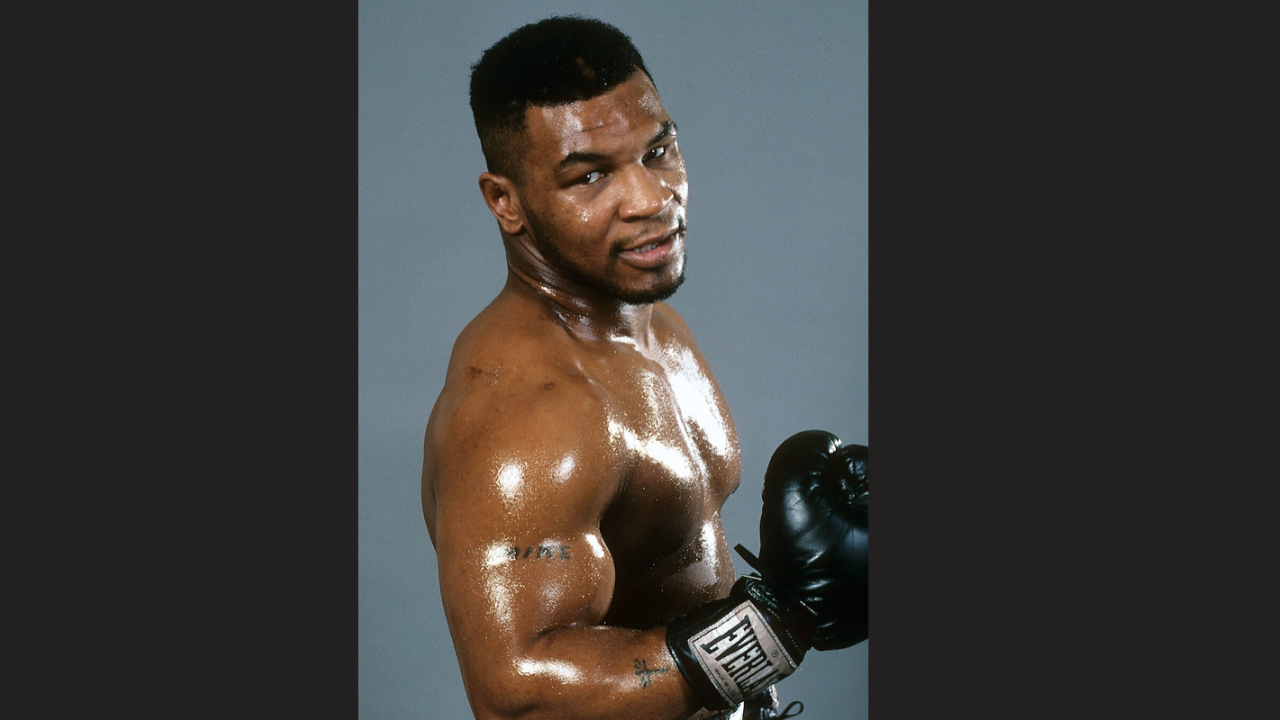
Thirteen million dollars buys a lot of silence in South Florida.
When real estate filings surfaced showing that Mike Tyson had closed on a sprawling estate in Delray Beach, Florida, the internet did what it always does with the former heavyweight champion of the world. It turned a transaction into a spectacle. Headlines immediately latched onto the novelty metrics. An eighty-foot resort-style pool. A private lake stocked with bass. Six bedrooms spread across more than twelve thousand square feet of gated limestone and glass inside the Tierra del Rey community.
To the casual observer scrolling past a tabloid feed, the purchase looks like another chapter in a familiar celebrity playbook. Rich athlete buys massive house. End of story.
Except with Mike Tyson, nothing about money or shelter has ever been simple.
To understand why a man nearing sixty would trade the neon frenzy of Las Vegas for a quiet equestrian enclave surrounded by water and palm trees, you have to look past the square footage. You have to look at the geometry of survival. For a fighter who once earned over four hundred million dollars in the ring only to file for bankruptcy in 2003 with twenty-three million dollars in debt, a house is never just a house. It is a ledger of who he used to be versus who he fought to become.
The Architecture of Chaos
Consider a hypothetical buyer walking through that same Delray Beach estate for the first time. Let us call him Marcus—a retired executive who spent thirty years in high-stakes corporate mergers, the kind of man who equates luxury with status. When Marcus looks at the twenty-seven-thousand-dollar-a-month property tax bill or the gated motor court, he sees a trophy. He sees leverage, prestige, and the validation of peers.
Now put Mike Tyson on that exact same threshold.
Tyson does not view walls through the lens of corporate triumph. He spent his childhood in Brownsville, Brooklyn, navigating condemned buildings and group homes before Cus D'Amato brought him to Catskill, New York, to teach him how to channel terror into violence. When Tyson first became rich in the late nineteen-eighties, he did not buy peace. He bought insulation against the world—and that insulation suffocated him.
Anyone who remembers the era of Tyson's infamous Farmington, Connecticut mansion understands this distinction. That fifty-two-room monstrosity, complete with a nightclub, indoor pool, and cages for Bengal tigers, was not a home. It was a monument to unchecked impulse. I have spent years covering the financial collapses of professional athletes, and there is a distinct, almost suffocating smell to those cautionary estates: stale cigar smoke, damp velvet, and the quiet panic of a man surrounded by forty people on his payroll who have zero incentive to tell him no.
In 2003, when Tyson stood in bankruptcy court, his financial ruin was treated as a punchline. People counted the Lamborghinis, the gold chains, and the two-million-dollar bathtub. They rarely stopped to calculate the psychological toll of realizing that every brick you owned belonged to creditors, promoters, or hangers-on. Losing everything does not just empty your bank account. It strips away your sense of gravity. You stop believing that anything you touch can last.
That is the invisible backdrop sitting directly behind the deed in Palm Beach County.
What Twelve Thousand Square Feet Really Buys
Step inside the Delray Beach property, and the contrast between 1995 and today becomes unmistakable. Located in Tierra del Rey—an exclusive, low-density community known for multi-acre lots and strict privacy rather than velvet ropes—the estate sits on roughly 2.7 acres of manicured tropical grounds.
The numbers tell a story of deliberate restraint, even at an eight-figure price tag.
Six bedrooms. Nine bathrooms. A club room designed for quiet evenings rather than three-hundred-person afterparties. An outdoor kitchen overlooking an eighty-foot pool that stretches like a mirror toward the back of the property. And beyond the manicured lawn, a private pond stocked with largemouth bass.
Stop. Think about that bass pond for a second.
You cannot rush a bass. You cannot intimidate the water into giving you what you want, and you cannot knock out the afternoon sun. Fishing requires the exact opposite nervous system from the one that made Iron Mike the most feared heavyweight on earth. In the ring, Tyson's genius lay in compression—coiling two hundred and twenty pounds of muscle into a fraction of a second, exploding upward before an opponent could register the danger. Everything in his prime was violent speed.
Standing beside a Florida pond at dusk, waiting for a line to twitch, demands surrender. It requires a willingness to let time pass without conquering it.
For decades, Tyson admitted in interviews that stillness terrified him. Silence meant being trapped alone with his own memories—the loss of his mother at sixteen, the death of his mentor Cus D'Amato, the prison sentence in Indiana, the tragic passing of his four-year-old daughter Exodus in 2009. When your internal world feels like an ambush, you fill your physical environment with noise, tigers, and chaos just to drown out the echo.
Buying a sanctuary built around water, trees, and distance from the Strip is not a splurge. It is a declaration of truce.
The Second Act Nobody Predicted
How does a man go from twenty-three million dollars in the red to writing a thirteen-million-dollar check in one of Florida's wealthiest zip codes?
The answer is not luck, and it is certainly not nostalgia. It is the slow, unglamorous work of reinvention.
Over the past decade, Tyson quietly dismantled the caricature that nearly destroyed him. Instead of chasing exhibition paydays out of desperation, he built real equity. He launched Tyson 2.0, transforming his personal history with cannabis into a multi-state consumer brand that generated tens of millions in revenue across North America. He turned his podcast, Hotboxin' with Mike Tyson, into a cultural confessional where athletes, comedians, and thinkers sat across from him not to watch him rage, but to watch him listen. Even his high-profile return to the ring against Jake Paul in late 2024—a spectacle that drew tens of millions of viewers worldwide—was approached not as a tragic comeback, but as a calculated business event where Tyson controlled his own narrative and pocketed a massive guaranteed purse.
Watching his financial trajectory feels a bit like watching a demolitions expert learn structural engineering. First, you have to clear the rubble of old contracts, predatory managers, and tax liens. Then, slowly, brick by unremarkable brick, you pour a foundation that belongs exclusively to you.
Florida itself plays a specific role in this equation. Unlike New York or California, Florida offers aggressive asset-protection laws, including one of the strongest homestead exemptions in the United States, alongside zero state income tax. For a high-net-worth individual who has already survived the machinery of court-appointed trustees and IRS audits, moving capital into tangible Florida real estate is not merely aesthetic. It is defensive architecture.
Yet even the sharpest tax attorney cannot manufacture peace of mind. Wealth management is simple on a spreadsheet—spend less than you earn, diversify risk, shield liabilities—but it is brutal in the human bloodstream when you grew up believing that money disappears the moment you stop fighting for it.
Why Tierra del Rey Matters More Than Miami
If Tyson had wanted the traditional celebrity lifestyle in South Florida, he would have bought a glass penthouse on Fisher Island or a megamansion on Star Island in Miami Beach, where yachts idle twenty feet from paparazzi lenses and every dinner reservation becomes a press release.
Instead, he chose Delray Beach, roughly fifty miles north of Miami's frenzy.
Tierra del Rey is not a neighborhood designed for being seen. Established in the late nineteen-seventies, the gated enclave consists of fewer than fifty estates spread across sprawling acreage where horses still graze beside tropical orchards and private lakes. Neighbors include low-profile hedge fund managers, medical executives, and retired athletes who value anonymity above flash. You cannot drive past the front door on a tour bus. You cannot dock a party boat along the backyard seawall.
There is a vulnerability in choosing obscurity after spending forty years at the center of global attention. Fame, for all its toxicity, acts like a narcotic; it convinces you that you only exist when strangers are watching. Walking away from the spotlight—even partially—means accepting that the roar of the crowd will eventually fade into the sound of crickets and wind moving through sawgrass.
I will admit, whenever I see a formerly bankrupt icon purchase an eight-figure property, a cynical reflex kicks in. History is littered with stars who staged brilliant second acts only to slide back into the same self-destructive habits that sank them the first time. You look at the thirteen-million-dollar price tag, the twelve thousand square feet, the maintenance costs that easily run hundreds of thousands of dollars a year, and you wonder: Is the foundation solid this time, or is the water rising again?
It is a fair doubt. Nobody heals in a straight line, least of all a man whose entire identity was forged in combat.
The Weight of an Empty Room
Look closer at the details of the estate, though, and the doubt softens.
In modern luxury real estate, square footage is often inflated for ego—bowling alleys nobody uses, twenty-car subterranean garages, screening rooms built to impress guests who leave after an hour. While the Delray Beach home certainly carries all the hallmarks of high-end coastal living—soaring ceilings, expansive limestone terraces, a primary suite built like a private spa—its center of gravity sits outdoors.
It sits on the eighty-foot lap and resort pool where a fifty-eight-year-old body battered by thousands of rounds of sparring can float weightless without joint pain. It sits along the shaded walkways where his wife, Lakiha Spicer—the partner widely credited with helping stabilize his life and business empire over the past fifteen years—and their children can walk without security details flanking every corner. And it sits beside that quiet stretch of freshwater pond.
Consider what happens when the noise finally stops.
For most of his adult life, Mike Tyson was treated as a natural disaster—a hurricane people bought tickets to watch from a safe distance, cheering the destruction until the storm passed, then criticizing the wreckage left behind. People loved the monster because the monster was profitable. Nobody made money off Mike Tyson being ordinary. Nobody sold pay-per-view packages to watch him read a book by a pool or untangle a fishing line at sunset.
To claim an ordinary afternoon when the entire world spent four decades profiting from your rage is its own kind of championship belt.
There is no ribbon-cutting ceremony for emotional survival. No referee raises your hand in the middle of a quiet Tuesday morning in Palm Beach County when the bills are paid, the house is yours free and clear, and the only ripple on the water comes from a bass breaking the surface beneath the Florida sun.
The pool stretches eighty feet across the backyard, still as glass before dawn, waiting for the first splash of a man who no longer has to fight to prove he is alive.