The wind over Howell, Michigan, usually smells of damp earth and the coming thaw of early April. But on this particular Saturday, there is a distinct, synthetic sweetness cutting through the chill. It is the scent of corn syrup, gelatin, and a thousand childhood prayers.
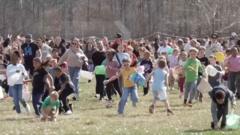
On the ground, the mud of the Livingston County Spencer J. Hardy Airport is a treacherous slurry. It clings to the soles of light-up sneakers and ruins the pristine white of Sunday-best tights. Parents shift their weight, clutching empty plastic buckets like shields, their eyes scanning the horizon for the first sign of the beast.
Then, the sound arrives.
It starts as a low-frequency hum, a mechanical heartbeat that vibrates in the marrow of your bones. A small plane breaks through the gray shroud of the sky, banking hard over the runway. For a moment, the world goes silent. The collective breath of five hundred toddlers is held in suspension.
The bay door opens.
White streaks begin to fall. They aren't raindrops. They aren't snow. They are thousands of marshmallows, tumbling through the slipstream like soft, sugary hailstones. They plummet toward the earth in a chaotic, beautiful descent, and the silence on the ground shatters into a roar of pure, unadulterated joy.
The Logistics of a Miracle
To an outsider, the Michigan Marshmallow Drop looks like a logistical nightmare or a very specific type of fever dream. To the residents of Howell and the surrounding counties, it is an essential rite of passage.
Consider the physics of the drop. If you throw a marshmallow from a height of several hundred feet, it behaves less like a rock and more like a feather caught in a gale. The drag coefficient of a standard jet-puffed cylinder ensures that it drifts, spins, and dances. It refuses to fall in a straight line. This unpredictability is the engine of the event.
The pilots who volunteer for this mission aren't just flying; they are performing a delicate aerial ballet. They have to account for wind shear that could blow the "snowfall" into the neighboring woods or, worse, onto the tarmac where no child is allowed to tread. They are aiming for a specific patch of grass, a target defined by the screaming enthusiasm of kids who have been waiting in the cold for two hours.
The event isn't just about the sugar. It’s about the scarcity. In a world where every desire is satisfied by a two-hour delivery window, there is something profoundly grounding about standing in a field, looking up, and waiting for the sky to provide. You can't order the drop on an app. You have to be there. You have to be fast. You have to be willing to get your knees dirty.
The Invisible Stakes of the Scramble
Watch a six-year-old in the middle of a marshmallow flurry and you will see the rawest form of human ambition.
Take a hypothetical child—let’s call him Leo. Leo is wearing a dinosaur-themed rain jacket that is slightly too small. He has been practicing his "pounce" in the living room for a week. To Leo, these marshmallows aren't just snacks. They are tokens. They are proof of his agility and his place in the world.
When the first white puff hits the mud three feet away, Leo doesn't think about the hygiene of eating a marshmallow that just bounced off a public airfield. He doesn't think about the "Best By" date. He sees a prize. He lunges. His hand closes around the soft, slightly chilled foam, and for a fleeting second, he is the most successful hunter-gatherer in the history of the Great Lakes State.
But the real magic happens in the exchange. The rules of the event are simple: you collect the marshmallows, but you don't eat them. Not yet. You trade them.
The marshmallows are the currency required to enter the next phase of the ritual. Each child carries their haul to a designated station where the white puffs are exchanged for a prize—usually an Easter egg filled with something more substantial, or perhaps a toy.
This is where the lesson lies. The event teaches a primitive form of economics. The effort (the scramble) leads to the commodity (the marshmallow), which is then traded for the ultimate goal (the prize). It is a microcosm of the adult world, stripped of its cynicism and wrapped in a coating of powdered sugar.
A Tradition Against the Grain
We live in an era of hyper-sanitization. We are told to keep our children inside, to avoid the mud, to fear the unpredictable. The Michigan Marshmallow Drop is a defiant middle finger to that trend. It is messy. It is loud. It is potentially cold. And it is exactly what we are missing.
There is a specific kind of community bond that only forms when you share a slightly absurd experience. When you stand next to a stranger in a damp field and both laugh because a piece of confectionery just bounced off your forehead, the barriers of modern life thin out. You aren't "demographics" or "target audiences." You are just two people watching the sky rain candy.
The event has been running for years, surviving shifts in local government, changes in airport regulations, and the ever-present threat of Michigan’s volatile spring weather. It persists because it taps into a deep-seated need for wonder.
In the 1950s, the idea of "futurism" was defined by flying cars and silver jumpsuits. In Howell, the future looks a lot more like a Cessna 172 and a bag of marshmallows. It is a low-tech miracle. It relies on gravity, basic aviation, and the fact that kids will always find it hilarious to see food falling from the clouds.
The Aftermath of the Storm
By noon, the planes have landed. The sky is empty again, returning to its standard shade of Midwestern slate. The mud in the field is churned and scarred by a thousand little footprints.
The kids are heading back to their minivans, their faces smeared with the evidence of a few "accidental" marshmallow ingestions that didn't quite make it to the trade-in station. They are exhausted. The adrenaline of the chase has faded, replaced by the heavy, warm glow of success.
Parents are shaking out blankets and trying to scrape the Livingston County soil off their shoes. There is a quietness that settles over the airport as the crowds disperse.
But look closely at the grass. You might see one or two white specks that were missed in the chaos. They sit there, nestled in the weeds, a tiny reminder that for one brief window of time, the laws of the universe were suspended.
We spend so much of our lives looking down at screens, looking at our feet, or looking at the bills on the kitchen counter. We forget that the sky is capable of more than just weather. It is a canvas for our imagination.
In Howell, they don't just wait for the sun to come out. They wait for the hum of an engine and the opening of a door. They wait for the moment when the gray clouds break and the world becomes, for a few seconds, a place where sweetness is free and it falls from the heavens like manna for the modern soul.
The mud will wash off the sneakers. The prizes will be broken or lost under car seats by Tuesday. But the image of that white flurry against the gray sky stays. It lingers in the back of the mind, a sugary ghost of a memory that says: Yes, it really happened. The sky opened up, and it was wonderful.