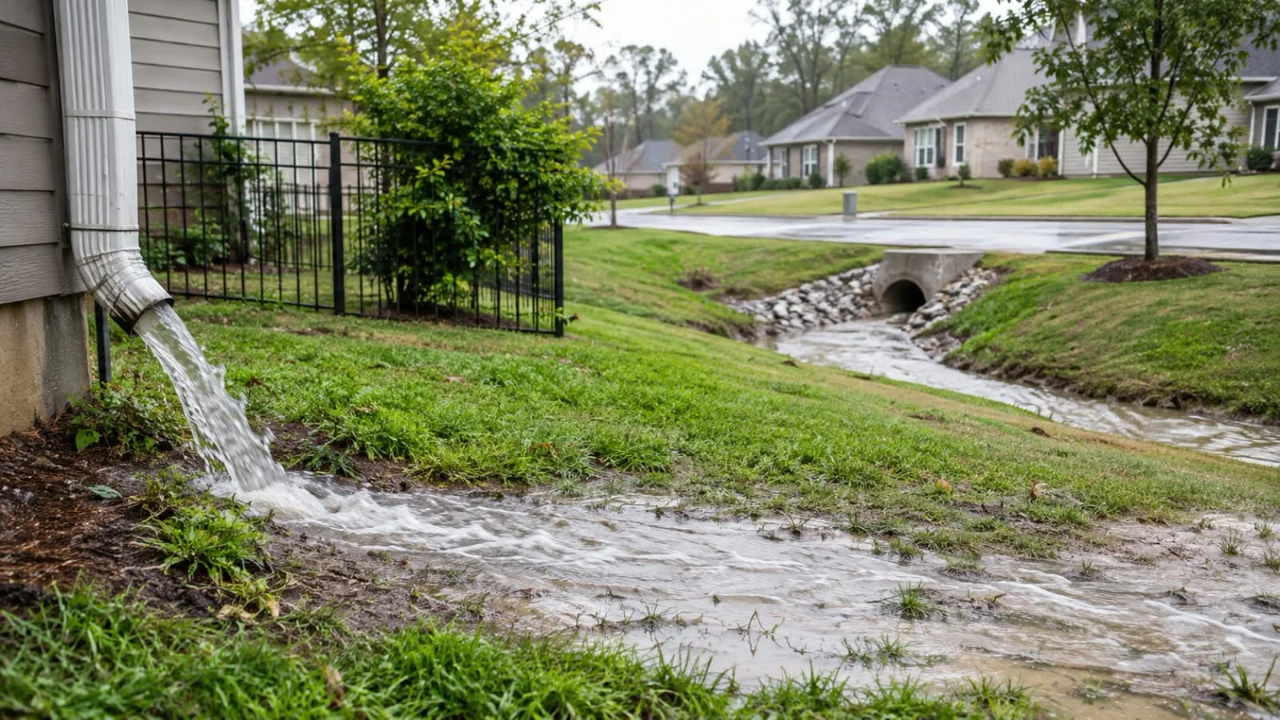
Water has no respect for property lines.
Ask anyone who has stood in their kitchen at two in the morning, listening to the rhythmic, sickening plip-plip-plip of muddy runoff seeping beneath a baseboard, watching years of savings dissolve into swollen drywall and ruined subflooring. You buy a house because you want a sanctuary—a quiet patch of earth where the outside world stops at the front door. Yet in Alabama, one homeowner discovered that when a neighbor or municipality alters the path of rainwater, the battle to protect your own foundation doesn't end when a jury finally agrees with you. Sometimes, winning $126,504 in court is only the intermission.
Rain falls. Gravity pulls it downhill. That simple physical law has sparked more bitter neighborhood wars and municipal courtroom battles across the American South than almost any zoning dispute or fence-line argument. In an Alabama stormwater dispute that recently took a sharp, frustrating turn on appeal, a property owner stood at the center of that exact nightmare. After watching relentless stormwater runoff erode his land and batter his home, he took his fight to court and secured a $126,504 judgment—a figure that represented not a lottery windfall, but the cold, itemized math of concrete, drainage engineering, and lost property value.
Then came the appellate court. And with a stroke of legal reasoning, that hard-won victory hit a wall.
The Sound of Mud Against Foundation Brick
To understand why a six-figure stormwater judgment unravels on appeal, you have to step out of the air-conditioned courtroom and onto wet red clay after an April downpour in Alabama.
Imagine—as a hypothetical composite drawn from dozens of Southern drainage disputes—a homeowner named Marcus who spent fifteen years maintaining a quiet split-level house at the bottom of a gentle slope. For the first decade, the woods uphill drank the rain. Pine needles, root systems, and soft loam acted like a giant green sponge, slowing every thunderstorm down to a harmless trickle by the time it reached Marcus’s backyard.
Then the trees came down. A new development—or a freshly graded lot, a paved driveway, a municipal culvert aimed a few degrees too far to the left—replaced that sponge with asphalt and compacted clay.
Suddenly, a two-inch rainstorm didn't soak into the earth. It sheeted off the pavement like water off a tin roof, gathering speed and volume until a brown, churning creek tore straight across Marcus’s yard. Within six months, his crawlspace smelled permanently of wet pennies and mildew. Hairline cracks stair-stepped up his brick veneer. Every time the sky turned bruised purple on the local weather radar, his stomach knotted before a single drop hit the roof.
That visceral dread is what drives ordinary people into the grinding machinery of civil litigation. Nobody wakes up eager to hire hydrologists, land surveyors, and appellate attorneys. You go to court because the alternative is watching your largest life asset sink into the mud while the person or entity responsible shrugs and blames the weather.
Why $126,504 Doesn't Feel Like a Windfall
When the Alabama homeowner in this case won a $126,504 judgment at the trial level, headlines naturally zeroed in on the dollar sign. Six figures sounds dramatic. To anyone who hasn't priced structural underpinning or French drain systems lately, it can even sound generous.
It isn't.
If you have ever lived through severe water intrusion, you know that $126,504 vanishes faster than dry topsoil in a flash flood. First come the remediation crews with industrial dehumidifiers screaming twenty-four hours a day, tearing out soaked insulation and mold-blooming sheetrock. Next come the structural engineers who tell you that saturated soil has shifted your footings, requiring helical piers driven deep into bedrock at thousands of dollars per pier. After that comes regrading the lot, installing heavy-duty catch basins, laying subterranean piping, and replacing ruined landscaping—all before you even account for the permanent stigma attached to a house that now carries a "water damage" disclosure on every future real estate listing.
At trial, the homeowner had to prove something deceptively hard: that the water wasn't merely an "act of God," but the predictable, unlawful consequence of how someone else altered the flow of surface water. A jury or trial judge listened to the testimony, weighed the engineering evidence, and landed on $126,504 as the fair measure of the harm done.
For a brief moment, the system worked. Justice had a receipt.
The Invisible Trapdoor in Stormwater Law
But civil litigation has a second act, and appellate courts do not care about the smell of wet carpet or the sleepless nights spent monitoring a sump pump. Appellate judges review cold paper transcripts, procedural rules, statutory immunity, and legal standards of proof.
And in Alabama stormwater cases, the law itself sits on shifting ground.
For generations, property law struggled with a basic question: what happens when someone changes their land and sends extra water onto their neighbor's property? In many jurisdictions, courts rely on what lawyers call the "modified civil law rule" or the "reasonable use doctrine." Think of surface water like a hot potato handed down a hill. Under traditional common-law thinking, an upper landowner has a natural right to let rainwater drain downhill onto lower land, provided they don't artificially channel, concentrate, or divert it in a way that causes unreasonable damage.
Here is where the legal trapdoor swings open.
Even when a property owner proves that diverted stormwater wrecked their yard or home, an appeal can upend the judgment on technicalities that feel completely detached from common sense:
- The Causation Tightrope: Defense lawyers on appeal routinely argue that the plaintiff failed to separate "natural" rainwater from "unnatural" diverted runoff. If four inches of rain fell in two hours, how much of that flooded basement came from the new culvert uphill, and how much would have flooded anyway? If an expert witness's math leaves even a sliver of daylight, an appellate panel can declare the damages speculative.
- Sovereign and Municipal Immunity: When the uphill culprit isn't a private neighbor, but a city, county, or state road project, Alabama's immunity doctrines and strict notice-of-claim deadlines become landmines. A trial court might focus on the fairness of compensating a ruined homeowner, while an appellate court enforces rigid statutory caps or immunity shields that wipe out or slash the award.
- Measure of Damages Disputes: In property law, you generally cannot recover both the full cost to repair your land and the drop in its market value if doing so creates a double recovery—and in some cases, if repair costs exceed the diminution in value, the law forces you to accept the smaller number. An appellate setback often hinges on whether the trial court applied the right formula when calculating that $126,504 figure.
Consider what happens next when an appellate court reverses, remands, or trims a hard-fought trial victory. The defendant doesn't write a check. Instead, the clock resets. Legal fees—which have already quietly eaten into any realistic recovery—keep ticking upward while the homeowner still stares at the same eroding backyard every time it rains.
The Asymmetry of Waiting Out the Rain
There is an unspoken math to property litigation that rarely makes it into court opinions, yet every homeowner caught in a drainage war feels it in their bones.
Time favors the side uphill.
When a municipality, developer, or well-insured property owner appeals a $126,504 judgment, the delay is an administrative line item. Files sit on a clerk's desk. Briefs are drafted in calm offices. Oral arguments are scheduled months out. Nobody at the appellate firm has to pull on rubber boots at midnight to clear leaves off a clogged trench drain so water doesn't breach the sliding glass door.
For the homeowner, delay is physical. Every season without the judgment money means choosing between two bad options: pay out of pocket for expensive drainage fixes you might never be reimbursed for, or leave the property vulnerable and watch the damage compound with every summer thunderstorm. Worse still, if you repair the damage yourself before the legal dust settles, defense attorneys may later argue you altered the evidence or spent money on "upgrades" rather than necessary repairs.
I have spoken with homeowners who became amateur meteorologists against their will, refreshing radar loops obsessively, memorizing inches-per-hour rainfall rates, keeping dated photo logs of muddy waterlines like crime-scene investigators. That hypervigilance changes how you live inside your own walls. A house stops feeling like shelter and starts feeling like a dam you are trying to hold together with bare hands.
What Homeowners Need to Know Before the Next Storm Hits
If you own property anywhere that gets heavy seasonal rain—and across Alabama and the Southeast, intense cloudbursts have become sharper and more frequent—this appellate setback carries a blunt warning. You cannot rely on a courtroom alone to rescue you after the water is already in your living room.
First, document the before, not just the after. Most people only pull out their phones once water is pooling against their foundation. By then, proving what changed uphill is ten times harder. Whenever clearing, grading, paving, or roadwork begins on an adjacent or uphill lot, take timestamped photos and video from multiple angles while the ground is still dry. Capture existing drainage swales, culverts, and vegetation before a single bulldozer blade touches the dirt.
Second, record storms in real time. Still photos of soggy grass rarely move judges. Video shot during an active downpour—showing water shooting out of a specific pipe, rushing across a newly paved boundary, and slamming into your property line—bridges the causation gap that appellate courts scrutinize so ruthlessly.
Third, understand the difference between a private neighbor and a government entity early. If city streets, county ditches, or municipal storm drains are feeding your floodwater, strict statutory notice rules apply—often requiring formal written notice within months of the damage, not years. Missing a procedural deadline at the beginning of a dispute is the easiest way to hand the other side an appellate victory years later.
Fourth, separate immediate mitigation from permanent litigation. Take reasonable steps to protect your home from catastrophic rot and mold, keep every single receipt, and have a licensed structural or civil engineer inspect the site before permanent grading changes erase the physical proof of how water entered your lot.
The Long Shadow Over Dry Ground
When the appellate court handed down its setback in this Alabama stormwater fight, the legal commentary focused on precedent, standards of review, and procedural precision. Those concepts matter. Without rigorous rules, courts would descend into guesswork.
Yet standing outside that legal framework is a simpler, stubborn truth: rain always finds the lowest point, and right now, the law often leaves the person standing at the bottom of the hill holding the bucket.
Somewhere in Alabama, a homeowner who already proved their case once in front of a court is reading dense appellate prose, trying to figure out what comes next while clouds gather on the western horizon. The $126,504 number on paper was supposed to mean the water had finally been pushed back. Instead, the storm just moved indoors—into filings, deadlines, and months of waiting for the sky to clear.