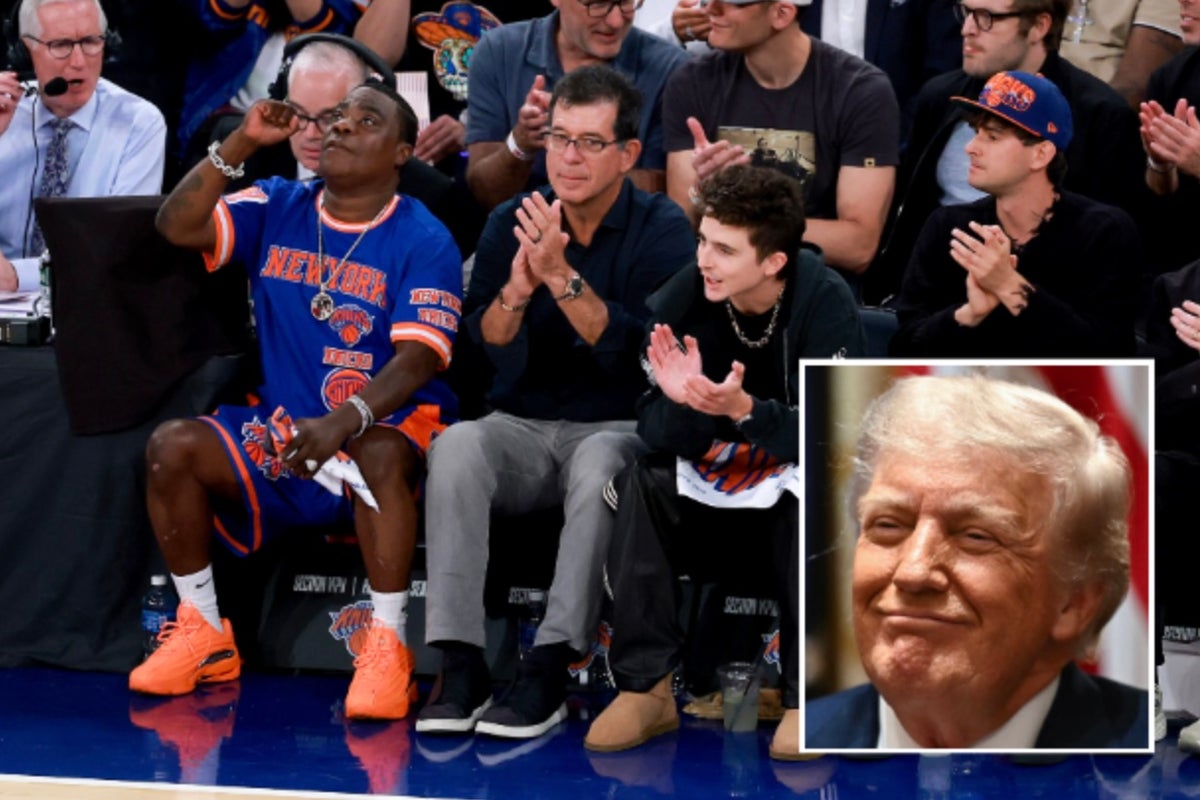
Donald Trump is returning to Madison Square Garden for Game 3 of the NBA Finals at the invitation of Knicks owner James Dolan, making him the first sitting president to attend a Finals game. While critics dismiss his sudden reappearance as the behavior of a textbook bandwagon fan, his history with the New York Knicks is far older and more complex than a simple desire to be seen with a winning team. This return to the world's most famous arena is not a sudden pivot to sports fandom, but the continuation of a fifty-year relationship with a franchise that served as the original stage for his public identity.
The Paper Trail of a Courtside Regular
The narrative that Trump only cares about the Knicks when they reach the championship round ignores decades of archival footage and property records. Both Trump and the Knicks franchise were born in the same year, 1946. His formal involvement with the team dates back to 1975, when the team's owners hired a 29-year-old Trump as a real estate consultant to help sell Madison Square Garden.
Long before his political ascent or his time on reality television, the arena floor was one of the few places in Manhattan where Trump found the specific validation he sought. During the 1980s and 1990s, high society gatekeepers in New York frequently rejected his brash style and tabloid-heavy personal life. The Garden's Celebrity Row operated under different rules. On the hardwood, status was determined by proximity to the action and visibility on the broadcast, not by the approval of old-money social circles.
NBA Commissioner Adam Silver, who worked within the league's executive ranks during those decades, recently pushed back against the idea that Trump is a newcomer to the fan base. Silver noted that Trump was a frequent presence not just at high-profile games throughout the 1990s, but also at the NBA drafts when they were hosted in the theater at Madison Square Garden.
From Tabloid Royalty to Political Lightning Rod
The nature of his attendance has fundamentally shifted over the years. In 1994, he brought Marla Maples to Game 3 of the NBA Finals. By 1999, he was sitting next to John F. Kennedy Jr. at a playoff game, a moment captured by wire photographers that exemplified the intersection of New York media, sports, and celebrity culture. He even filmed a cameo for the 1996 Whoopi Goldberg comedy Eddie, playing himself as a mogul offering unsolicited advice on how to run the franchise.
In 2010, during a period when the team was struggling to attract top-tier talent, Trump recorded an official recruitment video for the franchise, explicitly urging LeBron James to sign with New York by telling him that the real winners of the world belong in the city. Later that same year, during a live Knicks television broadcast, Trump used his courtside interview to drop some of his earliest public hints about a future presidential run.
The New York that Trump returns to for this championship series is vastly different from the one he left when he changed his official residency to Florida in 2019. The city's political executive, including Mayor Zohran Mamdani, reflects a progressive shift that stands in stark opposition to the president's platform. Mamdani, who purchased his own ticket on the secondary market for upwards of $8,000, publicly stated that while he welcomes anyone rooting for the team, he has no intention of crossing paths with the president during the game.
The Security and Spectacle of Game Three
The logistical reality of a sitting president entering Madison Square Garden introduces unprecedented complications for the NBA and everyday ticket holders. The Secret Service detail required for a presidential visit to the heart of Midtown Manhattan guarantees massive security cordons, closed streets, and severe delays at the arena gates.
When Trump attended the U.S. Open tennis championships in Queens, spectators blamed his security apparatus for bottlenecking entry lines, resulting in visible pushback from the crowd. Madison Square Garden presents an even tighter geographical challenge, sitting directly atop Penn Station, the busiest transit hub in North America.
The internal dynamics of the arena will face a unique stress test. Unlike modern corporate arenas where high-net-worth individuals are isolated in luxury skyboxes, Madison Square Garden’s identity relies on its courtside seats remaining visible to the entire bowl. Trump will be sitting in the direct line of sight of thousands of lifelong New Yorkers who largely vote against him, yet he will be sharing that space with James Dolan, an owner who has consistently defied local political pressure.
The Shared DNA of Survival
The alignment between Trump and the modern Knicks extends beyond simple nostalgia. Both the politician and the franchise spent the better part of the last two decades enduring intense public criticism, operational mismanagement, and declarations of permanent irrelevance. The Knicks became a league-wide punchline for failed free-agent pitches and constant coaching changes, mirroring the chaotic cycles of Trump's business and political career.
The team's current 13-game postseason winning streak has altered the atmosphere in Manhattan, creating a rare moment of civic unity in a deeply divided city. For Trump, appearing at the epicenter of this cultural revival is an opportunity to reassert his status as an essential New York figure, regardless of how local politicians view his presence. He isn't showing up to blend in with Hollywood actors like Ben Stiller or Timothée Chalamet; he is showing up because, in his view, the Garden was his stage first.
The game itself serves as a backdrop to a larger cultural negotiation. As the Knicks attempt to secure their first championship since 1973, the arena will hold two entirely different versions of New York history under one roof. One is the modern, progressive city represented by the fans in the upper decks and the local politicians paying their own way into the building. The other is the gritty, celebrity-obsessed, tabloid-driven Manhattan of the 20th century, epitomized by the man sitting in the front row as the guest of the owner.