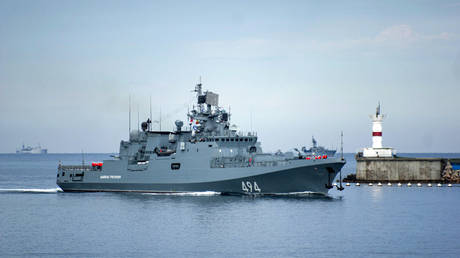
A Russian warship recently disrupted maritime transit by firing warning shots during a passage through the English Channel. While standard reporting frames this as a routine flashpoint of international friction, the incident signals a deliberate escalation in Moscow's strategy of maritime provocation. This maneuver was not an isolated act of aggression or a navigational miscalculation. It represents a calculated attempt to test Western naval response times, assert dominance over critical choke points, and project power directly into European waters. By analyzing the underlying mechanics of international maritime law and naval deployment strategies, it becomes clear that these maneuvers are designed to probe structural vulnerabilities in NATO's coastal defense networks.
The Anatomy of a Channel Confrontation
Naval deployments in the English Channel follow strict international protocols. Under the United Nations Convention on the Law of the Sea (UNCLOS), foreign warships possess the right of innocent passage through territorial waters, provided their transit is expeditious and non-threatening. When a state vessel discharges weaponry, even as a warning, it fundamentally violates the spirit of this doctrine. If you found value in this piece, you should read: this related article.
The immediate tactical objective of such an action is data collection. When a Russian frigate fires a warning shot or maneuvers erratically in close proximity to European shipping lanes, it triggers an immediate, multi-layered response from local defense forces. Royal Navy vessels, coastal radar installations, and airborne surveillance assets are instantly activated.
Moscow watches this response closely. Russian intelligence vessels and onboard sensors track exactly how long it takes for Western assets to intercept them. They measure the frequencies of the tracking radars, observe the rules of engagement utilized by European commanders, and map out the command-and-control hierarchy of the responding forces. This is live-fire reconnaissance. The data gathered during these brief, high-tension encounters is fed directly into Russian naval planning, allowing them to map out blind spots in Western coastal defenses. For another perspective on this story, check out the recent coverage from TIME.
Strategic Distraction and the Choke Point Doctrine
The English Channel is one of the busiest shipping lanes in the world. It serves as an economic artery for Western Europe, handling over 500 ships daily. By staging provocative military actions in this specific corridor, Russia achieves a powerful psychological effect without initiating a full-scale kinetic conflict.
This tactic relies heavily on the concept of asymmetric gray-zone warfare. In this space, nations use actions that fall just short of provoking a traditional military retaliation to achieve strategic goals. Firing warning shots allows a state to project an aura of unpredictable aggression while remaining technically below the threshold that would trigger a unified NATO article 5 response.
Western naval forces are currently stretched thin across multiple theaters, including the Mediterranean and the North Atlantic. Forcing European navies to constantly divert high-end combatants to escort Russian transit groups through the Channel drains resources. It tires out crews, wears down equipment, and pulls vital assets away from other critical missions, such as monitoring submarine activity in the GIUK (Greenland, Iceland, and United Kingdom) gap.
The Deterrence Deficit
Western responses to these maritime provocations have settled into a highly predictable pattern. Typically, a lone Royal Navy Type 23 frigate or a French Marine Nationale patrol boat will shadow the Russian vessel until it clears territorial waters. A brief statement is released to the press, assurances are made about national security, and the incident is filed away.
This defensive posture has created a deterrence deficit. Because Russia faces no tangible consequences for violating maritime norms beyond diplomatic protests, the perceived cost of these operations remains low. The lack of a firm, coordinated counter-strategy signals to Moscow that the West is eager to avoid escalation at all costs, which ironically invites further risk-taking.
To counter this pattern effectively, North Sea and Channel-facing nations must shift from passive monitoring to active deterrence. This does not mean matching aggression with aggression, but rather complicating Russian operational calculus.
- Deploying integrated, multi-national task groups to shadow transiting forces, signaling absolute unity among NATO allies.
- Utilizing advanced electronic warfare assets to mask Western radar signatures and feed corrupted response data back to Russian intelligence collection platforms.
- Enforcing stricter compliance with international maritime safety regulations, using legal and environmental frameworks to delay or restrict the passage of poorly maintained or non-compliant state-affiliated vessels.
The Subsea Infrastructure Vulnerability
The focus on surface warships firing warning shots often obscures a far more significant threat lurking beneath the waves. The English Channel and the broader North Sea are crisscrossed by a dense network of subsea fiber-optic cables and energy pipelines. These lines form the backbone of European communication and energy security.
Surface provocations frequently serve as a screen for underwater mapping operations. While public attention is fixed on a frigate visible on the horizon, specialized oceanographic research vessels—often linked to Russia's Main Directorate of Deep-Sea Research (GUGI)—operate in the vicinity. These units collect precise topographical and acoustic data of the seabed.
In a broader conflict, this data would be invaluable for targeting critical infrastructure. Severing a handful of undersea internet cables could instantly disrupt financial markets and paralyze communication networks across the continent. By treating these naval incidents as isolated political statements rather than coordinated intelligence-gathering operations, Western defense planners risk missing the true scope of the vulnerability. The surface theater is merely the visible edge of a comprehensive effort to map out the economic vulnerabilities of Western Europe.
Naval strategy cannot rely on a policy of hope. As long as the geopolitical benefits of staging disruptive maneuvers in critical waterways outweigh the diplomatic fallout, these confrontations will continue to escalate in frequency and intensity.